The two frameworks are related but not interchangeable. One is a roadmap. The other is a destination. Understanding which one your organization needs — and in what order — is the decision this article addresses.
Key Takeaways
- NIST CSF is a free, voluntary US framework for building and benchmarking a cybersecurity program — no certification is issued
- ISO 27001 produces a formal, third-party-audited certificate recognized globally by enterprise customers and regulators
- NIST CSF implementation covers roughly 80% of ISO 27001 requirements — making it a practical first step toward certification
- Defense contractors subject to CMMC must also satisfy NIST 800-171, a separate requirement layer distinct from NIST CSF
- Many organizations use NIST CSF first to build, then pursue ISO 27001 to certify
NIST CSF vs ISO 27001: At a Glance
| Dimension | NIST CSF 2.0 | ISO/IEC 27001:2022 |
|---|---|---|
| Governing body | NIST (US Dept. of Commerce) | ISO + IEC (international) |
| Geographic focus | US-centric, increasingly adopted globally | International standard |
| Certification | None — self-reported alignment | Formal third-party certificate |
| Document cost | Free to download | CHF 155 for the standard |
| Audit requirement | None required | Two-stage external audit |
| Best fit | Building/benchmarking a program | Proving security posture externally |
| Current version | CSF 2.0 (February 2024) | ISO/IEC 27001:2022 (October 2022) |
The clearest distinction: NIST CSF is a roadmap that helps you assess where your program stands and plan where it needs to go. ISO 27001 is a destination — a formal, audited proof that you've built and maintained a compliant information security management system.
Note on versioning: NIST CSF 2.0 (released February 26, 2024) expanded scope beyond critical infrastructure to all organizations and added a sixth core function: Govern. All references in this article use the current six-function version.
What Is the NIST Cybersecurity Framework?
NIST CSF is a voluntary framework developed by the US National Institute of Standards and Technology — a Department of Commerce agency — initially issued in 2014 in response to Executive Order 13636, and most recently updated to version 2.0 in February 2024. It was designed to be industry-agnostic and size-agnostic, though it carries particular weight for organizations working adjacent to US federal agencies.
The Six Core Functions
CSF 2.0 organizes cybersecurity activity into six functions:
- Govern — Establishes cybersecurity strategy, accountability, and risk management at the leadership level (newly added in CSF 2.0)
- Identify — Understand your assets, risks, and organizational cybersecurity context
- Protect — Implement safeguards to limit the impact of cybersecurity events
- Detect — Develop capabilities to identify cybersecurity events when they occur
- Respond — Take action when a cybersecurity incident is detected
- Recover — Restore capabilities and services impaired by an incident
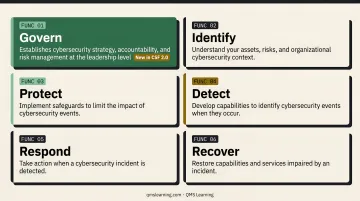
Prior versions of CSF treated cybersecurity as an operational function. CSF 2.0 moves it to the leadership level — reflecting how mature organizations now treat cyber risk as a board concern, not just an IT one.
Implementation Tiers
NIST CSF's built-in maturity measurement tool uses four tiers:
- Tier 1 — Partial: Risk management is irregular and case-specific
- Tier 2 — Risk Informed: Organizational awareness exists, but no organization-wide approach
- Tier 3 — Repeatable: Risk management methods are established and applied consistently
- Tier 4 — Adaptive: Practices continuously adapt using lessons learned and predictive indicators
These tiers let organizations benchmark current posture, set targets, and prioritize investment without requiring external audit. Structured self-assessment with no audit deadline is exactly what makes this useful for teams building a program incrementally.
A Critical Distinction: NIST CSF vs. NIST 800-171 vs. NIST 800-53
If you work in defense contracting, you've likely seen all three cited interchangeably — they're not the same thing:
- NIST CSF — Higher-level outcomes framework; voluntary; applies to all organizations
- NIST 800-171 — Specific control requirements for handling Controlled Unclassified Information (CUI); directly tied to DoD contracting and CMMC
- NIST 800-53 — Granular security and privacy control catalog for US federal agencies and their contractors; more detailed than CSF and used to implement it in federal contexts
Defense contractors navigating CMMC are working with NIST 800-171 — not NIST CSF.
What Is ISO 27001?
ISO/IEC 27001:2022 is the international standard for building and maintaining an Information Security Management System (ISMS). Published in October 2022, this third edition replaces ISO/IEC 27001:2013 and sets the requirements organizations must meet to earn — and keep — certification.
The CIA Triad Foundation
ISO 27001 is built on three core principles:
- Confidentiality — Only authorized individuals access information (enforced through access controls)
- Integrity — Data remains accurate and unaltered (enforced through change controls and validation)
- Availability — Authorized users can access information when needed (enforced through redundancy and incident management)
Every control in the standard maps back to protecting one or more of these three properties.
Annex A: 93 Controls Across Four Domains
ISO 27001:2022 Annex A contains 93 controls organized across four domains:
- Organizational — Policies, roles, responsibilities, supplier relationships
- People — Screening, training, disciplinary processes
- Physical — Physical access controls, equipment protection
- Technological — Authentication, encryption, vulnerability management
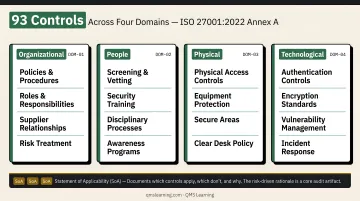
Organizations don't implement every Annex A control. Instead, a Statement of Applicability (SoA) documents which controls apply, which don't, and — critically — why. This risk-driven rationale is a core audit artifact.
The Two-Stage Certification Process
ISO 27001 certification follows a defined two-stage cycle:
- Stage 1 (Documentation Review) — Your ISMS design and documentation are evaluated for completeness and conformance
- Stage 2 (Certification Audit) — On-site verification confirms the ISMS is live, operational, and working as documented
Certifications are valid for three years, with annual surveillance audits in years one and two and a recertification audit in year three.
The 2022 ISO Survey recorded over 70,000 valid ISO/IEC 27001 certificates across 150 countries. For many enterprise and regulated-market buyers, an ISO 27001 certificate is a baseline procurement requirement — not a differentiator.
NIST CSF vs ISO 27001: Key Differences Explained
Certification and Verifiability
This is the clearest practical difference. ISO 27001 produces a formal, third-party-audited certificate that customers, regulators, and partners recognize worldwide. NIST CSF produces nothing equivalent — organizations self-report alignment, or may hire a third party to attest to it, but no official certificate exists.
In contract negotiations and enterprise sales cycles, this distinction is concrete. A procurement team asking for proof of information security posture can accept an ISO 27001 certificate. They cannot accept a NIST CSF self-assessment with equivalent confidence.
Geographic Scope and Stakeholder Expectations
- ISO 27001 dominates international business relationships — commonly required by European enterprises, global supply chain partners, and organizations subject to GDPR-related accountability expectations
- NIST CSF carries more weight in US federal and defense contexts, where alignment with NIST publications is often expected or contractually referenced
For a US-based organization with international ambitions, ISO 27001 certification is the more universally recognized credential. For an organization focused primarily on domestic federal contracting, NIST CSF alignment (alongside NIST 800-171 where applicable) may be the more direct path.
Cost and Access
| Cost Item | NIST CSF | ISO 27001 |
|---|---|---|
| Framework document | Free | CHF 155 |
| Implementation | Self-directed, no required spend | Gap assessment, remediation, auditor fees |
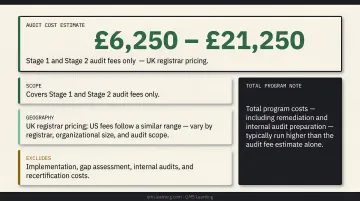
| Certification audit | N/A | £6,250–£21,250 for 1–426 employees (audit fees only) |
| Annual ongoing cost | None required | Surveillance audits years 1 and 2 |
The £6,250–£21,250 audit cost estimate covers Stage 1 and Stage 2 audit fees only — it excludes implementation, gap assessment, internal audits, and recertification. This figure reflects UK registrar pricing; US audit fees follow a similar range but vary by registrar, organizational size, and audit scope. Total program costs — including remediation and internal audit preparation — typically run higher.
Prescriptiveness and Maturity Fit
NIST CSF is more instructional — it tells you what activities to perform and provides the Implementation Tiers to measure your maturity. ISO 27001 is less prescriptive about how to achieve controls, but demands formal documented evidence that controls exist, function, and are continuously improved.
ISO 27001 is the right fit when your program already has documented processes in place. NIST CSF is where you start when it doesn't. Attempting ISO 27001 certification with an immature program means more remediation work, longer timelines, and a harder audit.
Which Framework Should Your Organization Choose?
The decision comes down to your primary driver:
- Building or assessing an internal program from the ground up? Start with NIST CSF. It provides structure without audit pressure or upfront cost.
- Proving security posture to external stakeholders? Pursue ISO 27001. The formal certificate is the only artifact that delivers credible, verifiable proof.
The Defense Contractor Scenario
Organizations subject to CMMC or NIST 800-171 should understand a critical point: neither NIST CSF nor ISO 27001 directly satisfies CMMC requirements. They are related but separate frameworks. CMMC is built on NIST 800-171 — not NIST CSF — and requires a formal assessment by a Certified Third-Party Assessment Organization (C3PAO).
Teams navigating CMMC alongside ISO 27001 are managing overlapping but distinct compliance stacks — and most tools or training programs only address one at a time.
QMS Learning's Defense Cybersecurity Readiness pathway covers CMMC, NIST 800-171, ISO 27001, and SOC 2 in a single program. The QMS Workbench AI tool is trained on NIST SP 800-171, CMMC Level 1/2/3 assessment guides, and ISO 27001 Annex A — supporting SSP drafting, POA&M entry building, and gap analysis across both frameworks. The pilot cohort opens Q3 2026.
The "Both Frameworks" Path
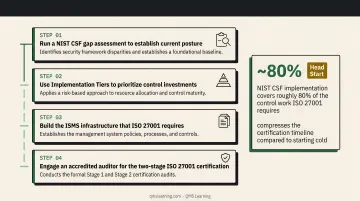
Many mature organizations use NIST CSF as a launch pad. The sequence works practically:
- Run a NIST CSF gap assessment to establish current posture
- Use Implementation Tiers to prioritize control investments
- Build the ISMS infrastructure that ISO 27001 requires
- Engage an accredited auditor for the two-stage ISO 27001 certification
In practice, NIST CSF implementation covers roughly 80% of the control work ISO 27001 requires — a meaningful head start that compresses the certification timeline compared to starting cold.
Frequently Asked Questions
What is the difference between ISO 27001 and NIST 800-53?
NIST 800-53 is a detailed control catalog designed for US federal agencies and their contractors — more granular than NIST CSF and typically used to implement CSF in federal contexts. ISO 27001 is an internationally recognized certification standard covering similar control domains but resulting in a formal third-party certificate.
Can an organization implement both NIST CSF and ISO 27001 simultaneously?
Yes — the frameworks are complementary. NIST CSF serves as the assessment and build phase, while ISO 27001 formalizes and certifies the resulting ISMS. Most organizations treat NIST CSF implementation as a practical precursor that reduces the gap remediation effort before an ISO 27001 audit.
Does NIST CSF compliance result in a certification?
No. NIST CSF has no certification mechanism. Organizations self-report their alignment or may hire a third party to attest to it, but no official certificate is issued. ISO 27001 is the standard that produces a formal, third-party-audited certification.
Which framework is more relevant for defense contractors?
Defense contractors in the DoD supply chain are primarily subject to CMMC and NIST 800-171 requirements — both of which are distinct from NIST CSF, though they share foundational logic. ISO 27001 may be pursued separately to satisfy commercial or international customer requirements alongside CMMC obligations.
How long does ISO 27001 certification typically take compared to NIST CSF?
NIST CSF can be self-implemented at any pace with no formal timeline. ISO 27001 certification typically takes 3–6 months for implementation, with audit fieldwork running 1–3 days for most mid-size organizations. Existing security maturity, scope decisions, and auditor scheduling are the primary variables.
Is ISO 27001 required for GDPR compliance?
ISO 27001 is not legally required for GDPR compliance. However, its controls map closely to GDPR's data protection requirements — particularly Article 32, which calls for appropriate technical and organizational security measures. Organizations with ISO 27001 certification find it easier to demonstrate GDPR accountability to regulators and enterprise customers.