Introduction
The ISO 9001 certification process is the structured sequence of preparation, documentation, audits, and ongoing surveillance an organization completes to earn and maintain an accredited Quality Management System (QMS) certificate.
This guide is built for quality managers, plant managers, and manufacturing leaders preparing for certification. Each step matters: it wins contracts, clears supplier audits, and cuts the cost of chasing repeat nonconformities.
ISO 9001 shows up constantly in sales materials and RFPs, yet many teams don't know what happens between "we're starting the project" and "we have the certificate." That gap stalls timelines and fails audits.
This article breaks down every step, what drives timeline and cost, and the mistakes that most often derail certification before it's granted.
Key Takeaways
- Process runs gap analysis → documentation → implementation → internal audit → two-stage external audit → surveillance
- Initial certification usually takes 3–6 months; size, sites, and QMS maturity can extend it
- Certification is what your organization earns; accreditation is what the certification body holds
- Hardest part is staff consistently demonstrating the QMS in daily work—not the paperwork
- Certificates last three years with annual surveillance and a full recertification audit to stay active
What Is ISO 9001 Certification—and Why It Matters for Manufacturers
ISO 9001 certification is third-party validation that your organization's QMS conforms to the ISO 9001:2015 requirements. An accredited certification body audits your processes and issues the certificate once it confirms conformity.
The lasting value comes from consistent, auditable processes that reduce defects, satisfy customer and regulatory requirements, and support continual improvement. The certificate proves that discipline is in place—it does not replace it.
Certification vs. Accreditation vs. the Standard
These three terms get mixed up constantly, and it trips up a lot of first-time applicants:
- The standard is the requirements document (ISO 9001:2015) published by ISO
- Certification is what your organization earns after an audit confirms conformity
- Accreditation is what the certification body holds, granted by a national accreditation board such as ANAB
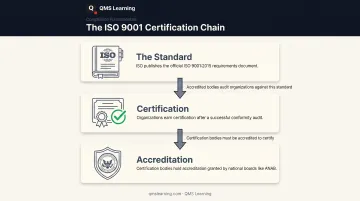
ISO doesn't certify anyone directly. Independent certification bodies do that work, and accreditation is what proves those bodies are competent to do it.
Why This Matters at Scale
ISO 9001 is the most widely adopted management-system standard in the world. The 2022 ISO Survey reported 1,265,216 valid ISO 9001:2015 certificates across 1.6 million sites globally.
For general manufacturing operations (injection molding, machining, fabrication, assembly, packaging), the standard specifically addresses traceability, supplier control, and nonconformance handling. Without a certified QMS in place, the common failure pattern looks like this:
- Work instructions vary by shift or operator
- The same nonconformities resurface because root cause never gets addressed
- Bids get lost outright when ISO 9001 is a procurement requirement
The ISO 9001 Certification Process: Step-by-Step
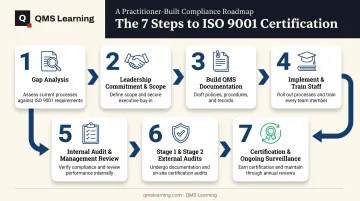
Certification runs from internal preparation through a two-stage external audit to ongoing maintenance. Each phase builds the evidence base auditors will eventually review, according to NQA's implementation guidance.
The audit itself is only the midpoint. Most of the real work, and most of the risk, sits in the preparation and implementation phases, long before an auditor shows up. Organizations pursue this in-house, with a consultant, or through a hybrid approach, and the choice shapes how each step below actually plays out.
Step 1: Conduct a Gap Analysis
Compare current processes against every ISO 9001:2015 clause to see what's already conformant and what needs new documentation or process changes. This forms the basis of your project plan and timeline.
Step 2: Secure Leadership Commitment and Define Scope
Top management has to formally commit resources and set the quality policy. Simultaneously, you define which sites, products, or departments fall inside the QMS scope, a decision typically discussed with your chosen registrar in advance.
Step 3: Build Required QMS Documentation
Your QMS needs a quality policy, quality objectives, a scope statement, procedures, work instructions, and forms. ISO 9001:2015 requires records across 16 clauses to serve as objective evidence during the audit.
This is where teams either build something usable or bury themselves in generic templates. QMS Learning's AI Workbench is trained on ISO 9001:2015 and can generate SOPs, procedures, and audit checklists in the standard's language, tailored to the facility rather than pulled from boilerplate.
Step 4: Implement the QMS and Train Staff
Procedures have to move off the page and into daily work. Every employee needs training on their role-specific responsibilities under the new system, not a generic overview session.
Role-specific, self-paced training distributes this knowledge across a team instead of funneling it all through one overloaded quality manager. QMS Learning's General Manufacturing Quality pathway includes a 16-hour ISO 9001 Internal Auditor course covering every clause of the standard, plus 27 interactive scenarios that give staff practical reps before an auditor ever asks a question.
Step 5: Run Internal Audits and a Management Review
A complete internal audit covering the entire QMS is mandatory before certification. A formal management review follows, where leadership assesses performance and assigns corrective actions.
Weak internal audit programs are a recurring audit finding. Auditors specifically look for evidence of auditor competence, risk-based scope, and follow-through on prior results.
Step 6: Complete the Stage 1 and Stage 2 Certification Audits
These are two distinct evaluations:
- Stage 1 reviews documentation and readiness, often remote, checking whether your QMS is developed enough to proceed
- Stage 2 is an on-site evaluation of whether documented processes are actually followed, using interviews, records, and direct observation
According to DNV's certification process overview, any nonconformities found require corrective action, verified by the auditor, before certification is granted.
Step 7: Receive Certification and Maintain It
A passing audit results in a certificate valid for three years. That validity is contingent on passing annual surveillance audits and a full recertification audit at the three-year mark. Certification isn't a one-time deliverable.
Key Factors That Affect Your ISO 9001 Timeline, Cost, and Difficulty
Several variables determine how smoothly and how quickly you get through this process:
- Organization size, site count, and process complexity — larger, multi-site operations need more documentation and more audit days
- Current QMS maturity — organizations already running consistent processes need less foundational work than those starting from zero
- Resourcing model — DIY, consultant-led, and hybrid approaches shift timeline and cost differently; consultants typically trade higher upfront cost for speed
- Registrar fees — NQA notes that quotes usually equal required audit days times a day rate, plus expenses, application fees, and annual management fees
- Staff ability to produce objective evidence — consistently the harder part of certification, more than documentation itself
Employee count is the single largest driver of audit duration, followed by scope, number of sites, shift patterns, and regulatory context.
Structured, role-specific training compresses the ramp-up period. Junior staff who can execute and evidence procedures correctly from day one get an organization audit-ready faster than teams relying on tribal knowledge held by one or two senior people. That's the gap platforms like QMS Learning close: role-based pathways plus a Manager Dashboard that shows where competency gaps still exist before an auditor finds them.
Common Mistakes That Delay or Derail Certification
Documentation is not the same as compliance. Auditors are primarily looking for evidence that documented processes are actually followed on the floor, not just written down somewhere. Stage 2 exists specifically to test this—through interviews, record checks, and direct observation.
Other errors show up repeatedly:
- Confusing certification with accreditation, or mistaking "we passed the audit" for "we built a system that delivers ongoing value"
- Treating certification as a one-time event rather than a continuous cycle of annual surveillance audits and recertification every three years
- Skipping a full internal audit and management review cycle before Stage 1, so gaps surface for the first time in front of the registrar
None of these are hard to avoid. Run the QMS as an operating system—prove people follow the process, fix what internal audits find, and plan for the surveillance cycle from day one.
Conclusion
The ISO 9001 certification process is a defined sequence: gap analysis, documentation, implementation, internal audit, a two-stage external audit, and ongoing surveillance. The certificate is a milestone; surveillance and continual improvement keep the system accountable after it arrives.
Understanding each step in advance is what separates organizations that certify smoothly from those that stall on nonconformities or missing evidence. Teams that build real QMS capability—not only files and procedures—stay audit-ready and keep the system useful in day-to-day operations long after certification.
Frequently Asked Questions
How much does it cost to get ISO 9001 certification?
Cost depends on organization size, number of sites, and whether you use a consultant, DIY toolkit, or full-service provider. Registrar fees are usually audit days times a day rate, plus application and annual management fees.
How long does it take to become ISO 9001 certified?
Most organizations finish initial certification in three to six months. Registrars typically require the QMS to run for at least three months—with a completed management review and internal audit—before the certification audit.
How difficult is it to get ISO 9001 certification?
The hard part is getting staff to consistently run and evidence processes in daily operations. Auditors test that in Stage 2 through observation and interviews, not document review alone.
What is the difference between ISO 9001 certification and accreditation?
Your organization earns certification for its QMS. Certification bodies hold accreditation, granted by a national accreditation board such as ANAB, confirming their competence to issue certificates.
Do I need a consultant to get ISO 9001 certified?
Consultants can accelerate the process, but many organizations successfully self-implement using structured training and toolkits. Platforms built around role-specific training and AI-guided documentation, like QMS Learning, are designed specifically for this in-house path.
How long does an ISO 9001 certificate last before renewal?
Certificates are valid for three years. Staying active requires annual surveillance audits in years one and two, plus a full recertification audit before the three-year mark to start the next cycle.