Introduction
A risk management plan is one of the most heavily scrutinized documents in any technical file. Notified body reviewers and FDA auditors open it first, and a generic template copied from a shared drive or standards forum rarely survives that first read.
The common failure: teams fill in a template's headings without understanding what ISO 14971 Clause 4.4 actually requires underneath each one. The result is a document that looks complete but triggers the same audit findings, review after review.
This guide breaks down the exact structure regulators expect. We'll cover each required element and how to turn a static template into a living, audit-ready plan your team actually uses.
Key Takeaways
- ISO 14971 Clause 4.4 and MDR/IVDR Annex I Section 3 both require a risk management plan for every device
- The standard mandates 7 specific elements — not a generic 5-step risk framework
- Your plan must be product-specific; a corporate SOP reference alone won't satisfy reviewers
- Missing team competencies and vague residual risk statements drive most repeat audit findings
- Keep the plan living: review and update it as new information surfaces across the device lifecycle
What Is an ISO 14971 Risk Management Plan (and Why You Need One)?
A risk management plan is a controlled document describing the procedures, activities, methods, and tools your organization uses to manage risk for a specific device across its entire lifecycle. It's not a philosophy statement — it's a roadmap a reviewer can trace, item by item, against the standard.
Clause 4.4 states that manufacturers must plan risk management activities and establish a documented plan for the particular device, consistent with the standard's overall process. MDR and IVDR Annex I Section 3 use nearly identical language, requiring manufacturers to establish and document a risk management plan for each device. That plan sits inside a continuous, iterative risk management process across the device's life cycle.
Plan vs. File: The Distinction That Trips Up Teams
These terms get used interchangeably, and that's a mistake reviewers notice immediately.
- Risk management plan: the roadmap — what activities will happen, who's responsible, and how acceptability will be judged
- Risk management file: the collected evidence — analyses, reports, review records, and the plan itself — proving those activities actually happened
Why an SOP Alone Doesn't Cut It
A general-purpose risk management SOP describes your process at the organizational level. Auditors expect the plan layered on top of it to answer device-specific questions for this product:
- Which hazards apply
- Which team members own each activity
- Which acceptability thresholds you will use
Reference an SOP without that layer, and you'll likely see it flagged as incomplete.
The 7 Essential Components of an ISO 14971 Risk Management Plan Template
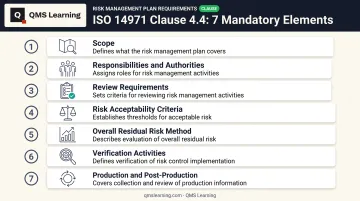
Clause 4.4 doesn't leave the content of a plan open to interpretation. It defines seven non-negotiable elements, and any competent reviewer will trace your document against each one section by section.
| # | Required Element | What It Covers |
|---|---|---|
| 1 | Scope | Activities planned for the device across its life cycle |
| 2 | Responsibilities and authorities | Who does the work, who signs off |
| 3 | Review requirements | How risk management activities get reviewed |
| 4 | Risk acceptability criteria | Policy-based criteria, including unknown-probability risks |
| 5 | Overall residual risk method | How combined residual risk is evaluated |
| 6 | Verification activities | Confirming controls were implemented and are effective |
| 7 | Production and post-production | Collecting and reviewing field information |
Scope of Risk Management Activities
Define three things up front:
- Organizational scope — which departments and suppliers are involved
- Object scope — which device, model, accessories, and variants the plan covers
- Lifecycle scope — which phases and processes are included
Align this section with your post-market surveillance plan so the two documents don't silently drift apart.
Responsibilities and Authorities
List the roles actually needed: development, a named risk manager, quality management, a clinical expert where relevant, and top management.
Separate responsibility (who performs the analysis) from authority (who can block release if residual risk isn't acceptable). Reviewers specifically check for this distinction; a plan that names roles but not decision authority is incomplete.
Review Requirements for Risk Management Activities
State how risk management activities will be reviewed, at what milestones, and by whom. Then specify the methods used for each activity—FMEA, hazard analysis, or another named technique—and how the overall analysis breaks into modular sub-analyses (by subsystem, by use phase, by software module). If a project needs a method that overrides your generic SOP, state that explicitly here.
Risk Acceptability Criteria
Define your probability and severity axes and how you'll derive benefit, whether quantitatively or qualitatively. Criteria must be predefined based on company policy, including how you'll handle risks where probability can't be reliably estimated. Accepting an individual risk doesn't eliminate the later overall residual risk evaluation. That remains a separate, mandatory step.
Method for Evaluating Overall Residual Risk
State exactly how individual and overall residual risk will be assessed and documented, plus how the benefit-risk determination gets made. "Acceptable" isn't a conclusion you can simply assert — the method that produced that conclusion has to be traceable in the plan.
Verification of Risk Control Implementation and Effectiveness
Define how the team confirms controls were actually built as designed and that they reduce the risk they were meant to address. These are two separate checks, often merged incorrectly into one.
Production and Post-Production Activities (The Living Document Clause)
Detail how complaints, literature, and field data feed back into the plan. According to Greenlight Guru's summary of ISO 14971:2019 documentation requirements, the plan should be treated as dynamic and revisited as new information emerges, not filed away after design freeze.
The ISO 14971 Risk Management Process: Applying Your Plan Step-by-Step
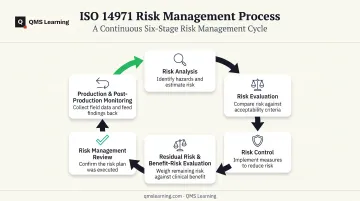
Once the plan is written, it has to drive the work. Here's the sequence most reviewers expect to see evidence of:
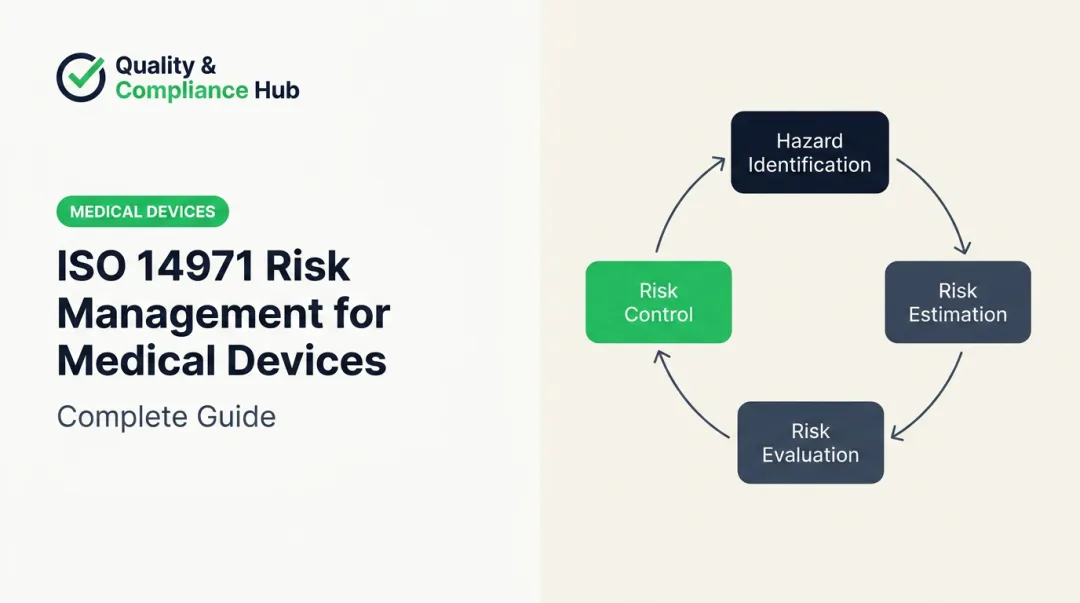
- Risk Analysis — Identify intended use, reasonably foreseeable misuse, hazards, and hazardous situations. Estimate probability and severity for each one.
- Risk Evaluation — Compare each estimated risk against the acceptability criteria your plan defined. Flag anything requiring control.
- Risk Control — Apply the hierarchy: inherent safety by design first, protective measures second, information for safety last. Document why each choice was made, not just what was chosen.
- Residual Risk and Benefit-Risk Evaluation — Assess what remains after controls and determine whether the device's benefit justifies it, using the exact method your plan specified.
- Risk Management Review — Conduct the formal pre-release review confirming the plan was followed, overall residual risk is acceptable, and post-market surveillance is ready to run.
- Production and Post-Production Monitoring — Collect complaints, field data, and literature on an ongoing basis. Feed anything new back into the plan and file.
One rule auditors watch closely: design controls come before warnings and labeling, not after. A benefit-risk argument does not substitute for a practicable design fix you skipped.
Common Mistakes That Get Risk Management Plans Rejected in Audits
Most rejected plans fail for a small handful of repeatable reasons.
- Missing team competency. A plan that doesn't name a qualified risk manager or clinical reviewer is an incomplete team on paper, and reviewers catch it fast.
- Treating an SOP as the plan. A generic procedure reference without device-specific scope, criteria, or roles gets rejected outright.
- Vague residual risk statements. Asserting "residual risk is acceptable" without showing the method and outcome that produced that conclusion is one of the most common deviations cited.
- Undefined review process. Failing to describe who participates in the risk management review, and how it's conducted, is avoidable — and frequently missed.
Real FDA warning letters show what this looks like in practice. In one case, FDA cited Smiths Medical for classifying a flow-rate failure mode as "negligible" despite links to multiple deaths, alongside inadequate design validation.
In another, FDA flagged a manufacturer for using an unapproved "Negligible" risk category that wasn't even defined in its own procedure. Both cases trace back to acceptability criteria that weren't controlled or tied to a defined plan.
How QMS Learning Helps Medical Device Teams Build Audit-Ready Risk Management Plans
Here's the problem most teams don't see coming: a consultant writes the risk management plan once, the device gets approved, and the judgment behind that plan walks out the door with them. The next design change starts from zero again, because nobody in-house understood why the plan was structured that way.
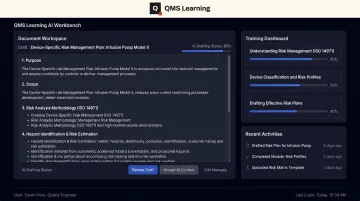
QMS Learning is building a Medical Device & Life Sciences QMS pathway (ISO 13485, FDA 21 CFR Part 820, ISO 14971), using the same practitioner-first model already live in its Aerospace & Defense and General Manufacturing pathways. The pathway pairs role-specific training with an AI Workbench trained on ISO 14971:2019 and its 2020 amendment.
Teams use it to:
- Draft device-specific risk management plans instead of reusing a generic template
- Keep capability and controlled-document history in-house permanently
- Build judgment that stays with the team through design changes and staff turnover
That approach comes from founder Will Trikha, a 20-year quality practitioner who has written over 1,000 audit findings and closed twice that many as a quality manager.
The Medical Device & Life Sciences pathway opens as a pilot cohort in Q3 2026, with early access for the first design-partner teams.
Frequently Asked Questions
What is the ISO 14971 risk management process?
The process follows Clauses 5–10 of the standard: planning, risk analysis, evaluation against acceptability criteria, risk control, residual/benefit-risk review, and ongoing post-production monitoring.
What is a risk management plan template?
A risk management plan template is a structured document mapped to ISO 14971 Clause 4.4's seven required elements. Customize it per device; do not treat it as a generic fill-in-the-blank form.
What are the 5 key components of a risk management plan?
Generic risk frameworks often cite five broad components: identification, assessment, mitigation, monitoring, and reporting. ISO 14971 specifically requires seven defined elements under Clause 4.4, which is a different and more detailed standard.
Is a risk management plan mandatory under ISO 14971?
Yes. Clause 4.4 and MDR/IVDR Annex I both require one per device. A generic SOP without product-specific detail does not satisfy this requirement on its own.
How often should a risk management plan be reviewed or updated?
Update it whenever new information arises (design changes, complaints, or post-market surveillance data), not only at scheduled intervals. Treat the plan as a living document, not a one-time deliverable.
What's the difference between a risk management plan and a risk management file?
The plan is the roadmap describing intended risk management activities. The file is the collected evidence, including the plan itself, proving those activities were actually carried out.