Introduction
Global market access for medical devices now runs through a single standard. As of February 2026, so does US market access. Yet many quality teams still treat ISO 13485 as a binder of controlled documents rather than the operating system it's meant to be.
That distinction matters. Having a quality management system (QMS) and being audit-ready are not the same thing. Teams pass certification audits, then freeze the first time a real CAPA investigation or supplier nonconformance lands on their desk. That gap produces findings, delayed clearances, and expensive rework.
This article covers:
- What ISO 13485 requires in practice
- How it compares to ISO 9001
- What the FDA’s Quality Management System Regulation changes for US manufacturers
- How to build compliance capability that holds up in a real audit
Key Takeaways
- ISO 13485:2016 sets QMS requirements for any organization in the medical device lifecycle, not only manufacturers.
- FDA's QMSR, effective February 2, 2026, folds ISO 13485:2016 into 21 CFR Part 820.
- Certification isn't always mandatory, but CE marking and most supply-chain contracts effectively require it.
- Passing a certification audit doesn't mean your team can execute a CAPA under real pressure.
What Is ISO 13485?
ISO 13485:2016 is the international quality management system standard for organizations that design, develop, produce, install, service, or support medical devices. Published by the International Organization for Standardization, its full title is "Medical devices — Quality management systems — Requirements for regulatory purposes."
ISO 13485:2016 is used for:
- Ensuring medical devices and related services consistently meet customer and regulatory expectations
- Establishing controlled documentation across the device lifecycle
- Building risk management into design, production, and post-market activities
- Maintaining traceability from raw material to finished device
- Driving corrective and preventive action (CAPA) when nonconformities occur
The standard is built on the ISO 9001 framework, but it stands alone. Companies can implement ISO 13485 without ever certifying to ISO 9001, and most medical device organizations do exactly that.
A Brief History of the Standard
ISO 13485 was first published in 1996, then went through a substantial revision in 2003. The current third edition, ISO 13485:2016, took effect in March 2016 and was reconfirmed by ISO as current in 2025, according to ISO's official standard page.
Each revision moved the standard further from generic quality management and closer to a regulatory document built around device safety and traceability.
Who Actually Needs to Comply?
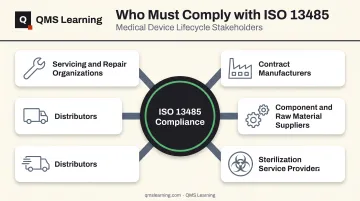
ISO 13485 isn't limited to companies that put their name on a finished device. Its scope covers any organization involved in design, production, distribution, installation, servicing, decommissioning, or disposal of medical devices, including suppliers and other external parties that serve those organizations.
That means compliance realistically extends to:
- Contract manufacturers producing devices under another company's label
- Component and raw material suppliers
- Sterilization service providers
- Distributors moving product through the supply chain
- Servicing and repair organizations
Certification itself is technically voluntary in many markets. In practice, it's functionally required — regulators, notified bodies, and larger customers simply won't do business with a supplier who can't demonstrate it.
Key Requirements of ISO 13485: The 8 Clauses
ISO 13485 is organized into eight clauses. The first three are largely introductory; the operational requirements live in Clauses 4 through 8.
| Clause | Focus |
|---|---|
| 1 | Scope |
| 2 | Normative references |
| 3 | Terms and definitions |
| 4 | Quality management system |
| 5 | Management responsibility |
| 6 | Resource management |
| 7 | Product realization |
| 8 | Measurement, analysis, and improvement |
Clause 4 (QMS documentation) requires a quality manual, document control procedures, and, critically, a medical device file for every device type or family your organization produces. This file has to exist before you can demonstrate compliance for that product line.
Clause 5 (Management responsibility) calls for a documented quality policy, defined authority and communication structures, and scheduled management reviews. Those reviews need to actually evaluate complaints, audit results, key performance indicators, and CAPA status, not just check a box that a meeting happened.
Clause 6 (Resource management) covers competence, training, infrastructure, and the work environment. You must show that people whose work affects product quality are competent, and that facilities and equipment support consistent, compliant production.
Clause 7 (Product realization) covers the bulk of day-to-day quality work:
- Planning and customer requirement capture
- Design and development controls
- Purchasing and supplier evaluation
- Production process controls
- Traceability and identification requirements
Clause 8 (Measurement, analysis, and improvement) governs complaint handling, internal audits, and control of nonconforming product. It also draws a firm line between corrective action, which reacts to a problem that already occurred, and preventive action, which addresses a risk before it becomes one.
A risk-based approach, formally introduced in the 2016 revision, runs through every one of these clauses. It no longer stops at design and development.
ISO 13485 vs. ISO 9001: What's the Difference?
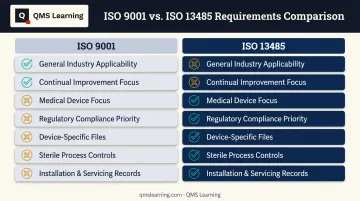
ISO 9001 is a general-purpose QMS standard that applies to any industry, from software companies to bakeries. ISO 13485 is a stand-alone standard built specifically for medical devices, with regulatory requirements built into a QMS foundation.
ISO 13485 adds requirements that ISO 9001 doesn't address:
- Medical device files for each product type or family
- Sterile device contamination controls and process validation
- Advisory notice procedures for field corrections
- Installation and servicing records
- Stricter traceability for implantable and life-sustaining devices
The two standards also diverge in philosophy. ISO 9001 centers on continual improvement and customer satisfaction. ISO 13485 prioritizes QMS effectiveness and regulatory compliance. Improvement still matters, but documented control comes first.
| Dimension | ISO 9001 | ISO 13485 |
|---|---|---|
| Applicability | Any industry | Medical devices and supply chain |
| Core driver | Continual improvement | Regulatory compliance and safety |
| Device-specific files | Not required | Required per device family |
| Sterile process controls | Not addressed | Explicit requirement |
How ISO 13485 Relates to FDA Requirements (QMSR & 21 CFR Part 820)
For decades, US-market manufacturers lived under a split system. FDA required compliance with its Quality System Regulation, 21 CFR Part 820, while the rest of the world required ISO 13485 certification. Companies selling globally ended up maintaining two parallel QMS frameworks: expensive, redundant, and a frequent source of audit confusion.
That split is closing. FDA's Quality Management System Regulation, effective February 2, 2026, amends 21 CFR Part 820 to incorporate ISO 13485:2016 by reference, according to the Federal Register final rule.
FDA projects the harmonization will generate net annualized cost savings of roughly $532 million at a 7% discount rate for the industry. Aligning with ISO 13485 is no longer optional for US-market manufacturers — it's the regulatory baseline.
A few things haven't changed:
- FDA retains specific additions on top of ISO 13485, including UDI documentation, device-tracking traceability, and detailed complaint and servicing record fields
- An ISO 13485 certificate doesn't exempt you from an FDA inspection; FDA neither issues nor requires those certificates
- EU MDR/CE marking still generally requires independent ISO 13485 certification through a notified body
Global manufacturers still need both: certification for the EU and QMSR alignment for the US.
Benefits of ISO 13485 Certification
The most obvious benefit is patient safety. Systematic risk management and design controls reduce the odds of a defective or unsafe device reaching a patient — that's the entire point of the standard's structure.
Beyond safety, certification opens doors:
- Market access: required, or strongly expected, for CE marking, many international markets, and FDA QMSR alignment
- Operational efficiency: documented processes cut rework, scrap, and repeat nonconformities
- Supply-chain credibility: larger OEMs increasingly won't qualify a supplier without it
Certification timelines vary widely depending on where a company starts. According to BSI's ISO 13485 guidance, the full journey from gap assessment to certification can run 12 to 24 months when you build a QMS from scratch.
Implementation alone often takes 6 to 12 months before you even have audit records ready to review.
Building Real Audit-Ready ISO 13485 Compliance
Here's the failure mode that shows up again and again: a team completes ISO 13485 training, passes the certification audit, and then freezes the first time an actual CAPA investigation, supplier nonconformance, or design change lands on their desk. Knowledge without applied capability.
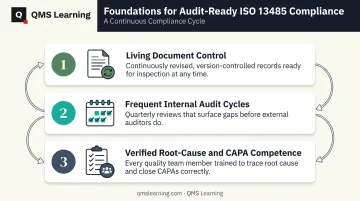
Three practical foundations reduce that risk:
- Living document control that stays current year-round, not a static binder updated only before audits
- Frequent internal audit cycles, with quarterly reviews that catch drift before an external auditor does
- Verified root-cause and CAPA competence across the full quality team, not locked in one senior manager
This is the gap QMS Learning was built to close. Founder Will Trikha spent 20 years on the audit floor, writing more than 1,000 findings as an auditor and closing twice that number as a quality manager. That span makes one pattern hard to miss: teams can pass training and still stall on live CAPA, supplier, and design-change work.
QMS Learning's upcoming Medical Device & Life Sciences pathway, piloting in Q3 2026, bundles ISO 13485, FDA 21 CFR Part 820, ISO 14971 risk management, and HIPAA into role-specific training. An AI Workbench pairs with that training to draft design history file entries, CAPA records, and risk-management plans.
The same premise drives every QMS Learning pathway: build the judgment and artifacts teams need when the next real compliance problem hits.
Frequently Asked Questions
What is ISO 13485:2016 used for?
ISO 13485:2016 defines quality management system requirements for organizations involved in medical devices, covering design, production, and servicing, so they consistently meet regulatory and customer requirements.
Is ISO 13485:2016 only for medical devices?
No. It applies to any organization touching the device lifecycle, including manufacturers, component suppliers, sterilization providers, distributors, and servicing companies, not only the company whose name is on the device.
How does ISO 13485:2016 relate to FDA requirements?
FDA's QMSR, effective February 2, 2026, incorporates ISO 13485:2016 by reference into 21 CFR Part 820, while retaining some FDA-specific additions such as UDI and complaint record requirements.
Is ISO 13485 certification mandatory?
Certification is not universally required by law. In practice it is required for CE marking, many international markets, and most supply-chain and customer relationships in the device industry.
How long does ISO 13485 certification take?
Timelines vary by QMS maturity, company size, and product complexity. Organizations building a QMS from scratch typically need 12 to 24 months from gap assessment to certification.
What is an ISO 13485 medical device file?
It's the required documentation set for each device type or family, covering design specifications, manufacturing details, labeling, and servicing records used to demonstrate ongoing compliance.