
Many quality leaders don't know what's confirmed versus speculative. Vendors circulate aggressive timelines. Consultants leak "draft" clause language that isn't official. Meanwhile, teams worry about falling behind on requirements that haven't even been published yet.
This article separates confirmed IAQG and ISO communications from industry speculation, then tells you what to actually do right now.
Key Takeaways
- IA9100 is the rebranded successor to AS9100D, tied to ISO 9001:2026's structure but still labeled Work In Progress by SAE
- ISO 9001:2026 targets a September 2026 publication; IA9100 follows with a slated Q1 2027 release
- Core clause structure stays intact: requirements are elevated, not rebuilt in a Rev D-style overhaul
- Cybersecurity, ethics, and human factors are the biggest thematic overlaps between both standards
- AS9100D remains valid today, so building audit-ready capability now beats scrambling later
What Is ISO 9001:2026 and Why It Matters
ISO 9001 is moving through Final Draft International Standard status as ISO/FDIS 9001, with an Edition 6 target of September 2026. That edition is expected to replace ISO 9001:2015. The date is an official target window, not a guaranteed publish day.
For any organization certified to ISO 9001—and for IA/AS9100 users whose standard is built on that base—the revision sets the next transition clock. Knowing what is changing early keeps gap assessments and training plans from starting late.
Five Areas of Refinement
Coverage of the draft (including Quality Magazine) points to five directional themes:
- Leadership accountability and ethical conduct
- Quality culture and employee engagement
- Risk and opportunity integrated into business planning
- Organizational knowledge management
- Supplier and lifecycle assurance
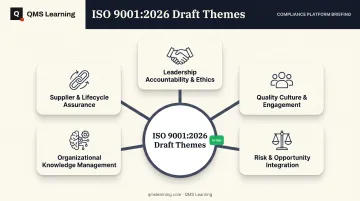
The Annex SL high-level structure is not changing. This is a refinement of existing clauses, not a rebuild from zero.
A Preview: The Climate Amendment
ISO already previewed this approach with ISO 9001:2015/Amendment 1:2024, the climate action changes update. Organizations must determine whether climate change is a relevant issue in their context analysis. That amendment took effect in February 2024. It shows how ISO folds new expectations into existing clauses instead of adding sections wholesale—the same pattern expected in 2026.
What Is IA9100 and Why AS9100 Is Being Renamed
IA9100 is the forthcoming global quality management standard for aviation, space, and defense organizations. It will replace the regional AS9100, EN9100, and JISQ9100 designations under one IA91xx family.
SAE lists it as Work In Progress: "Quality Management System Requirements for Aviation, Space and Defense Organizations." IAQG's 2025 Annual Report confirms the plan—end decades of regional variants by unifying those three standards.
AS9100D remains the current, valid standard today. SAE still lists it as a Current Standard with its 2016 revision date. Nothing about your existing certification needs to change right now.
The Confirmed Two-Stage Rollout
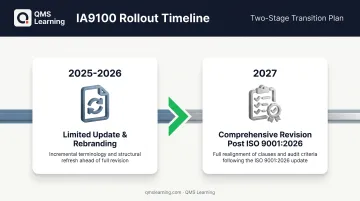
IAQG has stated the 9100 revision remains linked to ISO 9001:2026 timing, with publication slated for Q1 2027. Industry commentary (not an official IAQG schedule) describes this as:
- 2025–2026: A limited update addressing near-term needs and rebranding
- 2027: A comprehensive revision once ISO 9001:2026 finalizes
What's Expected to Change
SAE's official stakeholder topics list includes ethics, product safety, data protection/cybersecurity, APQP linkages, and technology adoption. Trade commentary adds more specific candidates:
- Information security requirements (possibly a new clause referencing ISMS principles)
- Expanded product safety integration
- Human factors formalized in root cause analysis
- Tighter sub-tier supplier controls
- Strengthened counterfeit parts prevention (building on the existing 8.1.4 clause)
None of these are confirmed final clause text. They're candidate themes worth preparing for, not requirements to certify against today.
How IA9100 Aligns with ISO 9001:2026
The dependency is direct and officially stated: IAQG has confirmed that IA9100's publication timing is tied to ISO 9001:2026. The aerospace standard builds on ISO 9001 clause-for-clause, then adds aerospace-specific layers on top.
Shared Thematic Pillars
Both standards are converging on the same underlying concerns:
- Leadership and ethical culture — accountability language appearing in both drafts
- Risk-based thinking — expanded beyond compliance checklists into business planning
- Knowledge management — treating institutional knowledge as a manageable asset
- Supplier and lifecycle assurance — extending oversight further down the supply chain
The Cybersecurity Convergence
Both standards are exploring references to information security management principles aligned with ISO/IEC 27001-style controls. Industry coverage (including Quality Magazine) notes this exploration is underway, though no official IAQG or SAE clause-to-control mapping exists yet. This is the area consultants speculate about most aggressively — treat specific control mappings as unconfirmed until IAQG publishes them.
Where IA9100 Goes Further
IA9100 carries aerospace-specific requirements that ISO 9001:2026 will never need to address:
- Product safety integration into design and production
- Counterfeit parts prevention (already codified at clause 8.1.4 in the current 9100 series)
- Configuration management across complex, long-lifecycle aerospace programs
For multi-standard suppliers running aerospace, automotive, and defense work simultaneously, this alignment is useful. One harmonized QMS baseline can underpin ISO 9001, IA9100, IATF 16949, and CMMC controls at once, which cuts redundant documentation across audits.
Timeline: What to Expect and When
| Period | What Happens |
|---|---|
| 2025 | ISO DIS finalized; gap-analysis window opens |
| 2026 | ISO 9001:2026 publishes (target: September); IA9100 limited update expected |
| 2027 | IA9100 major revision (slated Q1) |
| 2027–2030 | Transition window, timing pending IAQG confirmation |
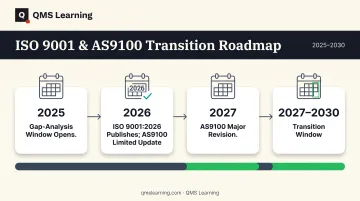
AS9100D certificates remain valid through the transition. Most organizations can time migration to a normal surveillance or recertification audit and avoid extra audit cost—the same pattern shops used in the AS9100D transition of 2017–2018.
Treat the dates above as targets, not guarantees. Neither IAQG nor SAE has published a formal transition schedule yet. If a vendor or consultant gives you an aggressive, precise IA9100 deadline, treat it skeptically.
How Aerospace Teams Should Prepare Now
Waiting for final published text means scrambling later. Instead:
- Run a gap assessment against known directional themes (cybersecurity, human factors, sub-tier supplier controls) rather than waiting for exact clause numbers.
- Document baseline information security controls proportional to your organization's size, ahead of a likely new clause.
- Build human-factors consideration into existing CAPA and root-cause processes now. Practicing this at low stakes, before it's formally audited, beats learning it under audit pressure.
- Strengthen sub-tier supplier oversight and counterfeit parts controls today. These aren't new concepts; AS9100D already covers counterfeit parts prevention at clause 8.1.4, but expect deeper scrutiny.
This is where QMS Learning's Aerospace & Defense Audit-Ready pathway fits. It bundles AS9100D Internal Auditor, ITAR Compliance, and Counterfeit Parts Avoidance training (19 modules, 94 lessons total) with role-specific content for empowered officials, engineers, and quality managers.
The pathway's Counterfeit Parts Avoidance course already covers SAE AS6174 and AS6081 detection methods, supplier control programs, and receiving-inspection workflows: the exact areas IA9100 is expected to strengthen.
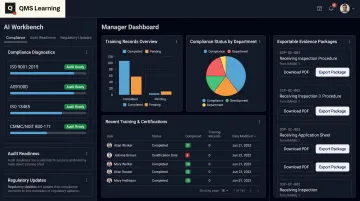
The included AI Workbench diagnoses compliance problems and generates audit-ready documentation. The Manager Dashboard exports a registrar-accepted evidence package with training records, completed scenarios, and time-stamped activity. As requirements evolve, teams built this way start ahead instead of from scratch.
Frequently Asked Questions
Is AS9100 being replaced by IA9100, and what is the latest version of the standard?
AS9100D is still the current, active standard. IA9100 is its confirmed rebrand, with SAE listing it as Work In Progress and IAQG targeting a phased rollout through 2026–2027.
What is the current status of the ISO 9001:2026 standard?
It's currently at Final Draft International Standard (FDIS) stage, under publication, with ISO's own record listing a September 2026 target month.
What is the difference between ISO 9001 and AS9100 standards?
AS9100 (soon IA9100) incorporates every ISO 9001 requirement, then adds aerospace-specific clauses like product safety, configuration management, and counterfeit parts prevention.
Will I need two separate transition audits for IA9100?
Likely, based on the expected two-stage rollout: a limited update around 2025–2026, followed by a comprehensive revision in 2027. Plan for two review cycles, though IAQG hasn't published a formal transition schedule yet.
Do I need to rebuild my QMS from scratch for IA9100?
No. The core clause structure is being preserved. This is an elevation of existing requirements, not a full rebuild like the Rev C-to-D transition.
When should my organization start preparing for IA9100?
Now. Start gap analysis against known directional themes — cybersecurity, human factors, sub-tier supplier controls — while you have a multi-year runway before any transition deadline.