This guide is written for quality managers, quality directors, and top management teams inside ISO 9001-certified organizations — manufacturing, aerospace, medical device, and beyond — who are preparing for a certification or surveillance audit. An Exemplar Global review of common ISO audit findings ranks inadequate management review third on its list, largely because teams treat it as a formality instead of genuine evaluation.
Here's what you'll get: what the process actually is, how it runs step-by-step, who needs to be in the room, and the specific mistakes that turn into audit findings.
Key Takeaways
- Clause 9.3 is a mandatory, documented top-management activity — not an optional meeting
- Three parts drive the process: defined inputs (9.3.2), structured evaluation, and tracked outputs (9.3.3)
- Annual-only reviews leave most auditors unconvinced; a tiered, risk-based frequency works better
- Most findings stem from missing inputs, absent top-management ownership, or untracked outputs
What Is Management Review & Why ISO 9001 Requires It
Clause 9.3.1 defines management review as top management's periodic, documented evaluation of whether the QMS remains suitable, adequate, and effective, and whether it still aligns with the organization's strategic direction.
The review exists to drive evidence-based decisions on resourcing, objectives, risk treatment, and improvement priorities.
Management Review vs. Routine Management Meetings
These two get confused constantly, and auditors notice the difference immediately.
- Management meetings cover day-to-day operations: sales pipeline, production schedules, staffing gaps
- Management review is scoped strictly to QMS performance against the documented management system
ASQ's guidance is blunt about this: management review should function as genuine due diligence, not a box-checking exercise. A meeting where leadership skims a slide deck and signs an attendance sheet doesn't meet that bar, even if it happens on schedule.
Why Data Quality Determines Review Quality
Clause 9.1.3 (analysis and evaluation of data) feeds directly into Clause 9.3. If your process performance data, customer satisfaction trends, or nonconformity analysis is thin, your management review will be thin too. No amount of discussion fixes weak inputs.
Review quality tends to mirror the maturity of your broader data analysis practices, not just what happens in the meeting.
How the Management Review Process Works: Inputs, Meeting, and Outputs
The process flows in a loop: teams collect data against defined inputs, top management evaluates it against QMS objectives, and decisions become outputs that feed the next cycle's inputs. A facilitator (often the Quality Manager or Management Representative) runs the session, but process owners should present their own data. Secondhand reporting invites gaps.
Step 1: Gather the Required Inputs (Clause 9.3.2)
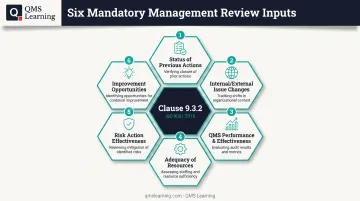
Six categories are mandatory:
- Status of actions from previous management reviews
- Changes in internal and external issues relevant to the QMS
- QMS performance and effectiveness (customer satisfaction, objectives, conformity, nonconformities, audits, and provider performance)
- Adequacy of resources
- Effectiveness of actions addressing risks and opportunities
- Opportunities for improvement
Each department owner should prepare and circulate a short report against their assigned inputs ahead of time. Compiling everything the night before is how gaps end up in front of an auditor.
Step 2: Conduct the Review and Evaluate the Data
This is a discussion, not a report read-out. Compare findings against prior periods to spot trends and root causes. A single quarter's nonconformity count means little without context on whether it's rising or falling.
External auditors look specifically for strategic engagement here: are risks and business context part of the conversation, or is leadership just walking through a checklist? NQA's registrar guidance makes the same point: the format matters less than whether the required inputs actually get evaluated and acted on.
Step 3: Document and Track the Outputs (Clause 9.3.3)
Every review must produce decisions in three areas:
- Opportunities for improvement: specific, not aspirational
- QMS changes needed: process, documentation, or scope adjustments
- Resource needs: headcount, budget, equipment, or training
Each output needs an owner, a timeframe, and resource allocation. Unresolved actions roll forward into the next review's Step 1 inputs, which is exactly what auditors trace across multiple review cycles to confirm the loop is closed.
Who Should Attend, How Often to Meet, and What Affects Effectiveness
Who Should Attend
Top management should chair the review, with functional owners (Quality, Purchasing, HR, Production, Sales) attending and reporting on their assigned input areas.
When full attendance isn't practical, department leads can prepare structured reports for review. Records still need to show top management actually evaluated and decided, not just received information.
Frequency: Why Annual Alone Falls Short
ISO 9001 requires "planned intervals," not a fixed annual schedule. In practice, most organizations run semiannual or quarterly reviews rather than a single annual event. A once-a-year review leaves twelve months where nobody's formally checking whether the QMS is still performing.
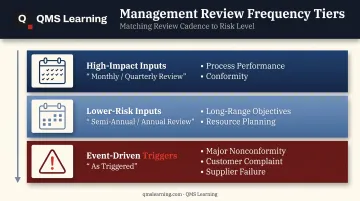
A practical approach ties frequency to risk and real events:
- High-impact inputs (process performance, product conformity, monitoring results) — reviewed monthly or quarterly
- Lower-risk inputs (long-range objectives, resource planning) — reviewed less often, but still on a defined schedule
- Event-driven triggers — a major nonconformity, significant customer complaint, or supplier failure should prompt an unplanned review rather than waiting for the next scheduled date
What Affects Effectiveness
- Data accuracy and availability — reviews built on incomplete data produce weak decisions
- Analyst competency — someone needs to actually interpret trends, not just report numbers
- Organizational complexity — multi-site operations need consolidated, comparable reporting
- Integration with other standards — organizations running ISO 14001 or ISO 45001 alongside ISO 9001 can combine reviews, provided each standard's distinct requirements stay traceable
Aerospace suppliers under AS9100D face added rigor beyond these factors. On-time delivery performance is an explicit management-review input under AS9100:2016, on top of everything ISO 9001 requires.
Common Mistakes and Misconceptions That Trigger Audit Findings
Most nonconformities in this area trace back to a handful of repeat patterns.
Treating it as paperwork, not evaluation. Auditors distinguish "attended" from "actively engaged" by looking for evidence of actual discussion — meeting minutes that show debate, questions, and decisions, not just a signed attendance sheet.
Skipping the harder-to-quantify inputs. Teams often cover customer satisfaction and audit results but skip "adequacy of resources" or "effectiveness of risk actions" because they're less obvious to measure. Both are mandatory.
Confusing frequency with completeness. Management review isn't a once-a-year event — it's an ongoing, documented activity whenever teams discuss performance data and assign actions.
Leaving outputs without an owner, timeframe, or resource commitment. An action with no name attached and no due date is impossible to verify as closed at the next review, and auditors will ask about it.
Assuming "everyone already knows." Smaller organizations sometimes skip formal documentation on this basis. It's precisely the assumption auditors flag as a finding — informal knowledge isn't objective evidence.
Pulling this evidence together manually across departments right before an audit is where most quality teams lose days they don't have. QMS Learning's Manager Dashboard keeps training records and audit-readiness metrics visible on an ongoing basis, so the evidence already exists when the auditor asks.
Conclusion
Management review is the mechanism that keeps a QMS strategically aligned. Treat it as a once-a-year compliance checkbox and that value disappears. What matters is three things: the quality of the inputs feeding it, the rigor of the discussion in the room, and whether outputs can be traced from one review cycle to the next.
Organizations that build this discipline early, with practitioner-informed processes and evidence on hand, walk into audits with answers already prepared. Everyone else scrambles to assemble them under pressure.
Frequently Asked Questions
What is the management review?
Management review is top management's periodic, documented evaluation of a QMS's suitability, adequacy, and effectiveness under ISO 9001 Clause 9.3. It results in decisions, not just a status report.
What should be included in a management review?
Required inputs cover previous actions, internal/external changes, QMS performance, resource adequacy, risk actions, and improvement opportunities. Required outputs are decisions on improvements, QMS changes, and resource needs.
Does ISO 9001 require a management review?
Yes. Clause 9.3 is mandatory for certification. The standard leaves frequency to the organization, but the review and its results must be documented.
Who should attend a management review meeting?
Top management should chair it, with functional and process owners (Quality, Production, HR, and Sales) reporting on their assigned input areas.
How often should management review meetings be held?
Most auditors consider annual-only reviews insufficient. A risk-based, tiered cadence (high-impact data more often than lower-risk items) holds up better under audit.
What happens if a company skips or poorly documents its management review?
This typically results in a minor or major nonconformity during certification or surveillance audits, since auditors need objective evidence, not verbal assurance that a review occurred.