The answer is clear. Organizations should proceed with ISO 9001:2015 implementation immediately. Current certificates remain valid through a three-year transition period, all foundational QMS work transfers to the 2026 revision, and waiting means forfeiting 2-3 years of operational benefits from a certified quality management system.
Key Takeaways
- ISO 9001:2026 publishes in September 2026 with a three-year transition window ending September 2029
- Core changes focus on quality culture demonstration, ethical behavior, climate considerations, and clearer risk/opportunity separation
- Organizations with strong 2015-compliant systems face minimal transition burden
- Companies not yet certified should implement ISO 9001:2015 now; foundational work transfers directly to 2026
- Training completed on ISO 9001:2015 remains valid; active subscribers receive 2026 updates at no additional cost
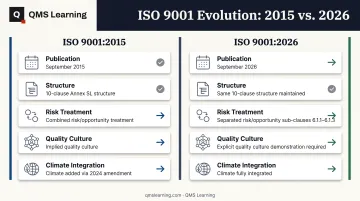
ISO 9001:2026 vs ISO 9001:2015: Quick Comparison
See what carries forward from 2015 and what actually changes in the 2026 revision:
| Area | ISO 9001:2015 | ISO 9001:2026 |
|---|---|---|
| Publication date & status | Published September 2015; currently the valid standard | Expected September 2026; FDIS approved August 7, 2026 |
| Core structure | 10-clause Annex SL structure, process-based approach, risk-based thinking throughout | Same 10-clause Annex SL structure; process approach unchanged |
| Leadership | Top management demonstrates commitment to QMS and customer focus | Expanded to promote and demonstrate quality culture and ethical behavior |
| Risk & opportunity | Combined treatment in Clause 6.1 | Split into sub-clauses 6.1.1–6.1.3 with clearer separation of risks and opportunities |
| Climate change | Added via 2024 amendment to Clause 4.1; determine whether climate change is relevant to context | Fully integrated into Clause 4.1; no expansion beyond 2024 amendment language |
| Employee awareness | Quality policy, objectives, contribution to QMS effectiveness, implications of nonconformity | Adds quality culture and ethical behavior (Clause 7.3) |
What is ISO 9001:2015?
ISO 9001:2015 is the current international quality management system standard published in September 2015. It applies to any organization regardless of size, sector, or geography: aerospace manufacturers to healthcare providers to service companies.
The 2015 revision introduced the Annex SL high-level structure, a standardized framework shared across all ISO management system standards. This structure enables easier integration with ISO 14001 (environmental management), ISO 45001 (occupational health and safety), and other management systems, allowing organizations to build one integrated management system rather than maintaining separate silos.
Core ISO 9001:2015 Principles
The standard rests on seven quality management principles:
- Customer focus: Understanding and meeting customer requirements while exceeding expectations
- Leadership: Establishing unity of purpose and direction
- Engagement of people: Competent, empowered people engaged at every level
- Process approach: Managing activities as interrelated processes
- Improvement: Continual improvement as a permanent objective
- Evidence-based decision making: Decisions based on data analysis
- Relationship management: Managing relationships with interested parties
Risk-based thinking replaced the separate "preventive action" clause from ISO 9001:2008. Rather than treating risk as a discrete activity, organizations now consider risk throughout QMS design and use, identifying, considering, and controlling risks at every stage.
Use Cases and Benefits of ISO 9001:2015
Typical applications include:
- Manufacturing: Machining, fabrication, assembly, injection molding, packaging
- Aerospace & Defense: AS9100D builds on ISO 9001:2015 requirements, adding aviation, space, and defense specifics
- Automotive: IATF 16949 extends ISO 9001:2015 for automotive quality management
- Medical Devices: ISO 13485 aligns with ISO 9001 structure while adding regulatory requirements
- Construction, healthcare, and services: Provides the QMS foundation when no sector-specific overlay applies
Organizations pursue ISO 9001 certification for multiple reasons:
- Improved operational efficiency: Standardized processes reduce waste and errors
- Enhanced customer satisfaction: Consistent quality delivery builds trust
- Better supplier management: Quality requirements cascade through the supply chain
- Competitive advantage: Certification opens doors to contracts requiring third-party QMS validation
- Foundation for industry-specific standards: ISO 9001 compliance is the first step toward AS9100D, IATF 16949, or ISO 13485
A 2021 study of 50 Indonesian automotive-component manufacturers found ISO 9001:2015 implementation associated with operational performance (35% explained variance) and business performance (31.6% explained variance)—correlation, not proof of causation.
What is ISO 9001:2026?
ISO 9001:2026 is the upcoming revision currently in Final Draft International Standard (FDIS) stage, with publication expected in September 2026. It is a targeted evolutionary update that keeps the existing quality management framework intact.
ISO standards undergo periodic review to remain relevant to modern business environments. The revision addresses digital transformation, organizational resilience, sustainability expectations, and ethical governance—themes reflected in targeted clause changes rather than wholesale restructuring.
Development Process and Timeline
ISO/TC 176/SC 2, the technical committee responsible for ISO 9001, initially voted in May 2021 to confirm ISO 9001:2015 without revision. That decision was reversed in August 2023 following a new-options ballot. Working Group 29 began the revision in January 2024.
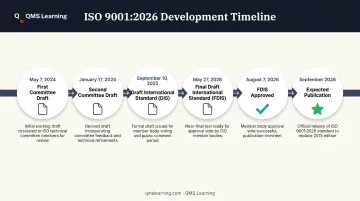
The revision progressed through multiple drafts:
- First Committee Draft (CD): May 7, 2024
- Second Committee Draft: January 17, 2025
- Draft International Standard (DIS): September 10, 2025
- Final Draft International Standard (FDIS): May 27, 2026
- FDIS Approved: August 7, 2026
- Expected Publication: September 2026
The September 2024 WG29 meeting included 56 members from 31 national bodies and 5 liaison organizations, while the May 2025 meeting had 48 participants from 27 national bodies and 8 liaison organizations.
Key Changes in ISO 9001:2026
Six primary changes distinguish ISO 9001:2026 from the 2015 version:
1. Integration of Climate Change Considerations
The February 2024 amendment to ISO 9001:2015 added climate change consideration to Clause 4.1. Organizations must determine whether climate change is a relevant issue for their context. ISO 9001:2026 formally incorporates this amendment language without expansion. Organizations already compliant with the 2024 amendment meet 2026 requirements.
2. Expansion of Leadership Responsibilities
Clause 5.1 now explicitly requires top management to promote and demonstrate quality culture and ethical behavior. This goes beyond the 2015 requirement to "demonstrate leadership and commitment," making visible quality culture a mandatory leadership activity.
3. Strengthened Quality Policy Requirements
Clause 5.2 mandates that quality policy must explicitly reference organizational context and strategic direction alignment. Policies can no longer exist as standalone compliance documents disconnected from business strategy.
4. Reorganization of Risk and Opportunity Management
Clause 6.1 is reorganized into sub-clauses (6.1.1–6.1.3) providing clearer separation between risk determination, opportunity identification, and action planning. Expanded Annex A guidance helps organizations understand when to address risks defensively versus pursue opportunities proactively.
5. Enhanced Employee Awareness Requirements
Clause 7.3 adds awareness requirements for quality culture and ethical behavior. All personnel whose work affects QMS performance must understand not just the quality policy and objectives, but the cultural and ethical expectations underlying them.
6. Enhanced Explanatory Content in Annex A
Annex A expands to more than 15 pages of supplementary guidance aligned with Clauses 4–10. This informative content clarifies intent and application without adding new requirements. Annex B (references to other ISO/TC 176 standards) is removed; its content moves to Annex A and online resources.

What is NOT Changing in ISO 9001:2026
What stays the same matters as much as what is new:
- Structure: The 10-clause Annex SL high-level structure stays in place. Clauses 1–10 keep the same order and basic organization.
- Core principles: Customer focus, process-based management, continual improvement, evidence-based decision making, leadership engagement, and risk-based thinking remain foundational.
- Operational requirements: Core Clause 8 operations and Clause 9 monitoring, measurement, audit, and management review stay largely unchanged, with only minor terminology adjustments.
ISO 9001:2026 also does not add substantial new requirements for:
- AI or digital transformation programs
- Expanded sustainability mandates beyond climate consideration
- Supply chain resilience obligations
- Service-sector-specific clauses
Organizations expecting dramatic shifts in those areas will find the revision more modest than anticipated.
Expected Timeline and Transition Period
Following September 2026 publication, certification bodies require 9–12 months for accreditation. First ISO 9001:2026 certificates are likely available by August 2027.
A three-year transition period is expected to run from September 2026 to September 2029, consistent with the 2015 transition that ended September 15, 2018. However, IAF has not yet issued final transition requirements. ISO 9001:2015 certificates remain fully valid throughout the provisional transition window.
During the 2015 transition, 47.24% of ISO 9001 certificates had transitioned by February 2018, up from 36.94% at December 2017. This historical precedent suggests roughly half of organizations transition in the first 18 months, with the remainder completing transitions in the final 12–18 months before the deadline.
Key Differences Between ISO 9001:2015 and ISO 9001:2026
Quality Culture and Ethical Behavior (New Emphasis)
ISO 9001:2015 implied quality culture through leadership and engagement clauses but did not explicitly mandate its demonstration. Organizations could meet leadership requirements through policy statements and resource allocation without visibly modeling quality values.
ISO 9001:2026's explicit requirement for top management to promote and demonstrate quality culture and ethical behavior closes that gap. Expanded Annex A guidance provides implementation methods, though specific audit criteria remain subject to certification body interpretation.
Demonstration Examples:
- Leadership participation in quality reviews and improvement projects
- Visible ethical decision-making when quality conflicts with schedule or cost
- Recognition programs aligned with quality values, celebrating individuals who raise concerns or stop processes
- Communication of both quality successes and failures, modeling accountability
- Allocation of resources demonstrating quality as a strategic priority
Auditors will increasingly look for evidence of how leadership communicates, models, and reinforces quality culture, not merely that a quality policy exists.
Climate Change Integration
The February 2024 amendment to ISO 9001:2015 added climate change consideration to Clause 4.1, requiring organizations to determine whether climate change is a relevant issue for their context. Clause 4.2 notes that relevant interested parties can have requirements related to climate change.
ISO 9001:2026 formally incorporates this amendment without expansion. Organizations already compliant with the 2024 amendment meet 2026 requirements in this area.
Practical Implications:
Climate consideration applies to context analysis (Clause 4.1), not necessarily to environmental management system implementation (that's ISO 14001's domain). Organizations must ask:
- Do climate-related physical risks (extreme weather, supply chain disruption) affect our ability to deliver products and services?
- Do customers or regulators impose climate-related requirements?
- Do climate-related opportunities (energy efficiency, sustainable materials) align with our strategic direction?
If climate change is determined not relevant to a specific organization's context, that determination (with supporting rationale) satisfies the requirement. The clause does not mandate climate action; it mandates climate consideration.
Risk and Opportunity Management Clarification
ISO 9001:2015 combined risks and opportunities in Clause 6.1, sometimes creating confusion about whether they required identical treatment. The single clause covered determination of risks and opportunities, planning actions to address them, integration into QMS processes, and effectiveness evaluation.
ISO 9001:2026 reorganizes Clause 6.1 into three sub-clauses:
- 6.1.1 General: Overall requirement for risk-based thinking
- 6.1.2 Risks and Opportunities: Determination and consideration
- 6.1.3 Planning Actions: Planning and integration of actions to address risks and opportunities
This structure provides clearer distinction between determining risks/opportunities and planning responses. Annex A significantly expands guidance on both concepts, helping organizations understand when to address risks defensively (preventing negative outcomes) versus pursue opportunities proactively (enabling positive outcomes).
The reorganization does not add new requirements but clarifies the process of risk-based thinking, making audit preparation and documentation more straightforward.
Leadership Accountability Enhancement
ISO 9001:2015 Clause 5.1 required top management to "demonstrate leadership and commitment" to the QMS and customer focus. ISO 9001:2026 explicitly adds promoting quality culture and ethical behavior to this clause.
Quality management no longer stops at process control and defect prevention. It now includes the cultural environment in which quality decisions are made.
Auditors will still expect the communication, modeling, and reinforcement evidence covered above. They will also probe how the organization responds when quality culture is tested—under schedule pressure, cost constraints, or aggressive customer demands.
Quality Policy Strengthening
ISO 9001:2015 required quality policy to be appropriate to purpose and context but didn't mandate explicit strategic alignment language. Organizations could write generic quality policies referencing "customer satisfaction" and "continual improvement" without connecting to specific business objectives.
ISO 9001:2026's strengthened Clause 5.2 requires quality policy to explicitly "take into account the context of the organization and support its strategic direction." Quality policies must clearly articulate connection to business strategy.
Practical Impact: A generic quality policy stating "We are committed to customer satisfaction and continual improvement" no longer suffices. An updated policy might state:
"Our quality management system supports [Company]'s strategic direction of diversifying into defense markets, achieving AS9100D certification by Q4 2027, and maintaining 99.5% on-time delivery. We commit to ethical supplier relationships, zero-tolerance counterfeit parts controls, and a quality culture where any employee can stop production to address a quality concern."
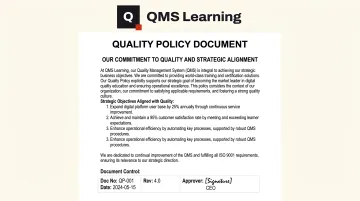
This specificity demonstrates quality policy as a strategic document, not a compliance artifact.
Awareness Requirements Expansion
ISO 9001:2015 Clause 7.3 required employee awareness of:
- Quality policy
- Relevant quality objectives
- Contribution to QMS effectiveness
- Implications of nonconformity
ISO 9001:2026 adds awareness requirements for quality culture and ethical behavior. Employees must understand not just what to do, but the cultural and ethical context in which they do it.
Implementation Approaches:
- Incorporate culture/ethics into onboarding training
- Include quality culture examples in periodic refresher training
- Feature quality culture and ethical behavior in leadership communications
- Integrate culture/ethics expectations into performance evaluations
- Use real examples (both positive and negative) to illustrate expected behaviors
Organizations with role-specific online training pathways can embed quality culture scenarios throughout technical training, helping employees see how culture and ethics apply to daily quality decisions.
Editorial Improvements and Annex Changes
Non-technical changes improve usability without adding compliance burden:
- Updated Terminology: Refined clause wording for clarity
- Annex A Expansion: Enhanced guidance aligned with Clauses 4–10, exceeding 15 pages
- Annex B Removal: ISO/TC 176 standards references moved to Annex A and online resources
These changes clarify intent and application, reducing ambiguity that sometimes led to inconsistent audit interpretations.
How to Prepare for the Transition to ISO 9001:2026
Conduct Gap Analysis Against Draft Standard
Perform a assessment comparing your current QMS against known ISO 9001:2026 changes. Focus on the clauses where substantive changes occur: 4.1 (climate), 5.1 (leadership culture/ethics), 5.2 (quality policy), 6.1 (risk/opportunity), and 7.3 (awareness).
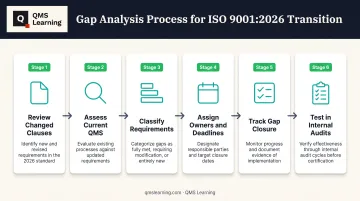
Gap Analysis Process:
- Review each changed clause requirement
- Assess current QMS processes and documentation against 2026 language
- Classify each requirement as met, requires modification, or requires new process/policy
- Assign owners and deadlines for addressing gaps
- Establish performance metrics to track closure
- Retain objective evidence of gap analysis and closure actions
After you close gaps, test the changes in internal audits before the external transition audit so issues surface while you still have time to fix them.
Update Leadership and Quality Policy Documentation
Review and revise your quality policy to explicitly reference organizational context and strategic direction alignment, satisfying strengthened Clause 5.2 requirements. Avoid generic statements; include specific strategic objectives your QMS supports.
Develop or enhance mechanisms for leadership to demonstrate quality culture and ethical behavior:
- Scheduled leadership participation in quality reviews (not delegation)
- Communication plans for quality successes and failures
- Recognition systems celebrating quality-focused behaviors
- Visible resource allocation supporting quality as a strategic priority
- Decision-making transparency when quality conflicts with schedule or cost
Update top management responsibilities documentation to reflect expanded Clause 5.1 requirements. Role descriptions and procedures should reference how leaders promote and demonstrate quality culture.
Enhance Risk and Opportunity Management Processes
Review existing Clause 6.1 processes to ensure clear distinction between risk determination, opportunity identification, and action planning. Update risk management documentation to align with ISO 9001:2026's sub-clause structure (6.1.1–6.1.3).
Action Steps:
- Separate risk assessment documentation from opportunity identification
- Clarify how the organization determines which risks require action versus which are acceptable
- Document how opportunities are systematically identified and evaluated
- Show integration of risk/opportunity actions into QMS processes
- Establish metrics demonstrating effectiveness of actions taken
Fold expanded Annex A guidance on risk-based thinking into training and procedures so employees understand why risk and opportunity management matters, not only what the procedure requires.
Train Employees on New Requirements
Develop or update training programs to address quality culture and ethical behavior awareness requirements (Clause 7.3). Training should help employees understand:
- What quality culture looks like in your organization
- How their role contributes to quality culture
- Ethical behavior expectations in quality decisions
- How to raise concerns without fear of retaliation
- Examples of quality culture in practice (both positive and negative)
Provide leadership training on demonstrating quality culture and ethical behavior in daily operations. Leaders need specific tools and techniques, not just awareness that the requirement exists.
QMS Learning's General Manufacturing Quality pathway offers role-specific ISO 9001 training that updates with the standard at no extra cost for active subscribers. It includes a 16-hour ISO 9001 Internal Auditor course covering every clause, plus AI tools that help teams apply requirements to live problems as they move from 2015 to 2026.
Evaluate and Update Supplier Management
Review supplier qualification and performance monitoring processes to ensure alignment with strengthened QMS requirements. Consider how supplier performance impacts organizational context, risks, and opportunities under the expanded 2026 framework.
Supplier Management Updates:
- Assess whether climate-related supplier risks (geography, transportation, resource availability) affect your context
- Review supplier quality agreements to anticipate ethical behavior expectations
- Update supplier qualification criteria to reflect risk/opportunity management approach
- Enhance supplier performance monitoring to capture cultural and ethical indicators, not just defect rates
Plan Certification Transition Strategy
Coordinate with your certification body to understand their ISO 9001:2026 accreditation timeline and transition audit scheduling. First 2026 certificates are likely available August 2027, with transition audits occurring between then and September 2029.
Transition Planning:
- Confirm your certification body's accreditation timeline
- Schedule transition audit (likely combined with surveillance or recertification audit)
- Budget for training, documentation updates, and audit costs
- Identify internal resources responsible for transition coordination
- Establish milestones tracking gap closure against the transition deadline
Organizations with surveillance audits scheduled for late 2027 or 2028 should plan to complete gap closure before those audits, allowing the transition assessment to occur without delaying certification maintenance.
Real-World Transition Example: Aerospace Manufacturer's Preparation
Scenario Setup
A mid-size aerospace component manufacturer with 150 employees supplies Tier 1 defense contractors. The company holds AS9100D certification, which builds on ISO 9001:2015 requirements, adding aviation, space, and defense-specific requirements.
The quality director faced a dual challenge: AS9100 will evolve to a new revision (IA9100) in parallel with ISO 9001:2026, creating overlapping transition requirements. The team needed to prepare for both transitions without disrupting production or creating compliance gaps.
Preparation Approach
Q4 2025: The quality director conducted a gap analysis comparing the existing QMS against the ISO 9001:2026 draft and anticipated IA9100 changes. The analysis identified 12 gaps across leadership accountability, quality culture demonstration, climate considerations, risk/opportunity separation, and employee awareness.
Q1 2026: A cross-functional implementation team formed, including representatives from quality, operations, and engineering. The team met monthly to address identified gaps, prioritizing leadership accountability and quality culture demonstration.
Q2 2026: The company updated its quality policy to reference strategic direction explicitly: customer diversification from aerospace into defense, operational excellence through Lean Six Sigma, and ethical supplier relationships focused on counterfeit parts avoidance.
Leadership began joining monthly quality reviews and launched a recognition program for employees who raised quality concerns or stopped production to fix issues.
Later in Q2 2026: Quality culture awareness training rolled out to all 150 employees. It tied individual roles to organizational quality commitments and used scenarios on ethical choices when quality conflicts with schedule pressure.
Results and Transition Readiness
By September 2026 (ISO 9001:2026 publication date), the company had addressed 80% of anticipated changes, with remaining items scheduled for mid-2027. Early preparation let the team work methodically instead of in crisis mode.
After a successful transition audit in Q1 2028, results included:
- ISO 9001:2026 certification 18 months ahead of the September 2029 deadline
- About 60% lower transition costs than organizations waiting until 2028–2029, when registrar schedules fill and consultant rates rise
- 15% fewer internal nonconformities between Q1 2026 and Q1 2028
Leadership participation in quality reviews and the employee recognition program created accountability that went beyond policy statements.
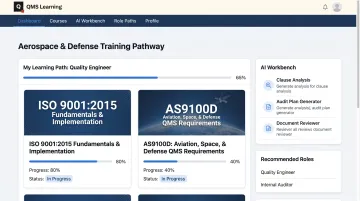
To keep that capability in-house, the company used QMS Learning's Aerospace & Defense pathway to train junior quality engineers on AS9100D and ISO 9001 fundamentals. The AI Workbench helped them generate audit-ready CAPAs and FMEAs during the transition, so skill stayed with the team rather than with outside consultants.
Conclusion
ISO 9001:2026 builds on the 2015 standard rather than replacing it. Organizations with strong 2015-compliant systems face a light transition focused on quality culture demonstration, ethical behavior integration, and clearer risk and opportunity management. The 10-clause Annex SL structure stays the same, core QMS principles persist, and operational requirements remain largely intact.
If you are considering certification, pursue ISO 9001:2015 now. Foundational QMS work—process documentation, leadership commitment, risk management, internal audits, and management review—transfers directly to 2026. Certificates remain valid until September 2029.
Waiting costs you 2–3 years of operational gains:
- Improved efficiency
- Higher customer satisfaction
- Stronger supplier management
- Competitive edge in markets that require third-party QMS validation
For certified organizations, treat the transition as continuous improvement, not just a compliance exercise. Use the gap-analysis window to strengthen leadership accountability, make quality culture more visible, and refine risk management. Those improvements create business value whether or not the 2026 revision requires them.
The standard mainly formalizes what high-performing quality teams already do. Build or refresh those ISO 9001 foundations now—documentation, internal audit skill, and risk discipline—so the move to 2026 stays incremental instead of disruptive.
Frequently Asked Questions
What are the key differences between ISO 9001:2015 and ISO 9001:2026?
Six areas change: quality culture and ethics, climate change (2024 amendment), risk/opportunity sub-clauses 6.1.1–6.1.3, stronger policy–strategy alignment, expanded employee awareness, and clearer Annex A guidance. Core QMS structure and principles stay the same.
What is the current status of ISO 9001:2026?
FDIS was approved August 7, 2026, with publication scheduled for September 2026. A three-year transition period is expected to run until September 2029. First ISO 9001:2026 certificates should be available by August 2027 after certification bodies complete accreditation.
Should I get certified to ISO 9001:2015 now or wait for ISO 9001:2026?
Get ISO 9001:2015 certified now. Foundational QMS work carries forward to 2026, and current certificates stay valid through the transition—so waiting only costs you years of operational gains and customer trust.
Do I need to recertify completely when ISO 9001:2026 is released?
No. ISO 9001:2015 certificates stay valid until the transition deadline. You complete a transition audit (often with a planned surveillance or recertification audit), not a full recertification from scratch.
How will ISO 9001:2026 affect my existing quality management system?
A solid 2015 system usually needs only targeted updates—leadership evidence of quality culture and ethics, policy linked to strategy, awareness training that covers those topics, and clearer risk/opportunity records. Most day-to-day processes stay the same.
Where can I download a PDF of the ISO 9001:2026 changes?
Standards must be purchased from the official ISO website. Draft versions are restricted to ISO member bodies. Many certification bodies and consulting firms publish change summaries and transition guides as free resources once the standard is published.