Introduction
An internal QMS audit is a planned, systematic self-examination of an organization's own quality processes against a standard (AS9100D, ISO 9001, ISO 13485) to verify conformance before an external body walks through the door.
This guide is written for quality managers, internal auditors, and compliance leads working in aerospace, defense, manufacturing, and medical device environments. In these industries, a weak internal audit program doesn't just create paperwork problems. It leads directly to external findings, recalls, or a suspended certification.
Despite these stakes, too many organizations treat the internal audit as a once-a-year checkbox: schedule it, run a generic template, file the report, move on. That's a missed opportunity.
Internal audits should function as diagnostic tools, surfacing real problems well before an external auditor ever sees them. This guide breaks down how the process actually works, what determines whether it produces real findings or a rubber stamp, and where the whole exercise tends to go sideways.
Key Takeaways
- ISO 9001, AS9100D, and ISO 13485 require self-conducted audits at planned intervals
- The audit cycle loops through scoping, fieldwork, reporting, and corrective action
- Effectiveness depends on auditor independence, risk-based scope, and evidence quality — not checklist completion
- Findings left in a "parking lot" resurface at the next external audit
- Done well, internal audits rehearse the external audit and prevent expensive surprises
What Is an Internal QMS Audit and Why It's Used
An internal QMS audit is a first-party review. Your organization examines its own processes to confirm two things: that documented procedures meet the applicable standard, and that people on the floor are actually following them.
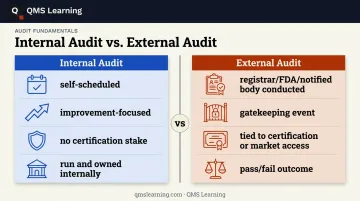
No registrar shows up. No pass/fail stamp gets issued. The organization runs it, owns it, and acts on it.
That's the core difference from external audits. Internal audits are self-scheduled and built for improvement. External audits (from a notified body, the FDA, or a certification registrar) are gatekeeping events tied directly to certification or market access. Fail one of those, and you're not looking at a coaching conversation.
| Standard | Clause | What it requires |
|---|---|---|
| ISO 9001:2015 | 9.2 | Audits at planned intervals confirming QMS conformance and effective implementation |
| AS9100D | 9.2 | Same structure as ISO 9001, plus aerospace-specific attention to performance indicators |
| ISO 13485:2016 | 8.2.4 | Planned audits, objective auditor selection, documented follow-up verification |
Regulated industries demand more from internal audits because the cost of failure is higher:
- Traceability: every part, lot, or record needs a documented paper trail
- Supplier accountability: a nonconforming supplier can trigger a full recall
- Repeatable process control: the same result, every shift, every operator, under scrutiny
Without a functioning internal audit program, nonconformances don't disappear. They wait. They surface for the first time during an external audit, or worse, inside a customer complaint, neither a good moment to discover a gap.
The ISO Auditing Practices Group makes this point directly: external auditors routinely compare their own findings against an organization's internal audit results to judge whether the internal program is actually working. If your internal audits consistently miss what the registrar finds, that gap becomes the finding.
How the Internal QMS Audit Process Works
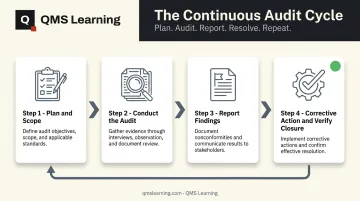
Think of the internal audit as a closed loop, not a single event. Plan, execute, report, correct, verify, then feed everything learned into next year's risk-based schedule.
ISO 19011, the guidance standard for auditing management systems, lays out this exact flow: establish the program, initiate the audit, prepare, conduct, report, and follow up. ASQ's summary of the 2018 revision confirms this structure and expands guidance on auditor competence.
What goes into it:
- An audit schedule with defined scope and criteria
- Checklists mapped to actual standard clauses, not generic templates
- Auditors trained and independent from the area under review
During fieldwork, auditors gather objective evidence through document review, record sampling, and interviews, then compare it against what's required. The output: documented nonconformances, root cause investigation, corrective actions, and a QMS that's measurably stronger heading into the next cycle.
Step 1: Plan and Scope the Audit
This step sets the audit objective, defines which clauses and processes are in scope, builds the schedule, and lines up resources (checklists, prior findings, staff availability) before anyone walks the floor. Rush this step, and the audit drifts toward whatever the auditor happens to notice that day instead of what actually carries risk.
Step 2: Conduct the Audit (Opening Meeting, Evidence Gathering, Interviews)
Auditors open with a short meeting to confirm scope with the process owner, then get to work: sampling records, observing processes as they actually run, and interviewing staff. The goal is simple: does what's written match what's happening? Interviews alone don't count as evidence; they need corroboration from a record or an observation.
Step 3: Report Findings
Findings get classified as nonconformance, observation, or opportunity for improvement. Each one needs three elements to hold up: the objective evidence, the specific requirement not met, and a clear statement connecting the two. Results go to management in a closing meeting.
One caution: an "opportunity for improvement" label should never soften something that's genuinely a nonconformance. If a requirement wasn't met, call it what it is.
Step 4: Drive Corrective Action and Verify Closure
Findings need root cause analysis and CAPA, not a quick patch. Correction fixes the symptom; corrective action removes the cause. This is where a lot of programs stall: teams either pick the wrong root cause method for the problem, or close the CAPA before anyone verifies the fix worked.
| Method | Best fit | Where it falls short |
|---|---|---|
| 5-Why | A bounded problem that has already occurred, like a recurring defect | Can oversimplify a cause with multiple contributing factors |
| FMEA | Proactive risk review before a new or changed process | Doesn't prove the cause of something that already happened |
This is exactly the diagnostic gap QMS Learning's AI Workbench was built to close. Feed it a plain-language description, such as "same defect appeared on 3 different jobs from the same supplier this quarter," and the Method Router reads the pattern: recurring, same source, multiple jobs.
It rules out FMEA since there's no new process involved, and routes the finding to 5-Why plus Supplier CAPA instead.
The system then generates the artifact itself: a formatted Supplier CAPA report with the 5-Why analysis attached, mapped to the relevant clause (AS9100D §8.4.3), ready to submit. CAPA closure stops depending on whichever senior engineer happens to be free that week.
Where and When Internal Audits Are Applied
Internal audits typically cover:
- Document control
- Design and engineering records
- Production and process control
- Supplier management
- Training records
- CAPA and nonconformance logs
These systems aren't reviewed once a year and forgotten. Internal audits sit at several points in the compliance lifecycle:
- Right after a new process goes live
- Ahead of every external certification or surveillance audit
- After major organizational changes, like a new ERP rollout or a site move
One correction worth making here: ISO 9001, AS9100D, and ISO 13485 all require audits at planned intervals — none sets a universal annual minimum. IAQG's clarification guidance on AS9100D is explicit that Clause 9.2.2 sets no fixed timeframe.
In practice, most organizations default to annual coverage as a baseline, then layer risk-based frequency on top. A supplier that just changed, a process that just launched, or an area with a recent nonconformance gets audited more often than something stable for three years. That's the real design intent — internal audits are a living schedule that shifts toward wherever the risk currently sits.
Key Factors That Affect Internal Audit Effectiveness
Two audits against the same checklist can produce wildly different results. The difference usually comes down to five factors.
Auditor independence and competence. Auditors shouldn't review their own work area. ISO 13485 states this outright, and ISO 9001 and AS9100D require similar objectivity. Training matters just as much: an auditor who doesn't know the clause well enough won't recognize the gap in front of them.
Checklist and scope quality. A checklist mapped precisely to standard clauses and process risk catches real issues. A generic, copy-pasted template mostly confirms a document exists, not that anyone follows it.
Sampling method and depth. How you select records and processes determines whether systemic issues actually surface. Pull the same three easy records every audit, and you'll get the same clean result every time, right up until a customer complaint proves otherwise.
Audit frequency and risk-based scheduling. Higher-risk processes, like a new supplier or a new product introduction, deserve more frequent review than something stable and unchanged for years.
Evidence and documentation standards. Every finding needs objective evidence (records, observations, data) that would hold up if a registrar or FDA inspector asked to see it directly. This is where programs break down. Pulling records from five different spreadsheets and shared drives the night before an audit eats days most quality teams don't have.
That's the exact gap QMS Learning's Manager Dashboard is built to close. Instead of manually assembling training records, completed scenarios, and generated compliance artifacts, the dashboard exports a single, indexed PDF (training history, timestamped Workbench activity, and standard-by-standard competency data) in minutes instead of days.
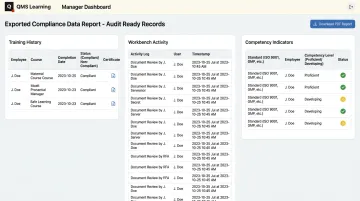
That difference changes how fast a team can respond, whether the request comes from an internal auditor or a registrar standing in the lobby.
Common Issues, Misconceptions, and When Internal Audits Fall Short
The biggest misconception: internal audits are a compliance formality rather than a genuine improvement mechanism. Teams that treat them as a checkbox exercise miss the entire point: the early warning that catches a gap before a customer or registrar does.
A few specific failure patterns show up repeatedly:
- Closing confused with fixing. Marking a finding "closed" isn't the same as eliminating its root cause. Skip that step, and the same nonconformity resurfaces at the next external audit.
- The parking lot problem. Someone notices a gap mid-audit, doesn't log it formally, and moves on. Months later, the same gap gets caught, this time by an external auditor.
- Rushed or under-resourced audits. When internal audits get squeezed into an afternoon by whoever's available, quality suffers regardless of checklist quality.
Under-resourced audits are the real problem, not internal auditing itself. Fixing it means investing in independent, trained auditors and giving them the time and evidence tools to do the job properly.
Frequently Asked Questions
What are the 7 steps of QMS?
Most QMS frameworks follow a similar lifecycle: quality policy and objectives, documentation, planning, implementation, monitoring and measurement, internal audit, and management review with continuous improvement. Exact naming varies by standard.
What are the types of audits in a quality management system?
Internal (first-party) audits are self-conducted for improvement. External audits, whether second-party (customer) or third-party (registrar), tie directly to certification or contract standing. Regulatory inspections, like an FDA visit, are a separate category.
What is a quality management audit?
It's a systematic, evidence-based review confirming whether a QMS conforms to a defined standard and functions as documented in daily practice.
How often should internal QMS audits be conducted?
ISO 9001, AS9100D, and ISO 13485 all require audits at planned intervals rather than a fixed annual minimum. Most organizations default to annual coverage, then audit higher-risk processes more often.
Who should conduct an internal quality audit?
Trained staff who aren't auditing their own work area, or an outside contractor, can both do the job. What matters is documented competence in the standard and genuine independence.
What is the difference between an internal and external QMS audit?
Internal audits are self-scheduled and improvement-focused, with no certification stake attached. External audits are conducted by a registrar or regulator and directly determine certification status or market access.