Introduction
A nonconformance shows up on the shop floor. The team documents it, contains it, and moves on. Then it happens again three months later.
That recurrence usually means root cause analysis, the investigative process inside CAPA, never found the actual cause.
RCA is the diagnostic step that determines why a nonconformance happened, not just what happened.
This matters most to quality, compliance, and operations professionals across aerospace, manufacturing, medical device, and EHS programs, where CAPA is an auditable QMS requirement enforced by registrars and auditors.
Here's the uncomfortable part: RCA shows up constantly in audit findings, yet it's one of the most poorly executed steps in the entire CAPA process.
This article breaks down how RCA actually works inside CAPA, what determines its quality, and when it applies at all.
Key Takeaways
- RCA identifies why a nonconformance occurred, not just what happened
- 21 CFR 820.100, ISO 9001, AS9100D, and ISO 13485 all require cause determination before CAPA
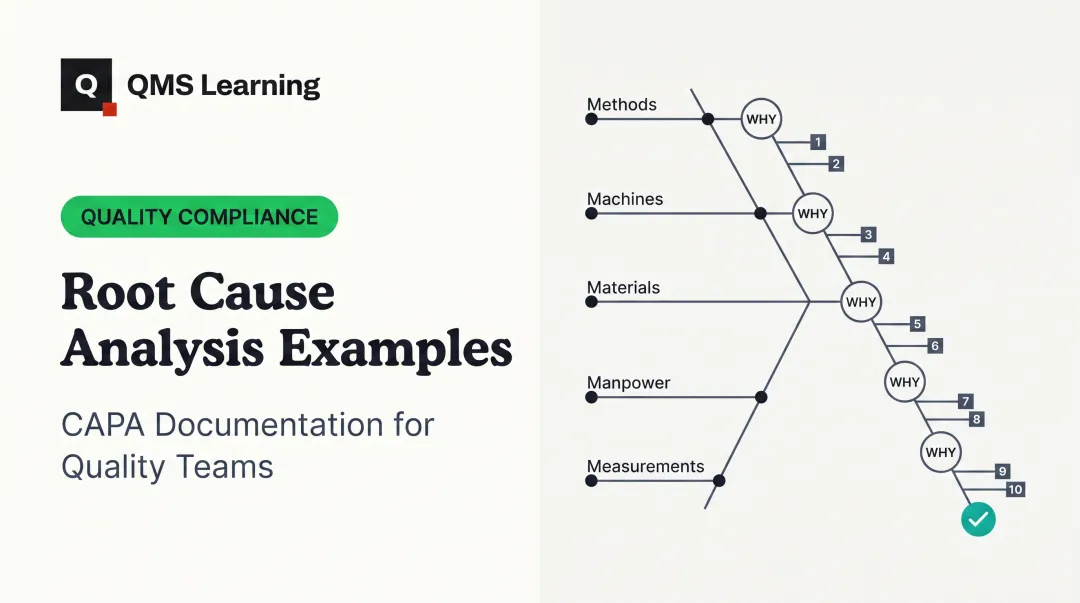
- 5 Whys, Fishbone, FMEA, Fault Tree, and Pareto Analysis are the top RCA methods, each suited to different problems
- Repeat nonconformities and audit findings trace back to weak RCA more than any other CAPA failure
- Data quality, team makeup, method fit, and effectiveness verification determine whether RCA succeeds
What Is Root Cause Analysis in CAPA?
RCA is the structured investigation used to pinpoint the precise underlying cause of a nonconformance — distinct from the symptom that triggered the complaint, deviation, or finding. It's designed to produce a permanent fix, not a reactive patch.
CAPA and RCA get used interchangeably, but they aren't the same thing:
| Term | What It Is |
|---|---|
| RCA | The diagnostic method: the investigative technique used to find why something happened |
| CAPA | The full systematic process (containment, investigation, correction, prevention, and verification) that RCA feeds into |
RCA sits inside both halves of CAPA. Corrective action uses it to fix what already went wrong. Preventive action uses it to catch conditions before they cause a nonconformance at all.
CAPA is mandated under ISO 9001, AS9100D, ISO 13485, and 21 CFR Part 820. RCA is more flexible: ISO's auditing practices guidance states that cause determination must happen before corrective action, but it doesn't lock organizations into one named tool. That means RCA should apply to any significant quality issue, not only after a formal CAPA record gets opened.
That gap between "should apply" and "does apply" is where most audit findings live. RCA is referenced in nearly every quality audit finding and FDA 483 observation, yet it's frequently reduced to a restated problem statement dressed up as an investigation.
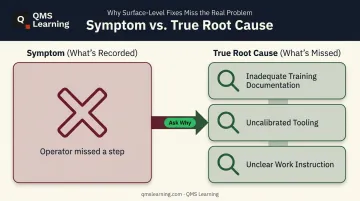
"The operator missed a step" is not a root cause.
It's a symptom with a name attached. It doesn't explain why the instruction wasn't followed, whether training was adequate, or whether the tool was calibrated correctly.
How Root Cause Analysis Works Within the CAPA Process
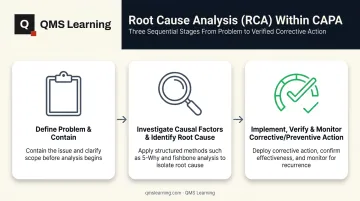
RCA doesn't happen in isolation. It's one stage embedded inside the larger CAPA workflow, typically kicking off only after containment actions are already in place, the stop-the-bleeding fix that keeps a bad process from causing more damage while the real investigation runs.
Before the investigation starts, teams need something to investigate:
- Nonconformance records and internal defect data
- Supplier and complaint records
- Audit findings and prior CAPA history
- SOP and process documentation
With that data in hand, a cross-functional team applies a chosen methodology to trace causal factors back to the actual root cause. Teams need to resist accepting the first plausible explanation, because the first explanation is usually the symptom, not the cause.
To prevent that mistake, the process runs through three checkpoints:
- A documented problem statement, written before anyone jumps to conclusions
- Causal-factor mapping, connecting the symptom to potential contributing causes
- Root cause hypothesis validation against actual evidence, not assumption
Once the root cause is confirmed, everything downstream changes: a validated corrective/preventive action plan, updated procedures or controls, and a Verification of Effectiveness (VOE) checkpoint before the CAPA can close.
That level of rigor only holds up if the right methodology gets chosen in the first place. Where teams go wrong: picking the wrong tool for the problem. Running a 5-Whys analysis on a multi-variable systemic issue produces a tidy-looking answer that's usually incomplete. 5 Whys is a linear technique, and systemic problems rarely have a single causal chain.
This is the exact gap AI-guided method-selection tools like QMS Learning's AI Workbench are built to close. The system reads a plain-language problem description, classifies it as an isolated incident, systemic supplier issue, process gap, or design risk, then recommends the matching method and explains why alternatives were ruled out.
Fed a description like "same defect on three jobs from the same supplier this quarter," the system selects 5-Whys plus Supplier CAPA and skips FMEA. FMEA is built for anticipating failures in new processes, not closing ones that already happened.
That judgment used to require a senior quality manager sitting in on every investigation. Now it's available to whoever opens the ticket first.
Step 1: Define the Problem and Contain It
Before any root cause work begins, teams need a data-backed problem statement (what happened, where, how often, and against what specification) plus immediate containment to stop further nonconforming output. Skipping this step is how RCA turns into guesswork.
Step 2: Investigate Causal Factors and Identify the Root Cause
Teams apply the chosen RCA methodology (5 Whys, Fishbone, FMEA, Fault Tree, or Pareto) to trace symptoms back through causal factors to the true root cause. Every hypothesis gets checked against evidence before it's accepted as correct.
Step 3: Implement, Verify, and Monitor Corrective/Preventive Action
With the root cause confirmed, teams design corrective and preventive actions, implement the changes, and monitor results through a VOE check. The CAPA doesn't close until the data shows the cause is actually gone, not just that tasks got completed on schedule.
Key Factors That Affect Root Cause Analysis Quality in CAPA
RCA quality isn't random. It tracks predictably with a handful of variables:
- Data quality and completeness: Incomplete nonconformance records or missing supplier and complaint data lead to shallow, sometimes wrong, root cause conclusions
- Methodology fit: Whether the team picks 5 Whys, Fishbone, FMEA, Fault Tree, or Pareto based on the actual nature and complexity of the problem, not habit
- Team composition: Cross-functional experts beat a quality department working alone; engineering, production, and quality each see a different piece of the problem
- Time and sequencing: Skipping the upfront problem-definition step and jumping straight to "root cause" usually just produces a restated symptom in different words
- Regulatory and documentation constraints: RCA evidence often needs to live in a controlled document system for audit traceability, not scattered across email threads
- Team capability and consistency: Whether junior engineers have the diagnostic judgment to pick and run the right method, or every investigation escalates to a senior manager by default
Where Most Organizations Fall Short
That last point is the one most organizations underestimate. Most quality staff can define 5-Why, FMEA, and Fishbone without hesitation. Knowing which one to reach for when a nonconformance lands on your desk Monday morning, with the auditor arriving Friday, is the harder skill.
Classroom training builds knowledge of methods. It rarely builds the judgment to apply them under pressure. QMS Learning's AI Workbench targets that exact gap, recommending the right method for each situation so newer engineers can make confident calls that used to require years of floor experience.
Common Pitfalls, Misconceptions, and When RCA Alone Isn't Enough
The biggest misconception: RCA and CAPA are the same thing. They're not. RCA is one investigative component feeding into the broader CAPA system — treating them as interchangeable is how organizations end up with a "root cause" that's really just a closed ticket.
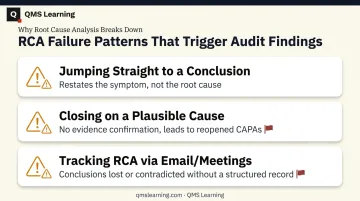
Other recurring failure patterns:
- Jumping straight to a conclusion. Skipping proper problem definition almost always produces a restated symptom, not a true cause
- Closing on a "plausible" cause. A reasonable-sounding explanation isn't evidence-confirmed. This is how CAPAs get reopened and nonconformities resurface at audit
- Tracking RCA through email and meetings. Without a structured evidence system, conclusions get lost, contradicted, or reconstructed from memory when someone later asks for proof
RCA can also be overkill. A minor, isolated deviation with an obvious, single-variable cause (a mislabeled bin, a one-time transcription error) doesn't need a full Fishbone workshop. A documented correction and a note-to-file is proportionate and defensible.
Running a formal 5-Whys exercise on every trivial issue just to satisfy a procedural checkbox burns team time. Worse, it trains people to treat RCA as theater instead of a real diagnostic tool.
Historically, this is where regulators have focused attention. FDA's FY2017 inspection data showed CAPA-related observations making up roughly a third of all Part 820 citations that year: a signal that "we did an RCA" and "we found the actual cause" are frequently two different things.
Conclusion
RCA is the diagnostic engine inside CAPA. Its entire job is finding the true cause of a nonconformance so the corrective and preventive actions that follow are permanent, not reactive patches that wear off in a quarter.
That distinction matters most in regulated industries, where RCA quality isn't a soft metric. It shows up directly in audit outcomes, repeat-finding rates, and how mature your QMS actually is versus how mature it looks on paper.
Getting RCA right (the right methodology, data, team, and documentation) matters more than simply completing the step and moving on. Building that diagnostic judgment across an entire team, not just the senior manager everyone escalates to, is what actually stops nonconformities from coming back. QMS Learning's AI Workbench closes that exact gap, giving every engineer the same method-selection judgment.
Frequently Asked Questions
What is root cause analysis in CAPA?
RCA is the investigative step within CAPA that identifies the underlying cause of a nonconformance, rather than just its symptom. It exists to support corrective and preventive action that actually prevents recurrence.
What are the 7 steps of CAPA?
Under FDA's CAPA basics guidance, the historical framework included seven elements: analyzing quality data, investigating causes, identifying actions, verifying effectiveness, implementing changes, communicating findings, and reporting to management review.
What are the 5 Whys in CAPA?
The 5 Whys is an iterative questioning technique used inside RCA. It asks "why" repeatedly to move past the first, surface-level explanation and reach a cause that, once fixed, stops the problem from recurring.
What is the difference between root cause analysis and CAPA?
RCA is a diagnostic method used to find the cause of a problem. CAPA is the full systematic process (containment, investigation, correction, prevention, and verification) that RCA feeds into.
Is root cause analysis required for every CAPA?
Every formal CAPA requires cause determination before corrective action is finalized. Organizations should also apply RCA proactively to significant issues before a formal CAPA even gets opened.
Which RCA method should I use for a CAPA investigation?
It depends on complexity. Simple, single-variable issues often suit 5 Whys. Multi-variable or systemic problems usually need Fishbone, FMEA, or Fault Tree Analysis instead.