Many manufacturers assume ISO 9001 already covers this. Others assume ISO 13485 means building a full device-maker quality system, complete with design controls and post-market surveillance, none of which applies to a contract machinist.
Neither assumption holds up. This guide breaks down what ISO 13485 actually requires for manufacturers and machining suppliers, whether certification is genuinely necessary, and how to build the capability without stopping production.
Key Takeaways
- ISO 13485 covers the full medical device supply chain, including machining and component suppliers, not just finished-device OEMs
- Certification is technically voluntary, but OEM purchase orders and quality clauses often make it a functional requirement
- Shops without design authority can document design and development (clause 7.3) as excluded
- FDA's QMSR folds ISO 13485:2016 into 21 CFR Part 820, effective February 2026
- Process validation (IQ/OQ/PQ) is usually the biggest gap for shops moving over from ISO 9001
What Is ISO 13485, and Why Are Manufacturers Being Asked for It?
ISO 13485 is the international quality management standard covering design, production, installation, and servicing of medical devices. It's easy to assume it only applies to companies that stamp their name on a finished device. It doesn't.
The standard's own scope language extends to suppliers and external parties providing raw materials, components, and services to device makers. Contract machinists and component suppliers fall squarely inside its intended audience, not on the sidelines.
The FDA's QMSR Raises the Stakes
In the US, this matters more than it used to. The FDA's Quality Management System Regulation (QMSR), effective February 2, 2026, incorporates ISO 13485:2016 directly into 21 CFR Part 820.
Component manufacturers generally sit outside direct QMSR applicability. Finished-device OEMs, though, must apply documented, risk-informed controls to their suppliers, so scrutiny on machining vendors is rising.
Built-In Scope Flexibility
Here's the part most machinists miss: ISO 13485 doesn't force every organization into every clause. A shop that builds strictly to a customer's print, with no design authority, can typically document clauses like 7.3 (design and development) as excluded or not applicable. That single distinction narrows the entire certification scope for a contract manufacturer.
Who's Actually Driving This Down to the Shop Floor
The pressure rarely comes from a regulator. It comes from the customer. OEMs and Tier 1 device makers are pushing ISO 13485, or specific clause compliance, into their approved supplier list criteria.
Stryker, for example, publicly describes risk-assessing and qualifying suppliers before approval. Quality agreements can include applicable standards, certification requirements, and audit acceptance.
That flow-down shows up as:
- New quality clauses on purchase orders referencing ISO 13485 or specific clauses
- Supplier questionnaires asking whether your QMS addresses traceability, validation, or CAPA
- Contract renewals that require you to hold or work toward certification
None of this means you need to rebuild your quality system from scratch. It means you need to understand exactly which pieces apply to you.
Do You Need ISO 13485 to Manufacture Medical Devices?
Short answer: no law requires it. Longer answer: most medical device market access and OEM relationships require it in practice.
Certification vs. Contractual Compliance
That practical pressure is why shop owners often confuse two different things: holding an ISO 13485 certificate versus meeting quality clauses flowed down through a purchase order.
Many machinists already supply medical device programs as approved, audited suppliers without their own certificate. The customer's quality agreement sets the bar—traceability, material certs, change notification—and the customer audits those requirements directly.
Risk-Based Scoping Works in Your Favor
Because contract machinists typically produce components without design authority, they can often exclude clause 7.3 (design and development) entirely. That single exclusion:
- Removes design history file requirements
- Removes design verification and validation obligations
- Narrows the audit scope to production, traceability, and process controls
This is why a machine shop's path to ISO 13485 usually looks lighter than a finished-device manufacturer's, even though both hold the same certificate.
When Certification Becomes Non-Negotiable
Certification stops being optional in a few specific scenarios:
- The RFQ explicitly mandates it. Some OEMs won't qualify a new supplier without a current certificate on file.
- You're involved in device assembly or sterilization. Once you move past component machining into assembly-level work, your regulatory footprint changes.
- You're expanding internationally. Canada requires Medical Device Single Audit Program evidence from legal manufacturers of Class II-IV devices, and the EU's MDR and Australia's TGA each carry their own conformity requirements that can effectively require certified suppliers.
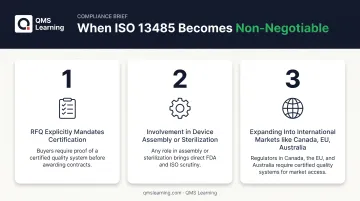
Device companies increasingly expect their supply chain to hold ISO 13485, even when the law does not require it.
If your growth plan includes more medical OEM accounts—or regulated export markets—certification becomes a competitive requirement well before it becomes a legal one.
ISO 13485 vs. ISO 9001: What Changes When You Add Medical Device Work
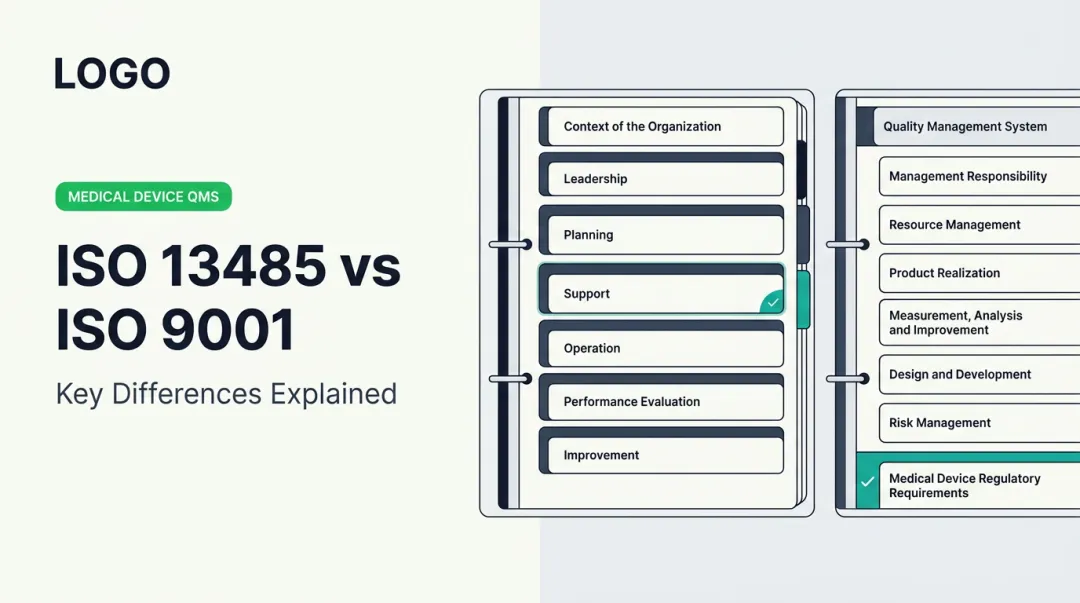
If your shop already runs ISO 9001, you have a head start. But the two standards aim at different things. ISO 9001 is broad and continual-improvement focused, built to work across any industry. ISO 13485 is risk-based, traceability-driven, and built around regulatory compliance and repeatable output.
According to BSI's comparison of the two standards, ISO 9001 centers on customer satisfaction and continual improvement, while ISO 13485 centers on device safety, regulatory conformance, and sustained QMS effectiveness.
| Area | ISO 9001 | ISO 13485 |
|---|---|---|
| Primary driver | Customer satisfaction | Device safety and regulatory conformance |
| Documentation | Organization decides what's needed | Quality manual and specific procedures are mandatory |
| Improvement | Open-ended continual improvement | Maintaining QMS suitability and effectiveness |
| Traceability | Not typically required | Lot/serial traceability often mandatory |
| Process validation | Rarely formalized | Required wherever output can't be fully verified by inspection |
What Actually Changes for a Machinist
On the floor and in the QMS, moving from ISO 9001 to ISO 13485 typically means:
- Building out mandatory quality manual content instead of a flexible one
- Adding lot and device traceability to manufacturing records
- Formalizing cleanliness and contamination control documentation
- Tightening document retention periods well past typical ISO 9001 practice
The tradeoff is flexibility. ISO 13485 dials back ISO 9001's emphasis on open-ended improvement in favor of consistency and auditability. You gain rigor, but you lose some room to interpret how you meet a requirement.
Key ISO 13485 Requirements Manufacturers & Machinists Must Satisfy
Once scope is defined, six areas make up the bulk of what a machining supplier actually has to build out.
Document Control and the Quality Manual
Version control, controlled distribution, and defined retention periods apply to every manufacturing and inspection record. Retention periods under ISO 13485 typically run longer than what most ISO 9001 shops practice today, and auditors will check that your system enforces this, not just states it.
Traceability and Identification
Machined components destined for implantable or non-implantable devices need:
- Lot or serial traceability tied to raw material heat/lot numbers
- Material certifications retained and linked to the finished part
- Handling and cleanliness documentation from receipt through shipment
Purchasing and Supplier Controls
Getting onto an OEM's approved supplier list means demonstrating:
- Documented qualification criteria
- Incoming inspection procedures backed by objective evidence
- Supplier agreements that define change-notification responsibilities
Process Validation
This is the requirement that catches the most ISO 9001 shops off guard. Certain CNC processes, passivation, and cleaning operations can't be fully verified by inspection alone—the output has to be validated instead.
Per GHTF/IMDRF process validation guidance, you need documented IQ, OQ, and PQ evidence showing:
- Installation conforms to specification (IQ)
- Process parameters stay within control limits (OQ)
- Output consistently meets requirements under real production conditions (PQ)
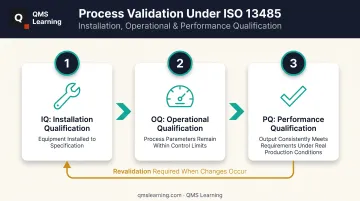
Any change to the process, equipment, or personnel triggers a documented revalidation decision.
Nonconforming Product and CAPA
ISO 13485 expects tighter documentation, root cause analysis, and timeline discipline than typical ISO 9001 shop-floor nonconformance handling. A verbal fix and a closed work order won't satisfy an auditor here.
Internal Audit and Management Review
Audit frequency and depth should map to the risk level of each process area. A process with formal validation requirements, like passivation, warrants deeper and more frequent internal audits than a low-risk secondary operation.
Common ISO 13485 Mistakes Manufacturers Make
Most audit findings against machining suppliers trace back to a handful of repeat issues.
- Treating it like ISO 9001 with extra paperwork. ISO 13485 is risk-based and device-specific. The mismatch usually shows up first in process validation and traceability—areas ISO 9001 shops rarely formalize.
- Poorly documented clause exclusions. Excluding design and development (7.3) is valid for most machinists, but the justification must be explicit. Vague or missing exclusion language gives auditors an easy opening.
- Weak purchasing and supplier controls. Material certifications get filed but not linked to work orders. Supplier performance isn't tracked, and the approved list isn't maintained on a set schedule.
- Inconsistent CAPA execution. Teams have a procedure, but staff haven't practiced it under pressure. Root cause stops at "operator error," and the same nonconformity returns two quarters later.
That last one is worth sitting with. A written procedure proves you know what root cause analysis should look like—not that your team can do it when a real nonconformity hits mid-shift with a customer waiting on parts.
Building Audit-Ready ISO 13485 Capability Without Slowing Production
Certification success depends on team capability, not just written procedures. Shop floor staff, quality engineers, and managers all need practiced judgment for process validation, traceability, and root cause work—the kind of judgment a procedure manual can describe but can't install on its own.
QMS Learning was built to close that gap. The platform pairs role-specific training with an AI Workbench that helps teams:
- Diagnose nonconformities and select the right method (5-Why, CAPA, FMEA, gap analysis)
- Generate audit-ready documentation without pulling senior staff off the floor
- Build the same capability many machinists already develop through the General Manufacturing pathway (ISO 9001)
For shops moving into medical device work, the Medical Device & Life Sciences QMS pathway opens as a pilot cohort in Q3 2026, covering ISO 13485, FDA 21 CFR Part 820, and ISO 14971. It is scoped to the transition described in this guide: what actually applies to a component supplier, not a full device-maker system.
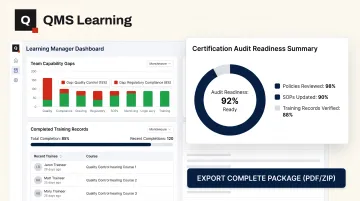
The Manager Dashboard tracks capability gaps across a team and exports evidence ahead of a certification audit: training records, completed scenarios, and generated documentation compiled into a single package instead of assembled by hand the week before an auditor arrives.
A Practical First Step
You do not need a full platform rollout to start. Before investing time and budget into certification prep, run an internal gap analysis mapping your current ISO 9001 QMS against ISO 13485 clauses. This tells you:
- Which clauses you already satisfy through existing ISO 9001 practices
- Which clauses need new procedures built from scratch (process validation is the usual gap)
- Which clauses you can justify excluding based on your actual scope of work
Done honestly, that gap analysis usually takes less time than shops expect. It also stops you from building requirements that never applied to a contract machinist in the first place.
Frequently Asked Questions
Do you need ISO 13485 to manufacture medical devices?
No law requires certification, but most OEMs expect it in practice. The requirement typically arrives through a purchase order's quality clause rather than through direct regulation.
What are common ISO 13485 mistakes?
The top mistakes are treating the standard like ISO 9001 with more paperwork, poorly documenting clause exclusions, and weak supplier or CAPA evidence. Most audit findings trace back to one of these three.
What is the primary difference between ISO 13485 and ISO 9001?
ISO 9001 is broad, industry-agnostic, and centered on customer satisfaction and continual improvement. ISO 13485 is risk-based and centered on device safety, traceability, and regulatory conformance.
Can a machine shop get ISO 13485 certified without doing product design?
Yes. Design and development requirements (clause 7.3) can typically be documented as excluded when a shop builds strictly to a customer's print, which narrows certification scope considerably.
How long does ISO 13485 certification take for a manufacturer?
Timelines depend on QMS maturity, company size, and audit readiness. Shops starting from an existing ISO 9001 system move faster; those starting from scratch can take well over a year.
Does ISO 13485 replace ISO 9001 once a manufacturer is certified?
No. ISO 13485 builds on ISO 9001's foundation and adds device-specific requirements, so certified manufacturers typically maintain both frameworks rather than retiring one.