DMAIC is one of the most cited quality frameworks in existence, yet many teams treat it as a five-letter acronym rather than an operational discipline. Only 31% of quality professionals say they fully understand how quality costs affect financial performance, according to ASQ's 2025 cost-of-quality study. That gap shows up on the shop floor as repeat nonconformities.
This article breaks down how DMAIC actually works, phase by phase, where it applies, what determines whether it succeeds, and when it's the wrong tool for the job.
Key Takeaways
- DMAIC moves through five gated phases: Define, Measure, Analyze, Improve, Control.
- DMAIC is built for processes that already exist and underperform, not for designing something new.
- Skipping root cause verification in Analyze is the most common reason DMAIC projects fail.
- Regulated industries lean on DMAIC because it creates a defensible, dated evidence trail for auditors.
- Not every problem needs full DMAIC rigor; simple, obvious fixes are often better solved with a quick 5-Why.
What Is the DMAIC Process?
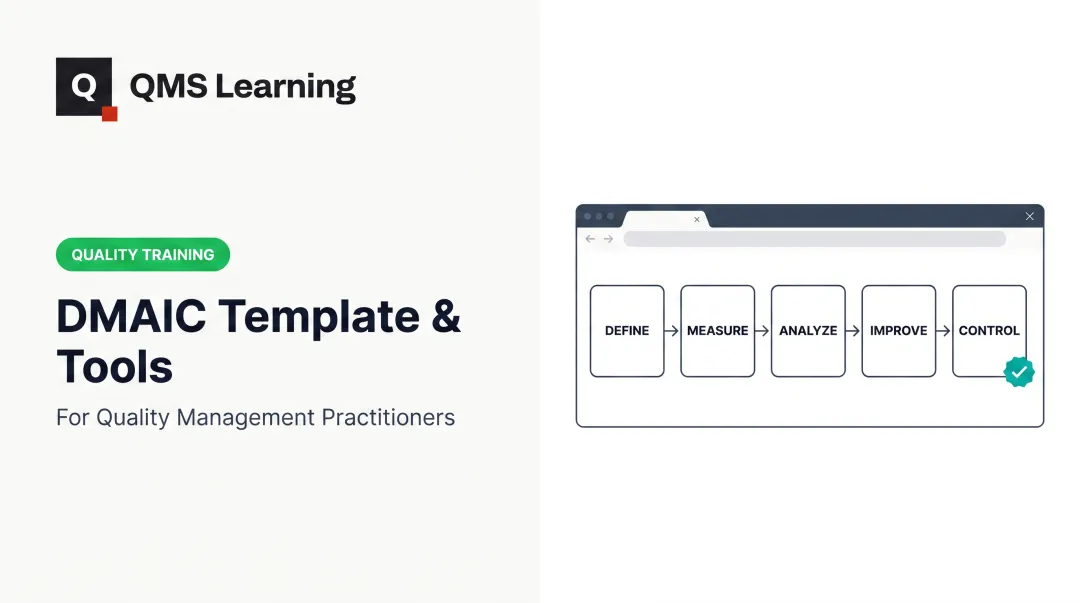
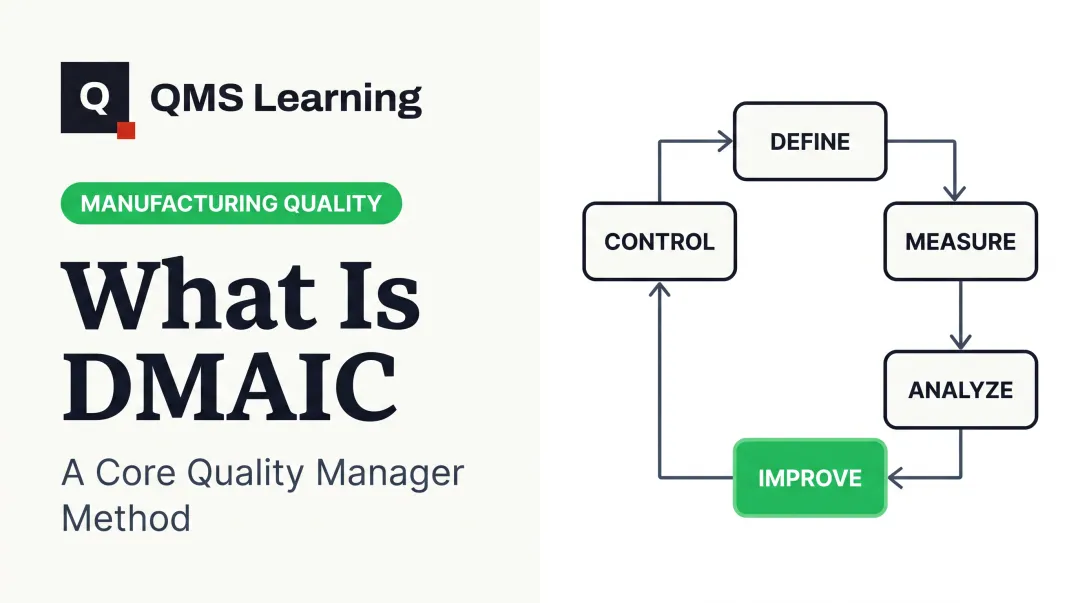
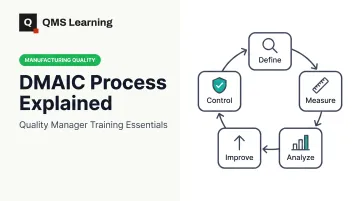
DMAIC (Define, Measure, Analyze, Improve, Control) is a structured, closed-loop improvement methodology. Teams use this data-driven sequence to eliminate verified root causes of defects or variation inside an existing process.
DMAIC is built to deliver three lasting outcomes:
- A verified root cause, not an assumed one
- An implemented fix tested before full rollout
- A controlled process that holds the gain over time
That last point separates DMAIC from a one-off correction. A fix that isn't monitored tends to drift back to the old failure pattern within a few months.
How DMAIC Differs From DMADV and PDCA
DMAIC is easy to confuse with neighboring frameworks. The scope is different:
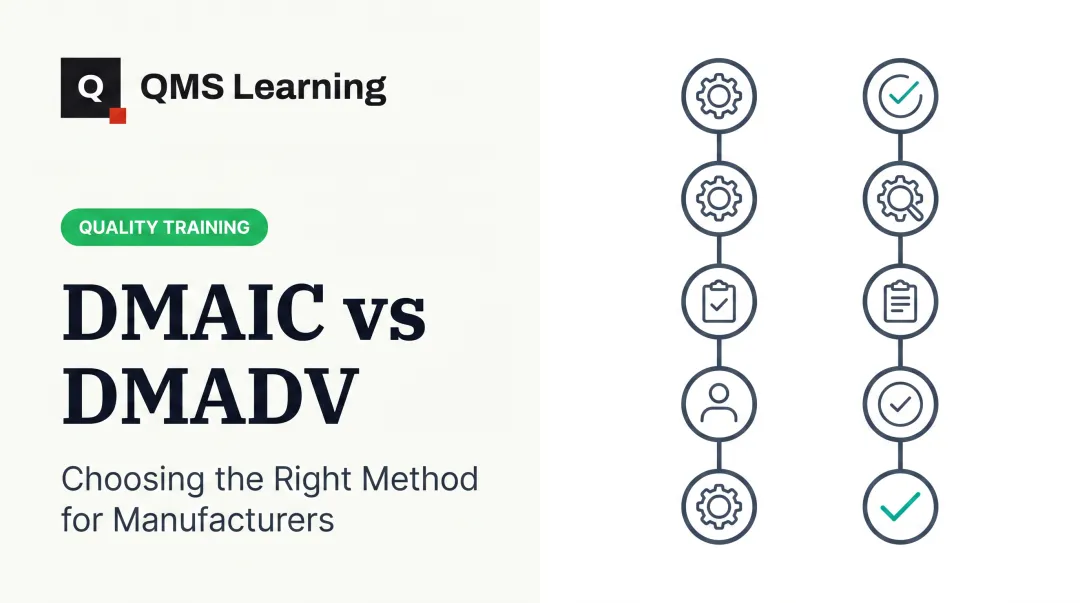
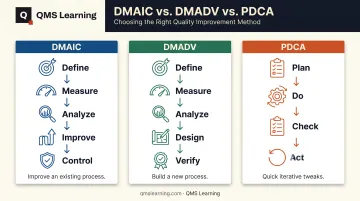
- DMADV (Define, Measure, Analyze, Design, Verify) builds new processes or products from scratch. If nothing exists yet, DMADV is the right tool, not DMAIC.
- PDCA (Plan, Do, Check, Act) is a lighter, faster cycle suited to stable processes needing small, iterative tweaks.
- DMAIC is reserved for complex or recurring problems where the root cause isn't obvious and the process already exists.
Why the DMAIC Process Is Used in Quality and Compliance-Driven Industries
Regulated manufacturers, aerospace suppliers, and medical device companies adopt DMAIC because it produces a documented, defensible root cause trail. When a nonconformity closes, auditors want evidence that the team investigated the actual cause, not just the most convenient explanation.
The financial case backs this up. In a 2017 McKinsey analysis of industrial manufacturers, one facility cut its combined cost of nonquality—warranty, waste, and rework—by roughly 30% after applying structured quality methods. A biopharma facility in the same study reduced product deviations by more than 50% and waste by 75%.
These industries demand three things DMAIC is built to deliver:
- Consistency across shifts, lines, and sites
- Traceable evidence of root cause investigation, dated and attributable
- Statistically valid decisions, not opinion-based fixes from whoever's loudest in the room
What Goes Wrong Without It
Skip the rigor, and teams implement corrective actions that treat symptoms. The nonconformity resurfaces a few months later. Auditors flag it as a repeat finding, and the CAPA gets reopened.
No ISO 9001 or AS9100 clause names "DMAIC" outright. But its logic mirrors exactly what auditors expect from root cause and CAPA clauses, which is why it's become a de facto best practice even without being written into the standard.
The harder problem for most teams isn't running DMAIC once they've chosen it. It's knowing whether DMAIC, 5-Why, or FMEA fits the problem in front of them—and a wrong pick is another path to repeat findings.
A Method Router approach closes that gap. QMS Learning's AI Workbench diagnoses the compliance problem type (systemic supplier issue, isolated incident, or design gap), recommends the right methodology, and generates the matching artifact.
That guided selection removes guesswork for a junior engineer on a first recurring nonconformity. It also spares senior quality managers from re-explaining the same decision tree for the tenth time.
How the DMAIC Process Works
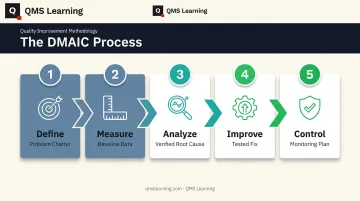
DMAIC moves an ill-defined problem through five sequential, gated phases, where each phase's output becomes the input for the next. Skip a step or rush it, and everything downstream inherits the weakness.
What goes in:
- A scoped problem statement
- Real process and customer data
- A cross-functional team with hands-on knowledge of how the work actually happens (not just how it's documented)
What comes out:
- Measurable variation and defect rates go down
- New performance locked in through monitored controls, not hope
Define
The team clarifies the problem statement, project goals, and customer requirements, then builds a project charter and a high-level process map. The output here is a scoped, agreed-upon problem, not a vague complaint like "quality is inconsistent."
The most common mistake in Define is scoping too broadly, or setting a goal with no measurable target. A charter that says "improve delivery performance" gives the team nothing to aim at. A charter that says "reduce late shipments from 12% to under 3% within one quarter" does.
Measure
Here, the team identifies key metrics, validates the measurement system, and collects baseline data to quantify how big the problem actually is before anyone touches the process.
This matters in regulated settings. Measure produces objective, dated evidence of current performance, exactly what auditors expect to see sitting behind any CAPA. Without a validated baseline, every claim of improvement later in the project is unprovable.
Analyze
The team uses tools like fishbone diagrams, 5-Whys, or Pareto analysis to test and verify root cause hypotheses, not just brainstorm them.
Skipping verification here is the single most common DMAIC failure point. Teams "fix" a cause that feels right but was never confirmed with data, and the entire improvement cycle gets wasted chasing the wrong problem.
Improve
The team brainstorms, pilots, and selects the solution that addresses the verified root cause, then implements it at scale.
Solutions get tested small first:
- Confirm the fix produces measurable improvement
- Check it doesn't introduce new problems elsewhere in the process
- Scale up only after the pilot data holds
Control
The team builds a monitoring plan, control charts, and standard work or SOPs to hold the gain, plus a response plan for if performance slips.
This phase produces the documentation trail auditors look for. Teams working from a controlled document and revision system, rather than scattered spreadsheets and email attachments, can pull that evidence together far faster than teams hunting through shared drives.
QMS Learning's Controlled Document Management System keeps SOPs, CAPA records, and revision history linked to the applicable standard clause, with an append-only audit trail. The Control-phase evidence package is ready when an auditor asks, instead of being assembled from scratch.
Where DMAIC Is Applied and Key Factors That Affect It
Where DMAIC Is Applied
DMAIC applies wherever a process already exists and is underperforming in a measurable way:
- Production lines and assembly operations
- Transactional and back-office workflows
- Service delivery and customer support
- Supply chain and logistics
- Administrative processes, like permit approval or invoicing
It typically enters at post-production, steady-state operations, not during initial process design. Common triggers include:
- Chronic defect rates that won't budge
- Missed SLAs or spikes in customer complaints
- Repeat audit findings and CAPA investigations
- Leadership directives tied to a cost-of-quality target
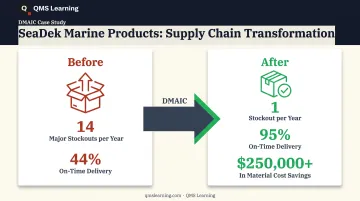
For example, SeaDek Marine Products applied Six Sigma and DMAIC to its supply chain and cut major stockouts from 14 in a single year down to one, saved more than $250,000 in material cost, and raised on-time delivery from 44% to 95%.
Most DMAIC projects stay bounded—weeks to months—while the Control plan keeps running long after the project closes.
Key Factors That Affect DMAIC Outcomes
A handful of variables determine whether a DMAIC project produces lasting results or stalls halfway through:
- Data quality — fails without reliable baseline data to measure against
- Process stability — unstable processes often need stabilizing before Analyze tools yield useful conclusions
- Measurement system validation — unvalidated gauges or reports make the baseline untrustworthy
- Project scope — meaningful, manageable problems move; overly broad ones stall
- Regulatory constraints — in compliance-driven industries, root-cause findings often must be traceable and exportable for registrars
Common Misconceptions and When DMAIC May Not Be the Right Fit
DMAIC gets misunderstood in a few consistent ways.
Misconception 1: It's only for manufacturing or Six Sigma programs. It applies to any process with a measurable, unclear-cause problem, including service, healthcare, and administrative functions.
Misconception 2: Completing the five phases guarantees success. Teams sometimes treat DMAIC as a checklist rather than a discipline for verifying root cause before acting. That mindset leads straight back to recurring nonconformities.
Control-phase discipline often gets dropped once a project formally "closes," even though Control exists to hold the gain indefinitely.
DMAIC isn't the right tool when:
- You're designing a brand-new process or product (use DMADV)
- The fix is already known and obvious
- It's a one-time incident, not a systemic issue
- No usable data exists to measure against
A clear warning sign is full DMAIC rigor on a simple problem a quick 5-Why or PDCA cycle would finish in an afternoon. That wastes time and weakens the framework's credibility for the problems that actually need it.
Know the phases and the limits. That judgment keeps gains from slipping and stops the same investigation from coming back every year.
Frequently Asked Questions
What are the 5 stages of the DMAIC process?
The five stages are Define, Measure, Analyze, Improve, and Control. Each phase's output becomes the next phase's input, so skipping or rushing one weakens everything after it.
What is the DMAIC process in Six Sigma with an example?
A manufacturer with high scrap rates would define the defect and its cost, measure the current scrap percentage, analyze the process for root cause, improve by piloting a fix, then control it with monitoring charts.
Is Six Sigma the same as the DMAIC process?
No. Six Sigma is the broader defect-reduction methodology and initiative. DMAIC is the core five-phase problem-solving framework used within Six Sigma to execute individual improvement projects.
What is the difference between DMAIC and DMADV?
DMAIC improves an existing process that's underperforming. DMADV, Define, Measure, Analyze, Design, Verify, is used to design a new process or product from scratch, or to fundamentally redesign one that's broken beyond incremental fixes.
How long does a typical DMAIC project take?
Timelines vary widely based on data quality and complexity, ranging from a few focused weeks to several months. The Measure phase often takes the longest, since baseline data collection depends heavily on what's already available.
What tools are most commonly used in each DMAIC phase?
Define uses project charters and SIPOC diagrams; Measure uses process maps and data-collection plans; Analyze uses fishbone diagrams and 5-Whys; Improve uses pilot testing; and Control uses control charts and SOPs.