Introduction
Ask ten suppliers to explain the difference between ISO 9001 and AS9100, and you'll get ten different answers. Most are wrong in some way.
That confusion carries a real cost. ISO 9001 and AS9100 are the two most-requested quality certifications across manufacturing supply chains today, yet plenty of suppliers pursue the wrong one, fail an audit because they misjudged the scope, or lose an aerospace bid entirely.
ISO 9001 is the universal standard almost every industry recognizes. AS9100 builds directly on top of it, adding aerospace and defense-specific requirements that primes like Boeing and Lockheed Martin expect their suppliers to meet. One is a broad baseline; the other is the specialized extension aerospace primes require.
Picking wrong isn't cheap. A general manufacturer chasing AS9100 unnecessarily burns budget on requirements it will never use. An aerospace supplier settling for ISO 9001 alone will get disqualified from the bids that matter most.
This guide breaks down exactly where the two standards diverge, and how to know which one your business actually needs.
TL;DR
- ISO 9001 is the industry-agnostic QMS baseline; AS9100 layers 100+ aerospace-specific requirements on top of it.
- AS9100 fully contains ISO 9001: holding both certificates separately is rarely necessary.
- The real differentiators: product safety, counterfeit parts prevention, configuration management, and first article inspection (FAI).
- Supply chain position decides it: aerospace/defense suppliers need AS9100; most others need ISO 9001.
- Passing either audit hinges on consistent, audit-ready evidence, not documents that only look right on paper.
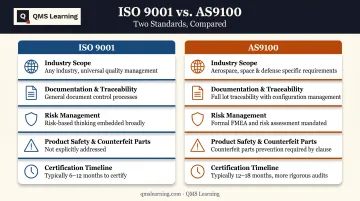
AS9100 vs ISO 9001: Quick Comparison
The fastest way to see how these standards diverge is side by side.
| Category | ISO 9001 | AS9100 |
|---|---|---|
| Industry scope | Universal — any industry, any organization | Aerospace, aviation, and defense only, managed by the IAQG |
| Documentation & traceability | Flexible — organization decides depth | Prescriptive — full traceability, configuration management, and FAI records required |
| Risk management | General risk-based thinking across the QMS | Structured, owned process (e.g., FMEA) tied directly to product safety |
| Product safety & counterfeit parts | No dedicated clause | Mandatory documented process for safety risk and counterfeit/suspect part prevention |
| Certification timeline | Requires a documented operating history before the initial audit | Same minimum, plus added prep time for aerospace-specific clauses |
Cost and Timeline Reality
Neither standard has a fixed price tag — certification bodies quote based on your organization's size, scope, and site count, not a published rate card.
Most accredited bodies still require your QMS to be fully operational for at least three months, complete with a management review and internal audit cycle, before the initial two-stage audit can begin.
AS9100 stretches that timeline further if you're starting without an existing quality system. You must build configuration management, counterfeit parts controls, and FAI records from scratch, then prove they've been running long enough to generate real evidence.
What is ISO 9001?
ISO 9001:2015 is the globally recognized quality management system (QMS) standard published by the International Organization for Standardization. It's industry-agnostic by design — a bakery, a machine shop, and a software company can all certify against it.
The standard doesn't tell you how to run your business. It tells you to prove your processes are consistent, your risks are managed, and your customers stay satisfied. That flexibility is the point.
ISO 9001 also serves as the foundation for nearly every sector-specific derivative that exists, including:
- AS9100 (aerospace, aviation, defense)
- ISO 13485 (medical devices)
- IATF 16949 (automotive)
Each of these adds industry-specific requirements on top of the same ISO 9001 core — meaning if you understand ISO 9001, you already understand most of what any derivative standard requires.
Use Cases of ISO 9001
ISO 9001 shows up wherever a customer wants proof of consistent quality without industry-specific overhead. Common triggers include:
- Supplier qualification requirements from OEMs or larger manufacturers
- Government contract bidding where a QMS certificate is a prerequisite
- Customer-driven quality audits and vendor scorecards
It's the default expectation across injection molding, machining, fabrication, assembly, packaging, and consumer goods manufacturing. Those shops usually need practical depth in internal auditing, CAPA, and management review—skills QMS Learning covers in its General Manufacturing Quality pathway for single- and multi-site ISO 9001 teams.
The payoff is measurable. According to BSI's ISO 9001 certification data, 60% of certified organizations report a reduction in errors, while 66% report improved products and services and 65% report increased customer trust.
What is AS9100?
AS9100, currently in its AS9100D revision, is the IAQG-managed aerospace, aviation, and defense extension of ISO 9001. It doesn't replace the ISO 9001 clauses; it wraps around them.
Certification is the entry ticket into aerospace prime supply chains. Without it, most tier-1 and tier-2 suppliers can't even bid. The added traceability and safety discipline also reduce recall and grounded-fleet risk that ISO 9001 alone was never designed to catch.
The Additional Requirement Areas
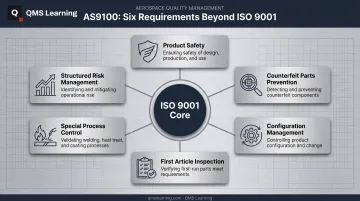
According to Smithers' summary of AS9100 requirements, AS9100D builds on ISO 9001:2015 with over 100 aerospace-specific requirements, concentrated in a handful of areas:
- Product safety — risk assessment tied to safety-critical parts
- Counterfeit parts prevention — detection, supplier control, and receiving inspection
- Configuration management — control of part revisions and design changes
- First article inspection (FAI) — verified proof that first production units meet spec
- Special process control — welding, heat treating, and other processes that can't be inspected after the fact
- Structured risk management — FMEA-style analysis run as an operational process, not a checkbox
Two related standards round out the family: AS9110 for MRO and repair stations, and AS9120 for aerospace parts distributors.
A successor standard, called IA9100, is in development to align with the upcoming ISO 9001:2026 revision. SAE still lists it as work in progress, with no confirmed release date or transition window yet.
Use Cases of AS9100
AS9100 is mandatory for anyone selling directly to primes like Boeing, Lockheed Martin, or Airbus, and it flows down through tier-1, tier-2, and tier-3 suppliers alike. It dominates in:
- Structural component manufacturers
- Machine shops supplying prime contractors
- Defense contractors operating under ITAR
Prime contractors don't leave this to interpretation. Lockheed Martin's supplier quality requirements name AS9100 directly for external providers doing design, development, or manufacturing work.
Boeing flows down 9100-series certification through its supplier quality program based on the activity being performed.
AS9100 vs ISO 9001: Which Is Right for You?
The decision usually comes down to four factors:
- Customer or contract requirements — does anyone actually ask for AS9100?
- Position in the supply chain — are you tier-1, tier-2, or further removed from a prime?
- Growth plans — are you targeting aerospace work in the next 1-2 years?
- Existing QMS maturity — do you already have a working ISO 9001 system to build on?
Choose ISO 9001 if your customers sit outside aerospace and defense, and a globally recognized quality baseline satisfies their expectations. Most general manufacturers never need anything more.
Choose AS9100 if you sell directly to aerospace or defense primes, or to their qualified suppliers. In that world, it's not optional — it's the price of entry.
Dual certification is rarely necessary. AS9100 already contains every ISO 9001 requirement in full. The one exception: certain contracts — some federal IT procurement vehicles, for example — explicitly demand a standalone ISO 9001 certificate regardless of what else you hold.
Here's the part most suppliers miss: the standard you choose matters less than whether your team can actually produce audit-acceptable evidence when an auditor asks for it. A quality manual full of the right clauses doesn't help if nobody on the floor can generate a compliant FAI record on request.
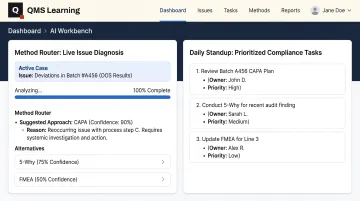
That evidence gap is what QMS Learning's role-specific pathways and AI Workbench are built to close:
- Method Router diagnoses a live compliance problem, selects the right approach (5-Why, CAPA, FMEA, gap analysis), and drafts documentation in the applicable standard's language
- Daily Standup surfaces the day's most urgent compliance tasks before they turn into audit-day scrambles
Real-World Example: Scaling From ISO 9001 to AS9100
S3 AeroDefense, an aerospace and defense manufacturer, is one company in this transition: moving from general quality practices toward the discipline aerospace prime contracts demand.
The challenge is familiar for manufacturers expanding into aerospace. Internal quality staff often know the fundamentals of a quality system but have not built real skill in root cause analysis and structured corrective action under audit conditions.
S3 AeroDefense used QMS Learning's root cause and corrective action training to close that gap. In the company's own words:
"The root cause and corrective action training transformed how our team approaches problem-solving. We now have a structured, disciplined process across our operations."
That shift, from ad hoc troubleshooting to a repeatable process, is what separates teams that pass aerospace audits from teams that stall during them. Configuration management, counterfeit parts control, and FAI documentation are not skills you pick up the week before an audit. They have to be practiced until they are second nature.
For any general manufacturer eyeing aerospace supply chain work, treat the AS9100 gap as a capability-building project, not a documentation exercise.
Explore the Aerospace & Defense Audit-Ready pathway to see how teams build audit-ready capability within 30 days of rollout.
Frequently Asked Questions
What are the key differences between ISO 9001 and AS9100?
AS9100 contains all of ISO 9001 plus aerospace-specific additions: product safety, counterfeit parts prevention, configuration management, and first article inspection. ISO 9001 has none of these dedicated requirements.
Is AS9100 being replaced?
Not yet. AS9100D remains the current standard, but the IAQG is developing a successor expected to align with ISO 9001:2026, with a multi-year transition window once it's released.
How hard is it to get AS9100?
It's more rigorous than ISO 9001 due to added traceability, configuration management, and safety documentation requirements. Organizations without an existing QMS should expect a longer runway than those upgrading from ISO 9001.
Do I need both ISO 9001 and AS9100 certification?
Usually not. AS9100 already meets every ISO 9001 requirement. The exception is when a specific non-aerospace customer or contract explicitly demands a standalone ISO 9001 certificate.
How long does AS9100 certification take?
Both standards require at least three months of documented operating history before the initial audit. Organizations upgrading from an existing ISO 9001 system typically move faster than those building a QMS from scratch.
What's the difference between AS9100, AS9110, and AS9120?
AS9100 covers design and manufacturing organizations. AS9110 covers MRO and repair stations. AS9120 covers aerospace parts distributors. All three are built on the same ISO 9001 foundation.