Getting this comparison wrong is expensive. Pursuing the wrong framework first can mean lost contract eligibility, duplicated audit spend, or missed commercial deals. The stakes are rising fast: the Department of Defense estimated that 8,350 medium and large entities will need Level 2 assessment status, but the Government Accountability Office found only 92 authorized C3PAOs as of December 2025 — a real bottleneck in assessor capacity.
This article breaks down what separates CMMC from ISO 27001, where they overlap, and how to decide which one (or both) your organization actually needs.
Key Takeaways
- CMMC is mandatory for DoD contractors handling FCI or CUI; ISO 27001 is voluntary and used across every industry worldwide
- Prescriptive maturity levels tied to NIST SP 800-171/800-172 define CMMC, while ISO 27001 relies on flexible, risk-based Annex A controls
- Significant control overlap at Levels 1-2 means an existing ISO 27001 ISMS can accelerate, not replace, CMMC certification
- The right choice depends on contractual obligation versus broader market credibility goals, not which standard is harder
- Combined gap analysis and shared evidence management cut duplicate work for teams pursuing both certifications
CMMC vs ISO 27001: Quick Comparison
Here's how the two frameworks stack up side by side.
| Dimension | CMMC 2.0 | ISO/IEC 27001:2022 |
|---|---|---|
| Purpose | Protects FCI and CUI within the DoD supply chain | Builds a risk-based ISMS to protect any sensitive information asset |
| Applies to | Mandatory for specified DoD contractors/subcontractors | Voluntary, often customer-driven, any industry |
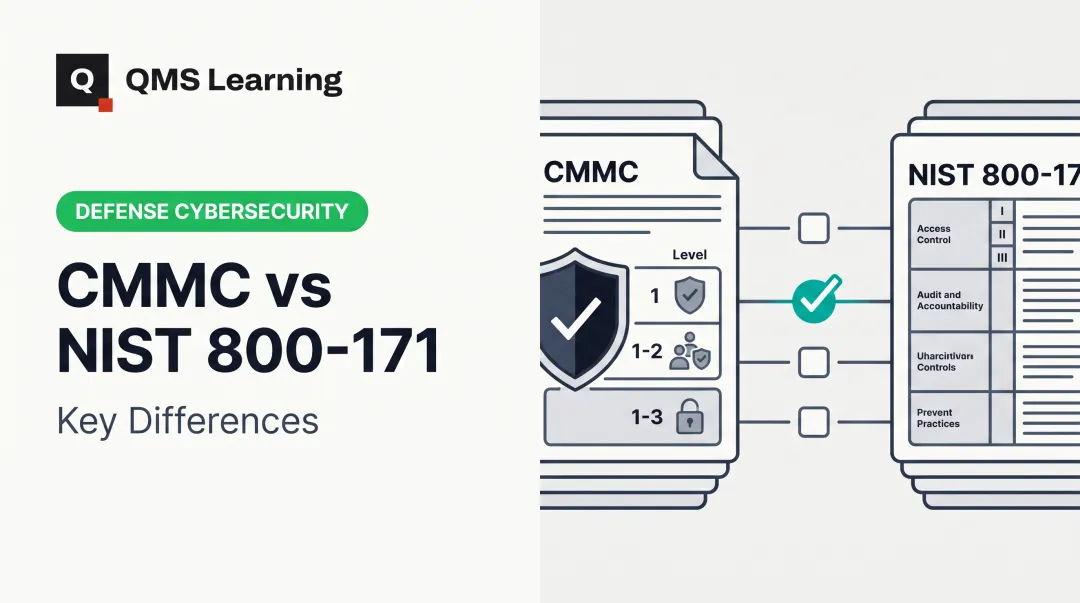
| Structure | 3 maturity levels tied to NIST SP 800-171 and 800-172 | Clauses 4-10 plus 93 optional Annex A controls |
| Assessment | Self-assessment (Level 1), C3PAO audit (Level 2), or DIBCAC review (Level 3) | Stage 1/2 audit by an accredited certification body |
| Cycle | Annual affirmation; assessments every 3 years | 3-year certificate cycle with annual surveillance |
| Recognition | DoD/federal-specific only | Globally recognized across industries |
On cost: DoD's own regulatory model puts a triennial Level 2 C3PAO assessment at $104,670 to $117,700, including an assumed $50,000 assessor fee, excluding remediation work.
On timeline: Coalfire Federal reports most contractors need 12 to 24 months from start to certification, though the actual assessment window can run as short as 2-6 weeks once you're ready.
ISO 27001 pricing varies more by scope — expect separate line items for consulting, the audit itself, and annual surveillance fees, with total preparation typically taking anywhere from 3 months to a year.
In July 2026, the Department of War suspended CMMC Phase II requirements originally scheduled for that November, pending a 60-day review. If you're planning your timeline, confirm the current enforcement status before locking in dates.
What Is CMMC?
CMMC 2.0 is the DoD's certification program for verifying that contractors and subcontractors actually protect Federal Contract Information and Controlled Unclassified Information. It exists because nation-state actors have repeatedly targeted the defense supply chain, and self-reported security claims weren't cutting it anymore.
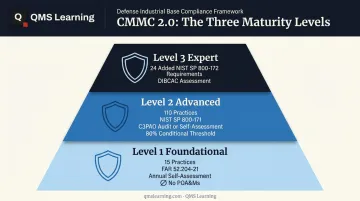
The model breaks into three levels:
- Level 1 (Foundational) — 15 practices from FAR 52.204-21, covering basic FCI protection. Annual self-assessment plus affirmation. No POA&Ms allowed.
- Level 2 (Advanced) — 110 practices from NIST SP 800-171, protecting CUI. Either self-assessment or C3PAO certification audit every 3 years, depending on the contract. A conditional status needs at least 80% control implementation, with remaining items closed within 180 days.
- Level 3 (Expert) — Adds 24 selected requirements from NIST SP 800-172 to defend against advanced persistent threats. Assessed by DCMA's DIBCAC, and Level 2 C3PAO status is a prerequisite.
The operational reality: certification is a prerequisite for winning or keeping DoD contract awards. It directly determines revenue eligibility, not just security posture. Miss it, and you're out of the bid.
Where CMMC Shows Up in Practice
CMMC typically enters the picture at the bid/proposal stage and then stays as an ongoing condition of contract performance. It's dominant among:
- Aerospace and defense manufacturers
- IT and managed service providers supporting DoD systems
- Subcontractors anywhere in the multi-tier DIB supply chain
A March 2026 analysis of the Cyber AB Marketplace counted roughly 1,074 organizations holding Level 2 certificates, with 178 new certificates issued that month alone. That's a fast-moving pace, but still a small pool against the estimated 8,350 entities that will eventually need to qualify.
Behind every one of those certificates sits a specific documentation package: a current System Security Plan (SSP) describing your environment and, where gaps exist, a Plan of Action and Milestones (POA&M) tracking closure. Assessors open these two documents first. Generic, templated versions are a leading cause of failed assessments.
What Is ISO 27001?
ISO/IEC 27001:2022 is the international standard for building and maintaining an Information Security Management System, or ISMS. Unlike CMMC, it isn't scoped to a single supply chain. It applies to any organization managing sensitive data, intellectual property, or customer records, in any country.
The core benefit is different from CMMC's contract-gate function. ISO 27001 gives you a structured, continuously improving risk management approach that builds credibility with customers, vendors, and international partners.
For SaaS companies and enterprise vendors, it's often a deciding factor in a sales cycle: the security questionnaire that gets skipped entirely because you already have the certificate.
The 2022 revision reorganized Annex A into 93 controls across four themes:
- Organizational controls
- People controls
- Physical controls
- Technological controls
Instead of a fixed checklist, organizations run a risk assessment and select applicable controls through a Statement of Applicability — flexibility CMMC simply doesn't offer.
Certification Process and Where It Fits
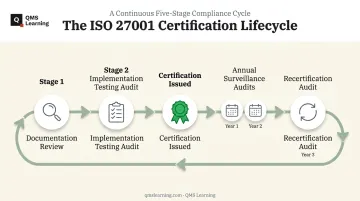
Certification runs through Stage 1 (documentation review) and Stage 2 (implementation testing) audits by an accredited certification body, followed by annual surveillance audits and full recertification every three years.
ISO 27001 tends to enter an organization's growth story as a market requirement rather than a legal one. It shows up when a customer, investor, or international partner asks for it. It's dominant in:
- SaaS and cloud providers
- Financial services
- Healthcare technology
- Multinational enterprises needing a globally portable certification
Adoption is climbing fast. The 2024 ISO Survey reported 96,709 valid ISO/IEC 27001 certificates worldwide, roughly double the 48,671 recorded in 2023.
CMMC vs ISO 27001: Which Is Right for You?
The decision comes down to three questions:
- Do your current or target contracts require CMMC? If a solicitation names it as a condition of award, there's no substitute.
- Do you need cross-industry or international credibility? ISO 27001 travels well outside the defense world; CMMC does not.
- What security infrastructure do you already have? Existing NIST or ISO controls reduce the lift for whichever framework comes next.
Situational guidance:
- Pursue CMMC first if a DoD contract makes it mandatory for award or retention
- Pursue ISO 27001 first if your priority is broader market trust across commercial industries
- Pursue both in parallel if you're a defense contractor also serving commercial clients: a combined gap analysis avoids redoing the same work twice
Here's a misconception worth killing off: ISO 27001 certification accelerates CMMC readiness at Levels 1-2 because of genuine control overlap in areas like access control and incident response. It cannot substitute for it. CMMC has its own prescriptive evidence requirements (the SSP and POA&M) and a mandatory DoD-recognized assessment path that ISO auditors simply don't perform.
Most compliance failures at this stage are capability problems, not documentation gaps. Teams know the control language but haven't built the internal judgment to apply it under audit pressure.
QMS Learning's Defense Cybersecurity Readiness pathway (pilot cohort opening Q3 2026) is built to close that gap. It walks compliance and IT teams through CMMC, NIST 800-171, ISO 27001, and SOC 2 as distinct courses.
Each course shares a common AI Workbench, trained on NIST 800-171, CMMC assessment guides, and ISO 27001 Annex A simultaneously. The same tool drafts SSP sections and POA&M entries regardless of which framework you tackle first.
There's no universally "better" framework here. The right one depends on your contract obligations and market strategy, not on which standard sounds more rigorous on paper.
Real-World Scenario: Pursuing Both Frameworks Efficiently
Picture a defense subcontractor holding a DoD contract that requires CMMC Level 2, while its commercial clients keep asking for ISO 27001 in vendor security questionnaires. Sound familiar?
Run as two separate projects, this gets expensive fast. Teams end up:
- Writing duplicate policies for overlapping controls
- Sitting through redundant audits that ask nearly identical questions
- Burning out compliance staff who are essentially doing the same work twice under different labels
The fix is consolidating control mapping and evidence management into a single system instead of maintaining parallel document sets for each framework.
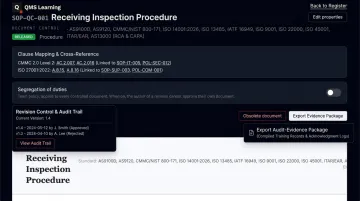
Map a controlled document like an access control procedure once to both CMMC's AC.L2 practices and ISO 27001's Annex A.9 controls, and the duplicate document disappears entirely. Update it once, and the system flags every linked record and training requirement across both frameworks that needs to follow.
That's the model behind QMS Learning's Document Management System: clause-mapped documents, single-revision control with a full audit trail, and a one-click Audit-Evidence Package. This package compiles training records, revision history, and acknowledgment logs into a single indexed export, usable as evidence for a C3PAO assessment and an ISO certification audit alike.
Teams that build audit-ready capability once, instead of retraining from scratch for every new framework, avoid this bottleneck entirely.
QMS Learning's Defense Cybersecurity Readiness pathway, opening as a pilot cohort in Q3 2026, covers CMMC, NIST 800-171, ISO 27001, and SOC 2 in one program.
Booking a 30-minute demo shows how the Workbench and evidence export apply to your specific contract timeline.
Frequently Asked Questions
How hard is it to get CMMC certified?
Difficulty depends on the level. Level 1 is a straightforward self-assessment, while Level 2 requires closing all 110 NIST SP 800-171 practices and passing a C3PAO audit, typically a 12 to 24-month process.
Is NIST better than ISO 27001?
Neither is universally superior. NIST SP 800-171 is a prescriptive US federal requirement for protecting CUI, while ISO 27001 is a flexible, globally recognized risk-based standard for any industry.
Does CMMC require a SIEM?
CMMC does not mandate a named SIEM product. CMMC Level 2 requires continuous monitoring, audit logging, and correlated incident detection: outcomes most organizations satisfy using SIEM tooling, though small companies can meet requirements manually.
Can ISO 27001 certification replace CMMC compliance?
No. DoD contracts requiring CMMC make it an enforceable condition of award, and no formal reciprocity currently exists between the two standards; even a perfect ISO certificate won't substitute for the required DoD-accredited assessment.
Which should I pursue first — CMMC or ISO 27001?
Pursue CMMC first if DoD contracts require it imminently. If broader market credibility matters more, start with ISO 27001 instead. When both are eventual goals, run the two efforts in parallel.
How much of my ISO 27001 evidence can I reuse for CMMC?
Most policies, procedures, training records, and risk documentation carry over. You'll still need to build CMMC-specific artifacts like the System Security Plan and Plan of Action and Milestones from scratch.