Introduction
ISO 14001:2026 was published on April 15, 2026, officially replacing the 2015 edition. The transition clock is now running for every certified organization.
If you're an EHS or quality manager, you already know what's coming: gap analysis, documentation updates, supplier reviews, and training rollouts. What you probably don't have is a clear starting point.
This guide breaks down the real timeline, the clause-by-clause changes that matter, and who feels the biggest impact. You'll also get a practical roadmap so you can transition without a last-minute scramble.
Key Takeaways
- ISO 14001:2026 published April 15, 2026; transition window runs about three years through ~2029
- Annex SL structure and EMS cycle stay intact; the update refines the existing standard
- Clause 6.3 (Planning of Changes) is the biggest new requirement; Clause 8.1 expands supply chain controls
- Start gap analysis now instead of waiting for the deadline year
- No legitimate free full-text PDF exists; buy the standard from ISO or a national body such as ANSI
ISO 14001:2026 Timeline: Key Dates and the Transition Deadline
The path to publication moved through several stages:
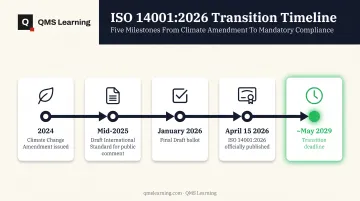
- 2024: The climate change amendment (Amd 1:2024) was issued to ISO 14001:2015
- Mid-2025: Draft International Standard released for public comment
- January 5, 2026: Final Draft International Standard (FDIS) released for an eight-week ballot
- April 15, 2026: ISO 14001:2026 officially published, incorporating the 2024 climate amendment
The transition period is expected to run approximately three years from publication. DNV, one of the major certification bodies, states that ISO 14001:2015 certificates must transition before May 2029 to remain valid.
That mirrors the precedent set when the 2015 edition replaced 2004: also a three-year window. Final confirmation of the exact policy still rests with the accreditation body overseeing the transition, so treat May 2029 as the working target rather than a locked date.
Why your calendar matters more than the deadline
Certification bodies themselves need time to gain accreditation to audit against the new edition. That means the first ISO 14001:2026 certificates are unlikely to appear before 2027-2028. Auditors need to be trained and accredited before they can issue them.
Practical implication: work backward from your own recertification or surveillance audit cycle, not from the 2029 deadline. Your internal timeline should include:
- Run a gap analysis against the new clauses
- Update documentation and procedures
- Train the team on changed requirements
- Complete at least one internal audit cycle before the external transition audit
One bright spot: if you already updated your EMS to address the 2024 climate change amendment, you're ahead of the curve. Most of that content carried straight into the 2026 edition.
What's Actually Changing in ISO 14001:2026? Clause-by-Clause Breakdown
Here's the part that matters most for anyone rewriting procedures: this is a moderate, targeted revision, not a ground-up rebuild. Most of the genuinely new material sits in the informative Annex A guidance rather than the normative requirements you're audited against.
Context of the Organization (Clause 4)
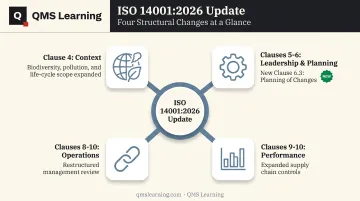
Clause 4.1 now requires organizations to consider broader environmental conditions, not just climate. That includes biodiversity, pollution levels, and resource availability.
Clause 4.3 pushes further: your scope decisions must explicitly reflect a life-cycle perspective. Upstream and downstream impacts you can influence can no longer be quietly left out of scope.
Leadership and Planning (Clauses 5-6)
Clause 5.1 sharpens accountability for top management, even when day-to-day EMS tasks are delegated to an EHS coordinator or plant manager. Leadership can't point to a delegate and walk away from responsibility.
The bigger change is Clause 6.3, Planning of Changes, a new clause with no direct equivalent in 2015. It requires formal evaluation and control of any change that could affect the EMS before that change happens. Changes that now need a documented planning review first include:
- New equipment
- New suppliers
- Facility expansions
- Process modifications
Operation and Supply Chain (Clause 8)
Clause 8.1 broadens the old "outsourced processes" language to externally provided processes, products, and services. That's a meaningfully wider net. Organizations now need documented evidence of environmental controls not just for outsourced manufacturing steps, but for procurement decisions and supplier relationships generally.
Performance Evaluation and Improvement (Clauses 9-10)
Management review (9.3) is now split into three sub-clauses (inputs, process, and results) with an explicit requirement to evaluate EMS effectiveness. Clause 10 loses its old 10.1 and folds that content into 10.2 and 10.3. Both changes are structural, not substantive. If your management reviews are already thorough, you're mostly reorganizing, not rebuilding.
Here's a quick reference for mapping your existing documentation:
| 2015 Clause | 2026 Clause | What Changed |
|---|---|---|
| 4.1 Context | 4.1 Context | Adds biodiversity, pollution, resource availability |
| 4.3 Scope | 4.3 Scope | Must reflect life-cycle perspective |
| 5.1 Leadership | 5.1 Leadership | Stronger top-management accountability |
| No equivalent | 6.3 Planning of Changes | New: formal change evaluation required |
| 8.1 Operational control | 8.1 Operational control | Expanded to externally provided processes/products/services |
| 9.3 Management review | 9.3.1-9.3.3 | Split into inputs, process, results |
| 10.1-10.3 Improvement | 10.2-10.3 Improvement | 10.1 removed, content merged into remaining sub-clauses |
Who Is Most Affected? Sector and Business Impact
The changes hit organizations differently depending on how their operations touch the environment and their supply base.
Manufacturing, food and beverage, chemicals, and pharmaceutical companies will feel the Clause 8.1 supply chain expansion the hardest. These sectors run on contracted services and purchased raw materials, so the "externally provided processes, products and services" language directly expands their documentation burden.
Mining, energy, and oil and gas organizations face tighter requirements on natural resource use, climate risk, and emergency planning. These were addressed loosely under ISO 14001:2015; the 2026 context requirements make them harder to gloss over.
Beyond sector, a few cross-cutting risk factors matter:
- Land use or water withdrawal activities now carry direct biodiversity obligations under the expanded Clause 4.1
- Sourcing from ecologically sensitive regions puts your supply chain squarely in scope
- Public net-zero or climate commitments invite heightened scrutiny: your EMS now needs to actually evidence those claims, not just state them
If any of these apply to your organization, move biodiversity and supply chain documentation to the top of your gap analysis list.
How to Prepare: A Practical ISO 14001:2026 Transition Roadmap
Skip the panic. Follow a sequence.
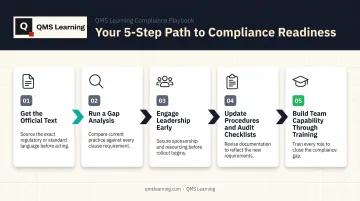
Get the official text. Purchase ISO 14001:2026 through ISO's store or an accredited national body such as ANSI. There is no legitimate free full-text PDF. Unofficial copies online are often inaccurate and still violate ISO copyright—use a licensed source only.
Run a formal gap analysis. Map your current EMS against the new requirements. Prioritize Clause 6.3 change management and Clause 8.1 supply chain controls first. These two carry the heaviest new documentation load.
Engage leadership early. Update the environmental policy, relevant job descriptions, and internal communications to reflect the strengthened top-management accountability language in Clause 5.1.
Update procedures and audit checklists. Revise supplier management processes and internal audit tools to match the restructured clauses. Run at least one internal audit against both the 2015 and 2026 requirements before your first external transition audit.
Build team capability, not just paperwork. A well-written procedure means nothing if the people running it don't understand the change. Train on the clause updates before the transition audit, not after.
For teams keeping the work in-house, QMS Learning's Environmental & Safety Compliance pathway includes an ISO 14001:2026 Transition course on every clause change, including Clause 6.3. The AI Workbench supports running the gap analysis, routing to the right method, and generating audit-ready documentation without a consultant.
Should You Wait for ISO 14001:2026 or Act Now?
If You're Not Yet Certified
Implement against ISO 14001:2015 now. First 2026 certificates aren't expected before 2027–2028, and the core EMS requirements carry forward largely unchanged. Waiting buys you nothing but delay.
Sitting on the sidelines for two years or more only postpones the actual business benefits of certification:
- Reduced environmental and regulatory risk
- Improved standing with regulators and insurers
- Competitive credibility with customers who require certified suppliers
If You're Already Certified
Don't treat the 2026 transition as a standalone project. Align it with your next scheduled surveillance or recertification audit instead.
That approach gives you:
- A natural deadline tied to your existing audit cycle
- No duplicate audit costs
- Gradual absorption of changes into your current EMS—not one disruptive push
Frequently Asked Questions
Is ISO 14001 being updated in 2026?
Yes. ISO 14001:2026 was published on April 15, 2026, replacing the 2015 edition. Certified organizations have a multi-year transition period to migrate their EMS.
Is there a free PDF version of ISO 14001:2026 available?
No legitimate free full-text PDF exists. The official standard must be purchased through ISO or an authorized national body like ANSI. Free guidance summaries and templates are available from certification bodies and training providers.
How long do organizations have to transition to ISO 14001:2026?
The expected transition period is approximately three years from publication, pending final confirmation from the IAF and accreditation bodies. Certificates will need to migrate by roughly 2029.
Will my ISO 14001:2015 certificate become invalid immediately?
No. 2015 certificates remain valid throughout the transition period, but they must be upgraded to the 2026 edition before the deadline to stay valid afterward.
What is the biggest new requirement in ISO 14001:2026?
Clause 6.3, Planning of Changes, is the standard's most significant addition. It requires formal evaluation of any change that could affect the EMS before that change takes place.
Do I need to completely redo my EMS for the new edition?
No. The revision builds on the same Annex SL structure used in 2015. A well-functioning EMS mainly needs targeted refinement around Clause 6.3 and Clause 8.1, not a full rebuild.