Here's the short version: IA9100 is still Work In Progress, according to SAE International's official record. IAQG's own 2025 Annual Report targets a Q1 2027 publication, tied to the release of ISO 9001:2026. Nothing is final yet.
This article covers what's confirmed, what's anticipated, and how to prepare without overreacting to unofficial "Rev E" leaks.
Key Takeaways
- IA9100 rebrands AS9100 to reflect international scope without a ground-up rewrite
- Full publication targets Q1 2027, timed with ISO 9001:2026
- Cybersecurity, ethics, and product safety are confirmed stakeholder-input topics, not locked clause text yet
- AS9100D-certified organizations won't need to rebuild their QMS; most changes clarify existing clauses
Rev D vs IA9100: Quick Comparison
Naming and Status
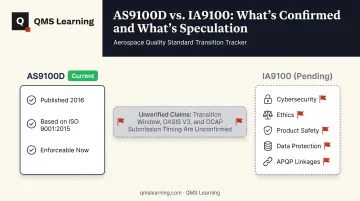
AS9100D is the current standard, revised September 20, 2016, and built on ISO 9001:2015. IA9100 is SAE's working name for the successor — still labeled Work In Progress, not a published "Rev E."
Anticipated Focus Areas
IAQG's own stakeholder input lists these themes for the revision:
- Ethics and quality culture
- Product safety analysis
- Data management and protection, including cybersecurity
- APQP linkages
- Technology adoption
Important caveat: specific clause numbers you may see floating around (like a dedicated 7.1.7 information security clause) aren't confirmed on SAE's official page. Treat those as industry speculation until the draft text is released.
What's Still Unverified
Much of the "Rev D vs Rev E" content online cites specifics that IAQG and SAE materials do not support:
| Claim | Status |
|---|---|
| 2-3 year transition window | Not officially confirmed |
| OASIS V3 mandatory for IA9100 | Not connected to IA9100 in official material |
| 90-day OCAP submission requirement | Not confirmed for IA9100 |
| Simplified site-structure classification | Not stated in SAE's IA9100 record |
The safer takeaway: expect a revision of existing processes, not a rewritten framework.
What is AS9100D?
AS9100D is the current, enforceable QMS standard for aviation, space, and defense organizations. It layers aerospace-specific requirements (configuration management, counterfeit parts prevention, supplier control, product safety) on top of ISO 9001:2015's core clauses 4 through 10.
It's the baseline nearly every certified aerospace supplier operates under today. If your certificate is active, this is what you're being audited against right now.
Use Cases of Rev D
AS9100D certification functions as a contract gate across the supply chain:
- OEMs and Tier 1-3 suppliers need it to bid on most aerospace and defense contracts
- MRO and repair stations rely on it to qualify for commercial aviation supplier lists
- Defense contractors often pair it with ITAR compliance obligations
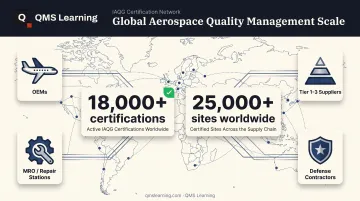
For scale: IAQG's global aerospace quality management scheme (AQMS) covers more than 18,000 certifications across 25,000 sites worldwide, according to members.iaqg.org. That figure spans the full 9100-series, not AS9100 alone, but it signals how deeply embedded the standard is across the industry.
What is IA9100 (the coming successor)?
IA9100 is IAQG's rebranded, internationally-aligned successor to AS9100, developed to sync with ISO 9001:2026. The name shift itself matters: "International Aerospace" replaces "Aerospace Standard," signaling a scope that has always been global.
Per SAE's revision policy, the intent is to "fix what needs improvement, limit new requirements to industry-wide interests, and support common interpretation," not introduce sweeping new obligations.
Who Should Watch the Transition
Organizations renewing certification between 2026 and 2028 will likely transition through this window as final rules solidify. A few groups should watch this closely:
- Multi-sector suppliers working across aerospace, defense, and automotive gain from closer alignment across quality frameworks
- Defense contractors already navigating CMMC and NIST 800-171 will find any IA9100 cybersecurity emphasis complementary to work they're already doing
- AS9100D program owners approaching recertification in that window need clarity on what changes, what stays, and when registrars will audit to the new text
No IAQG or SAE source publishes a transition-cost figure or audit-duration delta yet. IAQG has discussed OCAP (risk-based audit duration) and PBSRP (performance-based rewards) under the existing 9104-1 scheme, but these are current mechanisms worth monitoring with your certification body, not confirmed IA9100 requirements.
Rev D vs IA9100: How to Prepare for the Transition
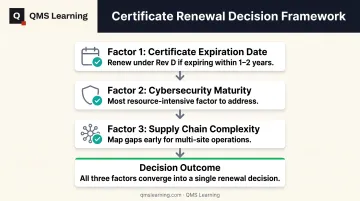
You don't need to freeze your QMS waiting for a final standard. Weigh three factors:
- Certificate expiration date — if it expires within 1-2 years, plan your renewal now under AS9100D
- Cybersecurity maturity — this is the most resource-intensive anticipated addition across every source reviewed
- Supply chain complexity — multi-site or multi-sector operations should start gap-mapping earlier
If your certificate expires soon: Renew under Rev D first. Don't wait on a standard that isn't published.
If you have more runway: Start mapping current controls against the anticipated IA9100 themes — ethics, product safety, and data protection — today.
Prioritize cybersecurity readiness on any timeline — every source flags it as the heaviest lift.
Structured AS9100D training plus disciplined audit-evidence tracking builds the documentation habits IA9100 will likely demand. QMS Learning's Aerospace & Defense Audit-Ready pathway bundles AS9100D Internal Auditor training with ITAR Compliance and Counterfeit Parts Avoidance — 19 modules and 94 lessons total.
Teams also get an AI Workbench trained on NIST 800-171 and CMMC control families, so cybersecurity gap analysis isn't a separate project bolted on later.
Real-World Example: Preparing a Supplier Organization for Transition
Picture a Tier 2 aerospace supplier with a small quality team. One senior quality engineer handles nearly every corrective action, every supplier nonconformity, every audit prep task. That's a common bottleneck, and a risky one heading into any standard transition.
The trigger for change is usually anticipation rather than crisis: leadership hears that IA9100 will tighten supplier oversight and add cybersecurity expectations, and decides to get ahead of it rather than scramble later.
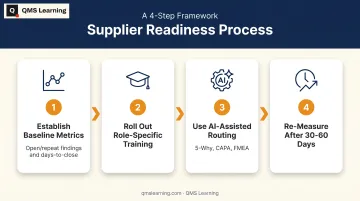
A practical readiness push looks like this:
- Establish a baseline before training: open findings, repeat findings, days to close corrective actions
- Roll out role-specific AS9100D and supplier-control training across the broader team, not just the senior engineer
- Use AI-assisted tools to route recurring problems (like supplier nonconformities) to the right method (5-Why, CAPA, FMEA) instead of relying on one person's judgment
- Re-measure the same metrics after 30-60 days
One documented example inside QMS Learning's platform shows the same pattern in practice. A recurring supplier defect was routed through 5-Why and Supplier CAPA, producing a CAPA record aligned to AS9100D §8.4.3. An auditor accepted the corrective action on first review—useful internal proof the process works for your organization, even if it is not an industry-wide benchmark.
The takeaway: early, role-specific training closes capability gaps before any standard formally shifts. Explore the Aerospace & Defense Audit-Ready pathway if your team is facing a similar bottleneck.
Conclusion
IA9100 builds on AS9100D. Most of what you're doing today under Rev D remains the foundation:
- Supplier control
- Configuration management
- Counterfeit parts prevention
The additions center on cybersecurity, ethics, and tighter supplier oversight.
Organizations that start gap assessments and staff training now, rather than waiting for the final IA9100 text in 2027, will transition smoothly. They'll also strengthen audit readiness under Rev D in the meantime, which matters regardless of which revision letter ends up on your certificate.
Frequently Asked Questions
What is the latest revision of AS9100?
AS9100 Rev D (2016) is the current, enforceable revision. IA9100 is the pending rebranded update, targeted for Q1 2027 publication.
Is AS9100 becoming IA9100?
Yes. IAQG is rebranding AS9100 as IA9100 to reflect its international scope and align with ISO 9001:2026. It is a rename and revision, not a different standard.
Will AS9100D certification still be valid after IA9100 is published?
IAQG has confirmed transition planning is underway, but a specific duration hasn't been published yet. Expect a multi-year window before full migration is required.
Do organizations need to rewrite their entire QMS for IA9100?
No. Most anticipated updates refine and clarify existing AS9100D processes rather than requiring a ground-up rebuild.
What is the biggest new requirement in IA9100 compared to Rev D?
Data management and cybersecurity readiness are the most resource-intensive anticipated addition, based on IAQG's stakeholder input themes.
When should aerospace suppliers start preparing for the IA9100 transition?
Start gap assessments and cybersecurity readiness now, especially if your AS9100D certificate renews within the next 1-3 years.