Introduction
Clause 9.3 of ISO 9001 requires top management to review the quality management system at planned intervals. That sounds straightforward. In practice, it's one of the areas where audit trails fall apart fastest.
This article focuses on two specific things: the mandatory inputs auditors expect to see discussed under Clause 9.3.2, and the mandatory outputs Clause 9.3.3 requires you to document.
Many quality teams treat management review like a general status meeting. Registrars don't see it that way. They check whether each required input was addressed by name, and whether every output landed as a documented decision, not a vague comment.
Below, we break down each input, each output, and the specific evidence auditors look for in the minutes.
Key Takeaways
- Six mandatory input categories under 9.3.2—including seven performance and effectiveness sub-elements—must be covered
- Documented outputs must address improvement opportunities, QMS changes, and resource needs (9.3.3)
- One annual review rarely satisfies auditors who expect trend data on performance, conformity, and monitoring
- Vague or undated minute entries are a common gap flagged in surveillance audits
- Minutes and action logs are documented information and must roll into the next review cycle
What Is an ISO 9001 Management Review, and Why Does It Matter?
A management review is top management's periodic, evidence-based evaluation of whether the QMS is still suitable, adequate, and effective for the business. It's a decision-making process built on real data, not a status update.
It's easy to confuse this with an internal audit, but the two serve different purposes:
- Internal audit (Clause 9.2): checks whether people are following documented procedures and whether the system works as designed
- Management review (Clause 9.3): checks whether the whole system still fits where the organization is heading strategically
Internal audit results actually feed into management review too: they're one of the seven required performance inputs, covered below.
ISO 9001 mandates this review because it forces a structured connection between operational data and business decisions. Without it, quality metrics live in a spreadsheet nobody at the top ever opens.
ISO's Auditing Practices Group frames management review as a two-way process: top management sets direction, and every level of the organization feeds it evidence.
Who Attends and How Often Should It Happen?
A member of top management must chair the review. Beyond that, attendance typically includes:
- Process owners who can speak directly to their own data
- Functional managers across operations, quality, and EHS
- Internal auditors, since audit results are a required input
According to NQA's guidance on management review meetings, the standard doesn't dictate a fixed frequency at all. It only requires "planned intervals."
In practice, a risk-based approach works better. Review critical metrics like nonconformities and process performance monthly or quarterly, and cover the full 9.3.2 list at least once a year.
ISO 9001 Management Review Inputs (Clause 9.3.2)
Inputs need to be gathered and analyzed before the meeting starts. If top management sees raw numbers cold, for the first time, in the room, that's already a sign the process is broken. An input is only useful once someone has turned data into a decision-ready summary.
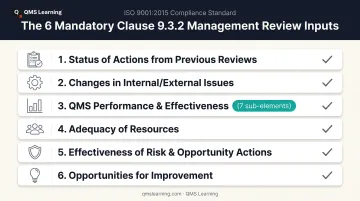
Status of Actions From Previous Reviews
Every open action item from the last review needs a status: closed, in progress, or overdue. Aging matters here: an action still open after three review cycles tells auditors something isn't working. Anything incomplete carries forward into the next review.
Changes in Internal and External Issues
This covers shifts in organizational context (Clause 4.1) and interested party needs (Clause 4.2), including new regulations, market pressure, a customer's changing requirements, or a supply chain disruption. If nothing changed, say so in the minutes. Don't skip the topic entirely.
QMS Performance and Effectiveness
This is the largest input category, and it splits into seven required sub-elements:
| Performance area | What to review |
|---|---|
| Customer satisfaction & feedback | Complaints, survey results, returns |
| Quality objectives | Progress against each stated target |
| Process performance & product conformity | Yield, scrap, first-pass rates |
| Nonconformities & corrective actions | Volume, recurrence, closure time |
| Monitoring & measurement results | Calibration status, inspection data |
| Audit results | Internal and external findings |
| External provider performance | Supplier scorecards, delivery, quality |
Auditors expect trend lines across these seven areas, not a single snapshot pulled together the morning of the meeting.
Adequacy of Resources
Cover whether people, competence, infrastructure, and work environment (Clause 7.1) still match demand:
- Headcount and skills vs. current inspection and process load
- Equipment, space, and tools that support conformity
- Work environment limits that slow or block quality work
A common gap: volume went up, but nobody flagged that the quality team is now short-staffed for the inspection load.
Effectiveness of Actions Addressing Risks and Opportunities
Pull up the risk register and walk each Clause 6.1 item:
- Action taken for that risk or opportunity
- Evidence it reduced the risk or captured the opportunity
- Items with no owner, no due date, or no follow-up
This input often gets skipped entirely—usually because there is no register to review in the first place.
Opportunities for Improvement
Bring Clause 10.1 opportunities onto the agenda instead of leaving them in a log nobody revisits:
- Near-misses and internal ideas still open
- Customer suggestions tied to product or process quality
- Audit findings that point past containment to systemic improvement
Treat each item as a candidate decision, not a parking lot.
ISO 9001 Management Review Outputs (Clause 9.3.3)
Outputs are documented decisions and actions, not discussion notes. Auditors want to see a named owner and a target date attached to each one, not a summary of what got talked about.
Required Output Categories
Clause 9.3.3 requires three output categories:
- Opportunities for improvement — process, product, or system-level changes moving into an action plan
- QMS changes — structural or procedural updates to keep the system current
- Resource needs — staffing, tools, training, or budget decisions
Mature QMS programs often add two more:
- Revised objectives/KPIs — updated targets reflecting new performance data
- Policy amendments — updates when strategic direction shifts
Documenting and Closing the Loop
Minutes need to record who attended, what was decided, and who owns each action item, with a date attached. "Discussed and noted" is a placeholder, not a decision.
Every output becomes an input to the next review. That's what creates the audit trail registrars trace back across multiple cycles: last year's resource decision should show up this year as either resolved or still open.
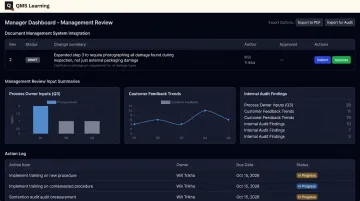
Compiling this evidence by hand, across multiple process owners each keeping their own spreadsheet, eats days before an audit. QMS Learning's Document Management System and Manager Dashboard close that gap: they pull management review inputs and outputs into a single audit-acceptable evidence export in minutes, using the same controlled-document and training records the rest of the QMS already runs on.
Best Practices and Common Mistakes to Avoid
A risk-based review calendar solves most of the frequency problem:
- Review high-impact inputs—performance data, conformity, and monitoring results—monthly or quarterly
- Cover lower-impact inputs, like policy and objectives, less often
- Address the full 9.3.2 list somewhere within the annual cycle
Two mistakes show up repeatedly in surveillance audits:
- Treating the review as a general business meeting. Teams discuss sales, operations, and budget, then wonder why the auditor writes a finding. Every one of the six 9.3.2 inputs needs to be worked through by name, even briefly.
- Recording vague outputs. "Discussed and noted" tells an auditor nothing. Every output needs a specific decision, an owner, and a date.
There's a third, quieter problem: reviewing a single point-in-time snapshot instead of trend data across periods. That misses the standard's intent.
It usually happens because the team hasn't practiced root-cause or trend analysis under pressure. When that skill sits with one senior person, junior staff default to superficial reviews the moment that person is out sick or in another meeting.
This is where QMS Learning's practitioner-built training and AI Workbench help close the gap. The Workbench's Method Router diagnoses the problem, selects the right method, and drafts the artifact automatically.
For example, when the same nonconformity turns up on parts from one supplier three times in a quarter, it flags a systemic issue, pairs 5-Why with a supplier corrective action, and drafts a ready-to-review artifact. A junior quality engineer can assemble a defensible, trend-based input without waiting on a senior reviewer's calendar.
Frequently Asked Questions
What should be included in an ISO 9001 management review?
Cover the six mandatory 9.3.2 inputs: prior action status, context changes, QMS performance and effectiveness, resource adequacy, risk and opportunity actions, and improvement opportunities. Outputs must cover improvement decisions, QMS changes, and resource needs.
What are the 7 quality management principles of ISO 9001?
Customer focus, leadership, engagement of people, process approach, improvement, evidence-based decision making, and relationship management, per ISO's official principles document. Management review decisions should trace back to these, particularly evidence-based decision making.
How often should ISO 9001 management reviews be conducted?
There's no fixed interval in the standard; it requires "planned intervals" only. Most practitioners review critical inputs monthly or quarterly and cover the full input list at least once a year.
Who is required to attend an ISO 9001 management review?
Top management chairs the review. Process owners, functional managers, and internal auditors typically attend, since their data and audit results feed directly into the required inputs.
What is the difference between management review inputs and outputs?
Inputs are the evidence brought into the meeting, such as performance trends, audit results, and resource status. Outputs are the resulting decisions: what changes, what gets funded, what improves.
What happens if a required management review input is skipped?
It typically becomes an audit nonconformity. Clause 9.3.2 inputs aren't optional discussion topics; auditors expect to trace each one through the minutes.