Introduction
Auditors don't pass or fail companies on good intentions. They pass or fail them on evidence.
An ISO 9001 checklist is the structured set of questions that finds, records, and reviews that evidence—so you can verify your QMS does what the standard and your procedures require.
Here's the problem: most checklists floating around online are generic. They're built for a hypothetical company, not yours. When your checklist doesn't reflect your actual documented processes, you end up gathering evidence for requirements that don't apply and missing the ones that do.
This guide covers what to lock down before you draft a checklist, the three formats worth using, and how to read conformant vs. nonconformant results. It also flags the mistakes that still sink otherwise solid QMS programs at audit time.
Key Takeaways
- Build checklists from ISO 9001 clauses and your own process documentation — never copy one wholesale
- Match the checklist format (clause-by-clause, process-based, or internal audit) to your audit's actual scope
- Sort findings into conformant, minor nonconformity, or major nonconformity — each demands a different response
- "Checking the box" without objective evidence is the single fastest way to fail an audit
What You Need to Build and Use an ISO 9001 Checklist
Before you write a single checklist question, you need the right reference materials on hand and internal agreement on what you're checking. Skip this step and you end up with a generic exercise that looks thorough but doesn't verify anything real.
Tools and Documents Required
At minimum, gather:
- The ISO 9001:2015 standard document itself, not a summary of it
- Your organization's existing process documentation and procedures
- Prior internal and external audit records, including any open corrective actions
- A checklist template, whether that's a spreadsheet, form, or dedicated software tool
Building this from a blank spreadsheet works, but it's slow. It's easy to miss clause coverage or leave evidence fields vague. AI-guided platforms (QMS Learning's AI Workbench is one example) can generate audit checklists from your organization's standard and facility context, which cuts the blank-page problem during setup.
Preconditions and Setup
Three things need to happen before drafting questions:
- Define the scope. Are you checking the whole QMS, one process like purchasing, or a single clause? Scope determines everything downstream.
- Secure management commitment and assign an owner. Someone needs to be responsible for keeping the checklist current, not just for the audit week.
- Gather supporting records early (training logs, calibration certificates, CAPA logs) so you're not scrambling for evidence mid-audit.
Types of ISO 9001 Checklists
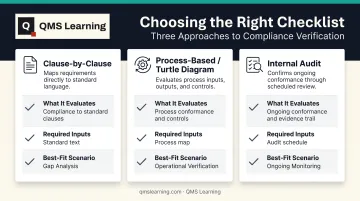
The right checklist format depends on what you're actually trying to verify: full-system compliance, whether one process actually works, or ongoing internal audit discipline. ISO's own Auditing Practices Group guidance warns that a generic checklist can interfere with auditing rather than help it. The format has to match the job.
Clause-by-Clause Checklist
This maps each checklist item directly to one of the ten ISO 9001:2015 clauses (clause 7 for resources, clause 8 for operations, and so on).
Needs: the standard text, your quality manual, and a clause cross-reference sheet.
Build it in three steps:
- List each applicable clause and sub-clause
- Write a verification question paired with the required evidence type
- Score each item as met, partially met, or not met, with room for evidence references
This format is best for full QMS gap analyses or new certification pushes. Its weakness: because it's organized by clause rather than workflow, it can miss cross-functional breakdowns that only show up when you follow a process end to end.
Process-Based (Turtle Diagram) Checklist
This evaluates a single process, such as purchasing, production, or another core process, by checking its inputs, outputs, resources, methods, and performance metrics. NQA describes the turtle diagram as a visual tool for directing an auditor toward process measures, people, and documentation together, rather than treating them separately.
Needs: a process map or turtle diagram, process owner interviews, and performance data.
Run it in three steps:
- Identify inputs, outputs, and the people or equipment involved
- Verify each step against the documented procedure and watch it happen
- Check performance metrics against targets to confirm the process works, not just that paperwork exists
This is the format most likely to surface real operational gaps. It costs more time and requires deeper process knowledge than a clause checklist, which is why few organizations use it for every process.
Internal Audit Checklist
This is a scheduled, structured checklist used by internal auditors to sample records and interview staff against both the standard and internal procedures.
Needs: an audit schedule, prior findings, and a sampling plan.
Run it in three steps:
- Select the scope and pull relevant clause or process items
- Interview process owners and request evidence live
- Record findings immediately with objective evidence references, not just pass/fail marks
It's the strongest tool for ongoing compliance monitoring and audit-readiness. It is less useful as a one-time planning document since it assumes a QMS is already up and running.
How to Interpret ISO 9001 Checklist Results
Misreading a result is its own kind of failure. Treat a real gap as minor, and it reaches the certification audit. Overreact to a trivial one, and you burn resources chasing a non-issue. Here's how the three outcomes should actually be handled:
Conformant. Evidence fully matches the requirement and your documented procedure. Record the objective evidence reference and move on. No further action needed.
Minor nonconformity. An isolated lapse: one missed record, one outdated document version. It doesn't point to a systemic breakdown. Log it, assign a corrective action with a deadline, and verify closure at the next audit.
Major nonconformity. Under ISO/IEC 17021-1's definitions, a major nonconformity affects the management system's capability to achieve its intended results. That means a required process missing entirely, or a systemic failure rather than a one-off slip.
When you find a major, respond immediately: root cause analysis, containment action, and notification to the quality manager before the certification audit proceeds.
There's no single published statistic on which ISO 9001 clauses get cited most often in nonconformities. Registrars don't publish that data consistently. What is well established is that certification bodies won't issue, reissue, or revise a certificate until a major nonconformity is corrected and verified. That alone makes majors the most expensive finding type on any checklist, in time and in risk to the certification date.
Common Mistakes and Best Practices When Using an ISO 9001 Checklist
A checklist is only as reliable as the discipline behind it. Most failures trace back to how the checklist is used, not what's written on it.
Common Mistakes to Avoid
- Using a generic, downloaded checklist without adapting it to your actual documented processes
- Marking an item complete because a document exists, without confirming it's the current, controlled version
- Treating the checklist as a one-time certification exercise instead of a living document reviewed at every internal audit cycle
Best Practices to Follow
- Update the checklist whenever a process, procedure, or the standard itself changes
- Involve process owners in building the checklist items for their own area, rather than having one person draft the whole thing alone
- Keep a version-controlled record of checklist history and evidence
That last point is where most organizations still rely on scattered spreadsheets and email threads.
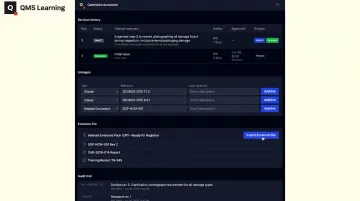
Purpose-built document management systems keep an append-only audit trail so every revision, review, and acknowledgment stays on record. QMS Learning's controlled document system maps documents to their applicable clauses and exports evidence as a single indexed file for the registrar, instead of a hand-assembled packet under deadline pressure.
Conclusion
An effective ISO 9001 checklist comes from two sources at once: the standard's clauses and your organization's actual, documented way of working. Neither one alone is enough.
Choosing the right format (clause-by-clause, process-based, or internal audit) and correctly reading conforming results versus minor and major nonconformities is what separates a passed audit from a failed one. None of that happens by accident during audit week.
It happens because the checklist stayed current, owned, and evidence-backed all year. That ongoing discipline, not the last-minute scramble, is what keeps a QMS audit-ready.
Frequently Asked Questions
What is the ISO 9001 audit checklist?
An ISO 9001 audit checklist is a structured set of questions built from the ISO 9001 clauses and your process documentation. Auditors use it to gather objective evidence during internal or certification audits — not as a form to complete for its own sake.
What are the 6 documents required by ISO 9001?
The "six documents" (document control, record control, internal audit, nonconforming product, corrective action, preventive action) come from ISO 9001:2008, not the current 2015 version. ISO 9001:2015 requires organization-appropriate "documented information" instead, though many companies keep similar procedures for practical reasons.
How many items are typically on an ISO 9001 checklist?
There's no fixed number. A single-process checklist might run 10-20 items; a full clause-by-clause system checklist can exceed 100. It depends entirely on your scope and organizational complexity.
Is there a free ISO 9001 checklist available?
Yes — several registrars and consultancies offer free downloadable templates. Use them as a starting point only. They need customization to your actual processes before they're useful in a real audit.
How often should an ISO 9001 checklist be used?
ISO 9001 requires internal audits "at planned intervals," not a fixed annual minimum. In practice, teams use checklists during internal audits, before management review, and whenever a process or procedure changes.
Can one ISO 9001 checklist be used across multiple sites?
The clause-based core can be standardized across sites. The process-based sections should be customized per site, since equipment, staffing, and operations rarely match exactly between locations.