Introduction
A missed root cause doesn't disappear. It comes back as the same defect, the same audit finding, and often the same safety risk you thought you'd closed out months ago.
In regulated manufacturing, that repetition is expensive:
- Scrap gets reworked twice
- Auditors flag the same nonconformity on a follow-up visit
- A corrective action that looked solid on paper gets rejected because the "root cause" was really just a symptom wearing a different label
The 5 Whys method exists to stop that cycle. It's one of the simplest tools in the quality toolkit, yet it directly affects quality control, failure prevention, scrap and rework costs, worker safety, and whether a registrar accepts your corrective action on first submission.
The Aviation Suppliers Association logged 41 repeat audit findings in a single year, warning that failing to address the true root cause drives that recurrence.
This guide breaks down how to run a 5 Whys analysis correctly—and when to reach for a bigger tool instead.
TL;DR
- 5 Whys is an iterative questioning technique that traces a problem from surface symptom to a fixable process cause.
- Originated at Toyota under Sakichi Toyoda and Taiichi Ohno; now core to lean manufacturing, Six Sigma, and CAPA.
- Best for simple-to-moderate problems (human error, process gaps); not a standalone method for complex, multi-cause failures.
- A shallow 5 Whys chain is one of the most common reasons auditors send corrective actions back for rework.
What Is the 5 Whys Method?
The 5 Whys method is an iterative root cause analysis technique. You ask "why" repeatedly, traditionally five times, until you move past a surface symptom and land on a fixable process cause.
Sakichi Toyoda developed the underlying approach, and Taiichi Ohno spread it through Toyota's production floors in the 1950s. Ohno trained staff to keep pursuing the causal chain rather than stopping at the first plausible answer. Five isn't a magic number. Some chains resolve in three questions, others need eight.
You'll find 5 Whys embedded in:
- CAPA and nonconformance investigations — serving as the standard starting point for most quality management systems
- Maintenance and reliability engineering — tracing equipment failures back to missed inspections or worn components
- Process engineering — isolating where a workflow breaks down
- Safety incident reviews — determining what allowed a near-miss or injury to occur
Documentation format varies. Most teams use a simple tabular "why" chain, one answer per row. When a problem clearly has more than one contributing path, some teams branch the chain into a fishbone-style diagram instead of forcing everything into a single line.
5 Whys vs. Other Root Cause Tools
5 Whys, fishbone diagrams, and FMEA solve different problems, and mixing them up is a common audit weakness.
| Tool | Best for | Key limitation |
|---|---|---|
| 5 Whys | A single, linear cause chain behind an observed nonconformity | Tends to isolate one root cause even when several exist |
| Fishbone (Ishikawa) | Generating many possible causes across categories (people, methods, machines, materials) | Doesn't itself prove which candidate cause is the real one |
| FMEA | Prospectively identifying and prioritizing potential failure modes before a process is finalized | Answers a different question: prevention, not retrospective investigation |
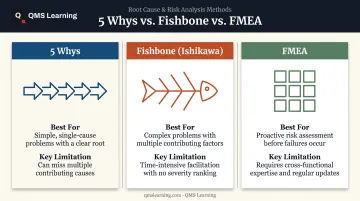
If your problem has one obvious causal thread, 5 Whys is faster than either alternative. If it's safety-critical or clearly multi-factor, start with a fishbone or FMEA instead.
Why the 5 Whys Method Matters — and Where It Falls Short
Disciplined root cause analysis separates a corrective action that sticks from one that just resets the clock on the next nonconformity. Get it right, and you see fewer repeat failures, lower scrap and rework costs, and audits that close without a fight.
Done well, 5 Whys:
- Uncovers hidden systemic causes that a surface-level fix would miss
- Builds shared team understanding without requiring statistical training
- Integrates directly into CAPA and 8D workflows most quality systems already use
- Speeds up investigation of straightforward, single-cause problems
The cost of getting it wrong is measurable. APQC's benchmarking data puts scrap and rework at 0.6% of sales for top-performing manufacturers versus 2.2% for bottom performers, a gap that translates to roughly $32 million a year at $2 billion in annual sales. Superficial investigations that let the same failure mode resurface are a direct contributor to that spread.
Known Limitations of the 5 Whys Method
5 Whys has documented weaknesses, and pretending otherwise is how weak corrective actions end up in front of an auditor. Peer-reviewed analysis in BMJ Quality & Safety identifies three recurring problems:
- Investigators stop at symptoms — there's no rule that five questions is enough, or too many.
- Results vary by investigator: two competent teams can produce two different, equally plausible chains from the same starting point.
- Single-cause bias forces one linear path, even when a failure has multiple contributing causes.
You can blunt each of these weaknesses with a few simple checks:
- Backing every "why" with facts and data, not off-the-cuff deduction
- Reading the finished chain backward to confirm each link logically causes the next
- Escalating to a fishbone diagram or FMEA when the issue is safety-critical or clearly multi-factor
How to Conduct a 5 Whys Root Cause Analysis — Step by Step
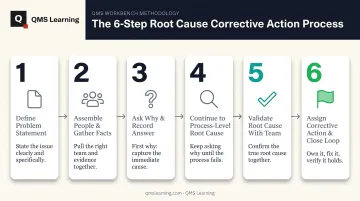
Forget the literal instruction to "ask why five times." In practice, a solid 5 Whys investigation moves through six practical stages, and most weak corrective actions fail because a team skipped one of them.
The most common mistakes:
- Skipping fact validation and guessing at causes instead
- Accepting the first plausible answer rather than digging further
- Stopping before reaching an actual process-level cause
Step 1 – Define and Write Down the Problem Statement
Write a specific, factual problem statement, not a vague symptom. "Parts failed dimensional inspection on Job 4471, lot size 200, 12 units out of tolerance" gives the team something concrete to investigate.
"Quality issue with machined parts" doesn't. A fuzzy starting point guarantees a fuzzy, inconsistent investigation.
Step 2 – Assemble the Right People and Gather Facts
Pull in the people who actually touch the process: the operator, the maintenance tech, the inspector who caught the defect. Gather data and direct observations before anyone guesses at a cause. Skip this step and the team chases opinions instead of evidence.
Step 3 – Ask "Why?" and Record Each Answer
Ask why the problem occurred, and record the answer. Then test it with backward validation: state the answer, add "and therefore," and check that it logically produces the problem. If the logic doesn't hold, the answer isn't solid enough to build on—rewrite it before you go further.
Step 4 – Continue Until You Reach a Process-Level Root Cause
Keep asking until the answer points to a fixable system or process gap—not a symptom, and not a person. "Operator error" is almost never the root cause; it's usually where a weak investigation stops.
A true root cause is something you can put a corrective action against:
- A missing procedure
- An untracked maintenance schedule
- An unclear work instruction
Step 5 – Validate the Root Cause With the Team
Review the complete chain with stakeholders before finalizing it. Check every link against the evidence gathered in Step 2, not against gut feel. This is also where a second set of eyes catches single-cause bias. If someone flags a second plausible path, don't ignore it.
Step 6 – Assign Corrective Action and Close the Loop
Convert the validated root cause into a corrective action with a named owner, a due date, and a defined effectiveness check. A root cause without an owner is just a paragraph in a report.
The effectiveness check—confirming the fix actually prevented recurrence—is what auditors look for as objective evidence that the loop closed.
5 Whys Example Walkthrough
Here's a simplified machining example. The same logic transfers to almost any production floor.
Problem statement: A batch of machined parts failed final inspection for out-of-tolerance dimensions. 12 of 200 units in Job 4471 exceeded the diameter tolerance.
Why did the parts fail inspection? The dimensions drifted out of tolerance partway through the run.
Why did the dimensions drift? The cutting tool had worn beyond its usable life.
Why was a worn tool still in use? The scheduled preventive maintenance check on that tool was missed.
Why was the PM check missed? No owner was accountable for confirming the check was completed before the run.
Why did the process allow a missed PM check to go unnoticed? There was no system tracking PM schedules or flagging overdue checks.
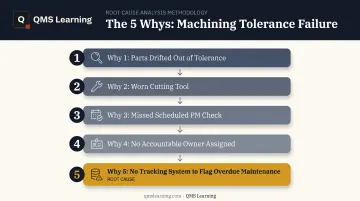
This is where teams often stop—tempted to write “operator error” and close the file. One more level usually exposes the real gap.
The root cause isn’t the operator. It’s the missing PM tracking system: a process-level failure that will keep producing worn-tool escapes no matter who runs the machine.
Corrective action:
- Implement a digital PM tracking log with automated overdue alerts
- Assign a maintenance owner and a rollout due date
- Verify at the next audit with objective evidence: on-time PM logs and zero recurrence of tool-wear dimensional failures on that machine
How QMS Learning Helps Teams Master 5 Whys and Beyond
Running a 5 Whys correctly once, in a training class, is easy. Doing it consistently, months later, under audit pressure, with a different team member leading the investigation, is the actual skill gap most quality programs never close.
QMS Learning's AI Workbench addresses that gap directly. A team member describes a live problem in plain English, and the Workbench's Method Router diagnoses what's actually happening (a process gap, an isolated incident, a supplier change, a design issue) and selects the right approach.
- 5 Whys + Supplier CAPA for a recurring supplier defect on three jobs in a quarter—systemic, not one-off
- FMEA when a new process is under evaluation and no failure exists yet to investigate
- Gap Analysis when the task is a standards comparison
The Workbench then generates the artifact itself, mapped to the applicable clause, so a completed 5 Whys chain doesn't just live in someone's notebook.
The Manager Dashboard compiles completed scenarios, training records, and time-stamped Workbench activity into a single audit-evidence package. That is the documentation registrars expect as objective evidence—not just a signed form.
None of this replaces judgment. It's built on it.
Founder Will Trikha spent 20 years on aerospace audit floors, writing more than 1,000 findings as an auditor and closing roughly twice that number as a quality manager. That practitioner background shapes how the Method Router distinguishes a real process-level cause from a symptom dressed up as one.
Mastering 5 Whys means building the judgment to know when to stop digging. QMS Learning makes that judgment permanent across a team, not dependent on one person.
Frequently Asked Questions
What is the 5 Whys method?
The 5 Whys method is an iterative questioning technique developed at Toyota that traces a problem back to its root cause by repeatedly asking "why" it occurred. It typically takes five rounds of questioning, though some chains need more or fewer.
What are the 5 steps of root cause analysis?
General root cause analysis flows through defining the problem, gathering data, investigating causes iteratively, identifying the true root cause, and implementing and verifying a corrective action. 5 Whys is one method used within that broader process.
What are the 5 Whys examples?
This guide's machined-parts walkthrough shows dimensional drift traced back to a missing PM tracking system. The classic Toyota example, documented by Taiichi Ohno, traces a stopped machine through a blown fuse, poor lubrication, and a worn pump shaft to a missing strainer.
Who invented the 5 Whys technique?
Sakichi Toyoda is credited with developing the technique. Taiichi Ohno later used and popularized it across Toyota's production floors in the 1950s, training personnel to pursue the full causal chain.
What are the 5 Whys method?
5 Whys can stop at symptoms rather than true root causes, produce different results depending on who's investigating, and force a single cause onto problems that actually have several. It works best for simple, linear problems.
How is the 5 Whys different from a fishbone diagram?
5 Whys traces one linear chain of causes behind a specific nonconformity. A fishbone diagram instead maps multiple possible cause categories at once, making it better suited to problems with several plausible contributing factors.