This article is written for quality managers, quality directors, and continuous improvement leads running an ISO 9001 QMS across manufacturing operations. Document control is one of the most frequently cited nonconformities during ISO 9001 audits, and it gets referenced constantly in relation to clause 7.5 without being executed well on the floor. Teams confuse "having documents" with "controlling documents."
Here's what this guide covers: what document control actually is, why ISO 9001 requires it, how the procedure works step-by-step, where it applies, and what commonly goes wrong.
Key Takeaways
- ISO 9001 clause 7.5 requires controlled issuing, approval, distribution, revision, and obsolescence of documented information.
- Outdated or unapproved documents remain a leading source of audit findings.
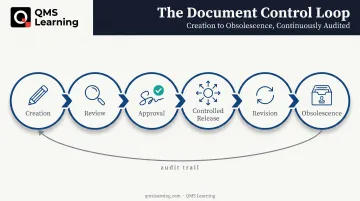
- Core flow: identification → review/approval → controlled distribution → revision control → obsolescence.
- Scope includes procedures, work instructions, forms, drawings, and external documents across the product lifecycle.
- Clear ownership, revision discipline, and a digital system beat shared drives for sustained control.
What Is a Document Control Procedure?
A document control procedure is a documented, auditable process defining how an organization creates, reviews, approves, distributes, revises, and retires QMS documents. The goal is straightforward: only current, authorized versions stay in use.
Done right, personnel always work from the latest approved revision. Superseded content gets marked obsolete or physically removed from the point of use, not left sitting in a binder on the shop floor next to the current version.
Document control vs. document management. These terms get used interchangeably, but they shouldn't be:
- Document control is the governance layer: who approves changes, how versions get tracked, when a document expires or gets replaced.
- Document management is the broader system or software used to store and organize files, controlled or not.
A shared drive can be part of document management. It's not document control unless approval workflows, version enforcement, and obsolete-document removal are built into how it's used.
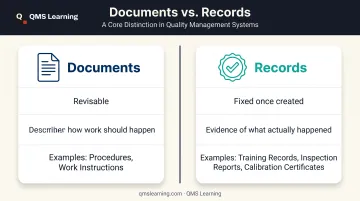
Documents vs. records. ISO 9001 treats these differently under clause 7.5. Documents describe how work is supposed to happen and are revisable (procedures, work instructions). Records are evidence of what actually happened, and they're fixed once created.
A training record, an inspection report, a calibration certificate: none of those get revised after the fact. Confusing the two is a common source of QMS structural problems.
Why the Document Control Procedure Is Used in ISO 9001
Clause 7.5.3 of ISO 9001:2015 requires that documented information needed for the QMS be controlled so it is available and suitable for use, where and when it is needed. It must also be protected from loss, misuse, or unauthorized change. That covers distribution, access, retrieval, storage, legibility, and, critically, change control.
In practice, ISO 9001 demands two things:
- Consistency of process execution across shifts, lines, and sites: everyone builds the part the same way, regardless of who is on the floor.
- Traceability of which procedure revision was in effect at any given point in time, so a nonconformity investigation can reconstruct exactly what instructions an operator was following.
An engineering team added a shaft chamfer to a design. The work instructions were updated, except the copy sitting in the production system never was. The change never made it to the floor.
Units shipped without the chamfer. The gap surfaced only after assembled products reached field operations, triggering rework, lost customer confidence, and lost sales in the hundreds of thousands of dollars (Quality Magazine).
That's not a training failure or a competence gap. It's a document control failure, and it's the exact scenario clause 7.5.3 exists to prevent.
Two points matter in practice:
- Document control is mandatory, not a best practice you can opt into. The method is left to the organization; ISO does not require a specific software or format.
- Certification bodies treat it as a systemic clause. When document control fails, findings often cascade into training records, production control, and CAPA, because those functions all depend on people working from the correct revision.
How the Document Control Procedure Works (Conceptual Flow)
At a conceptual level, document control is a closed loop: creation → review → approval → controlled release → revision → obsolescence, with an audit trail preserved at every stage.
What feeds into the process:
- Draft documents and proposed redlines
- Regulatory or customer requirement updates
- Internal corrective actions (CAPAs) that require a procedure change
What happens during the process:
- Subject matter experts review for technical accuracy and compliance
- An authorized approver signs off formally
- The document gets a unique version identifier and is released to defined distribution points
How it's controlled:
- Defined roles (document owner, reviewer, approver, document controller)
- Access permissions on controlled copies
- A master list showing every controlled document and its current revision status
The end result: outdated versions are archived or stamped obsolete, current versions become the only ones authorized for use, and a traceable revision history exists for whenever an auditor asks to see it.
This is also where most organizations lose control at scale. Spreadsheet-based master lists work fine at ten documents and one site. At two hundred documents across three shifts, someone eventually approves a change and forgets to notify the second shift, or a revision gets emailed around without anyone logging who acknowledged it.
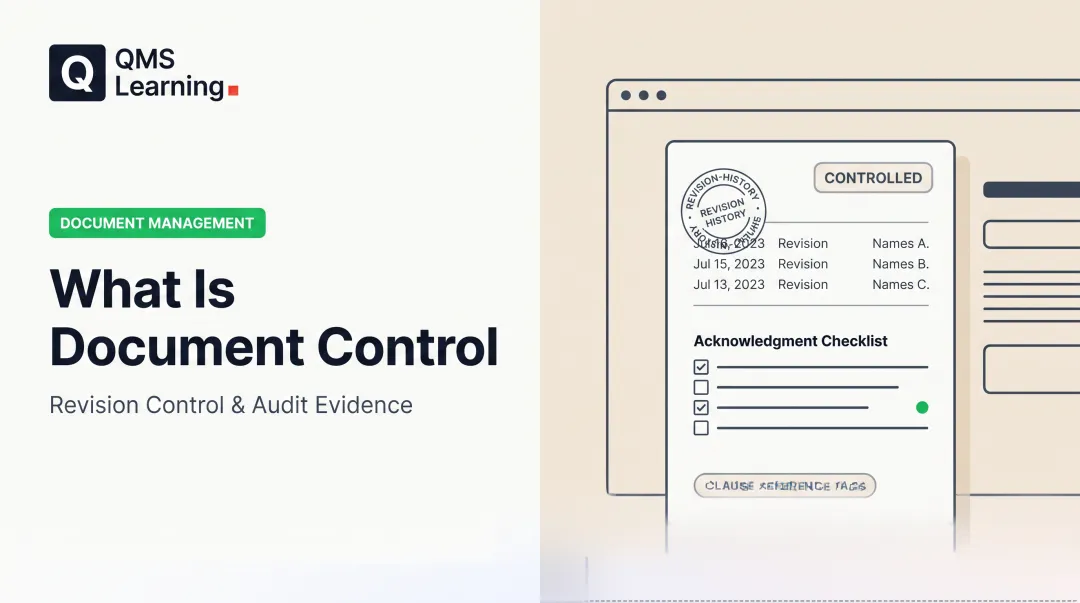
That gap is what QMS Learning's Document Management System was built to close. It keeps an append-only revision history that can't be quietly edited, links each controlled document to the ISO 9001 clauses it satisfies, and captures read-and-understand acknowledgments per person and per revision. The loop stays intact without relying on memory of who got last quarter's email.
Step 1: Document Creation, Identification & Review
The author drafts the document using a standardized template and naming/numbering convention, then routes it to designated technical reviewers. Reviewers check for accuracy, completeness, and compliance with applicable standards before the document goes anywhere near approval.
Step 2: Approval & Controlled Release
An authorized approver signs off. The document receives a version number and effective date, then gets released to the master document list. Distribution happens only to approved access points—not a general folder everyone can dig through.
Step 3: Revision, Distribution & Obsolescence Control
When a change is triggered—a CAPA, a customer requirement, a scheduled review—the cycle repeats with a new revision number. The previous version is immediately archived or stamped obsolete, pulled from active use points, and retained according to the organization's retention schedule.
Where Document Control Applies and Key Factors That Affect It
Where the Document Control Procedure Is Applied
Document control covers more than procedures. It applies to:
- Quality manuals and QMS procedures
- Work instructions and forms
- Drawings and specifications
- External documents such as customer specs and referenced industry standards
It's triggered at recurring lifecycle points, not just once at setup:
- New process or product introduction
- Following internal or supplier corrective actions
- After management review
- During periodic scheduled reviews
This is a recurring process for the life of the QMS. It never gets "finished."
Key Factors That Affect Document Control Effectiveness
A few variables determine whether a document control system actually holds up under audit:
- Ownership clarity: someone specific owns each document, not "the quality department" in the abstract
- Review cycle adherence: scheduled reviews actually happen on schedule, not eighteen months late
- Access control granularity: the right people at the right sites and shifts see the current revision, and nobody else
- Training integration: staff are trained on the current revision specifically, not just "trained on the procedure" at some point in the past
- Multi-site/multi-language consistency: larger manufacturers need the same revision live everywhere at once, in every language it's issued
Training integration is where many systems fail audit. You need evidence that a specific person acknowledged a specific revision—not only that "the document changed." Per-person, per-revision acknowledgment timestamps make that evidence automatic. When a document changes, linked training is flagged so nobody trains against a version that is already obsolete.
Common Issues, Misconceptions, and When It May Not Be Enough
"Our shared drive is our document control." It isn't. A shared folder is document storage. Without version enforcement, an approval workflow, and active removal of obsolete files, nothing stops someone from opening last year's work instruction because it happened to be the file they had bookmarked.
"We assign revision numbers, so we're covered." Revision numbers are one piece. Auditors check the review and approval workflow behind that number and whether distribution control actually kept the old version out of circulation. A number alone proves nothing about whether the change was reviewed by the right person.
Process vs. outcome confusion. Some teams point to zero open document-related CAPAs as proof the system works. Auditors don't take that at face value. They sample documents at the point of use: walking the shop floor and checking whether the physical or on-screen copy an operator is using matches the current released revision.
A clean CAPA log doesn't matter if the floor copy is a revision behind.
When manual tracking stops being enough. Spreadsheets work at small scale. As document volume, site count, or revision frequency grows, tracking gets error-prone. Pulling audit evidence together can take days of reconstructing email trails and sign-off sheets.
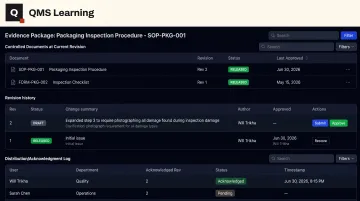
That is usually when teams need a system that builds an indexed, audit-ready evidence package in minutes instead of days. The package should compile:
- Controlled documents at the current revision
- Revision history with review and approval records
- Distribution and acknowledgment logs
Document control is the backbone of QMS reliability, not a filing chore. Discipline matters more than the format you pick. Past a certain scale, though, the tools decide whether that discipline is still practical to sustain.
Frequently Asked Questions
What are document control procedures?
They're the documented rules an organization follows to create, review, approve, distribute, revise, and retire QMS documents. The goal is ensuring only current, authorized versions are ever in use.
What are some examples of document control procedures?
Examples include document creation and naming conventions, review and approval workflows, version control rules, distribution and access control, and processes for removing or archiving obsolete documents.
What is the difference between document control and document management?
Document control refers to governance rules: approval, versioning, obsolescence. Document management is the broader system or software used to store and organize documents, whether or not they're formally controlled.
What documents does ISO 9001 require to be controlled?
ISO 9001 clause 7.5 requires control of all "documented information" the QMS needs to function, including procedures, work instructions, forms, and relevant external documents like customer specifications.
Who is responsible for document control in an ISO 9001 QMS?
Responsibility typically sits with a designated document controller or quality manager, though document owners and approvers across departments carry their own defined roles in the process.
What happens if document control fails during an ISO 9001 audit?
Auditors issue a nonconformity when outdated, unapproved, or unavailable documents are found in use. Certification bodies classify systemic failures as major findings, and unresolved major findings can put certification status at risk.