Introduction
Ask three certification bodies what ISO 9001 costs, and you'll get three different numbers. That's not a sales tactic — it's how the system works. Price depends on your headcount, site count, industry, and how much outside help you bring in.
Many manufacturers make the same mistake: they get one quote, assume it's "the" price, and budget accordingly. Then the internal labor hours show up. So does the training. So does the surveillance audit bill 12 months later that nobody planned for.
This guide breaks down real cost ranges by company size, the full list of cost components, what pushes price up or down, and how in-house preparation compares to hiring a consultant — so you can build a budget that actually holds up.
Key Takeaways
- Initial certification for a small manufacturer typically runs $6,000-$7,000, not counting internal labor or prep work
- Certification is a 3-year cycle (initial audit, two surveillance audits, and recertification), not a one-time fee
- Audit days scale with headcount under IAF rules, so more employees and more sites mean higher costs
- Consultants speed up implementation but cost more upfront; internal training builds capability that stays with your team
Quick Answer: ISO 9001 Certification Cost at a Glance
There's no single national price list for ISO 9001. The most reliable public data point: a 2023 worked example for a 35-person CNC shop put initial certification at $6,350–$6,800 (The Center's 2023 ISO 9001 cost breakdown).
That figure is a small single-site reference — not a universal benchmark. Mid-size and multi-site orgs need scope-specific quotes.
At a glance:
- Initial cert for a small shop: roughly $6,350–$6,800 (four-day audit ~$1,400/day + $750–$1,200 admin/travel)
- Real cost spans three years: surveillance audits annually + recertification — not just the first invoice
- Price drivers: headcount, number of sites, industry/regulatory complexity, QMS maturity, consultant vs. internal build
- Single site with solid documentation → lower end; multi-site or regulated (aerospace, medical) → budget higher
- No reliable published U.S. dataset for mid-size/large tiers — get a scope-specific registrar quote
How Much Does ISO 9001 Certification Cost? (Pricing Overview)
ISO doesn't issue or charge for certification. ISO writes the standard. Independent, accredited certification bodies (registrars) set their own fees and run the audits. Pricing varies because quotes reflect each registrar's labor and travel costs, not a fixed product.
The other piece nobody mentions in the sales conversation: your organization absorbs a second, often larger cost — building the quality management system itself. Skip that step, and you'll either fail the audit or scramble to fix it mid-process.
Common budgeting mistakes:
- Pricing only the audit invoice and ignoring internal staff hours
- Forgetting that surveillance audits and recertification are recurring costs, not optional add-ons
- Choosing an unaccredited registrar to save money (their certificate won't carry the same weight with customers)
Typical Cost Range by Organization Size
| Organization profile | Initial certification cost | Notes |
|---|---|---|
| Small, single-site, under ~50 employees | $6,350-$6,800 | Based on a 35-person shop example; four audit days at ~$1,400/day |
| Mid-size, ~50-250 employees or multi-process | No reliable published range | Audit days scale up per IAF headcount tables; get quotes |
| Large, multi-site, or regulated industry | No reliable published range | Site sampling, travel, and complexity require custom quotes |
These figures typically include document review, on-site audit days, and certificate issuance. They exclude internal labor, consultant fees, training, and document management software.
The Real 3-Year Cost, Not Just Stage 1/Stage 2
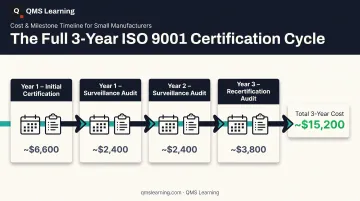
Certification isn't a one-and-done purchase. It's a three-year cycle: initial certification, then two annual surveillance audits, then a recertification audit that restarts the clock. Using the 35-person shop example, the full cycle looks like this:
| Audit event | Estimated cost | Timing |
|---|---|---|
| Initial certification (Stage 1 + Stage 2) | ~$6,600 | Year 1 |
| Surveillance audit | ~$2,400 | Year 1 (follow-up) |
| Surveillance audit | ~$2,400 | Year 2 |
| Recertification audit | ~$3,800 | Year 3 |
| 3-year total | ~$15,200 | — |
That's roughly double the sticker price most companies budget when they only plan for the initial invoice.
Key Factors That Affect the Cost of ISO 9001 Certification
Cost isn't arbitrary. It's shaped by your organizational scope, your industry, and how much outside help you use, not by ISO 9001 itself. The standard's requirements are identical for every company that adopts it.
Company Size and Number of Locations
Certification bodies calculate required audit days from your effective headcount, following IAF-aligned guidance. More people and more sites mean more audit days, and more audit days mean a higher invoice.
Per IAF MD 5 guidance, a company with 26–45 employees needs roughly 4 audit days, while one with 176–275 employees needs about 9. Multi-site organizations get partial audit-day sampling, but the central management function still gets audited every year.
Industry and Process Complexity
Regulated or technically demanding sectors such as aerospace, medical devices, and defense-adjacent manufacturing typically require deeper documentation and more audit hours than a straightforward, single-process shop. Auditors also add time for:
- Multiple shifts
- Outsourced processes
- Temporary work sites
Current State of Your Quality Management System
If you already have informal quality controls, standard operating procedures, and some documentation discipline, gap-closing work is lighter. Starting from zero costs more in both time and money, whether that time is billed by a consultant or absorbed by your own staff.
Internal Expertise vs. External Consultants
Hiring a consultant speeds up implementation but adds a direct line item to your budget. Training your own staff to lead the QMS build reduces that reliance over time. QMS Learning's General Manufacturing Quality pathway gives quality teams a self-paced path through ISO 9001 internal auditing, CAPA, audit program management, and management review. That lets them prepare for certification without a full-time consultant on payroll.
Certification Body and Geography
Audit fees, travel expenses, and regional labor rates all vary by registrar and location. Request quotes from several accredited bodies before signing anything. The day rate is often negotiable, and an out-of-town auditor adds lodging costs you'd otherwise avoid.
Cost Breakdown of ISO 9001 Certification
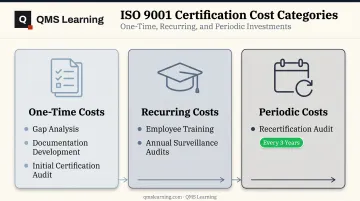
The total investment stretches well past the audit invoice. Plan across three categories: one-time setup costs, recurring costs, and periodic costs that hit every three years.
| Cost category | Type | What it covers |
|---|---|---|
| Preparation, gap analysis & documentation | One-time | Assessing current processes against ISO 9001:2015 clauses and building required documentation |
| Employee training | One-time / recurring | Staff awareness and internal auditor competence (repeats as staff turn over or the standard updates) |
| Certification body audit fees | One-time | Per-day audit rate times required days, plus admin and travel |
| Annual surveillance audits | Recurring | Shorter audits (often 1 day) in years 1 and 2 confirming continued compliance |
| Recertification audit | Periodic (every 3 years) | A full reassessment similar in scope to the original audit |
The line item most companies underestimate is preparation. Building a compliant QMS from scratch (writing procedures, mapping processes to clauses, training internal auditors) often takes more hours than the audit itself. Whether that time comes from a consultant's invoice or your own team's calendar, it's a real cost that belongs in the budget from day one.
In-House vs. Consultant-Led Certification — What's the Cost Difference?
Here's the truth most quotes don't tell you: the biggest swing in total ISO 9001 cost usually isn't company size. It's whether you build the QMS in-house or bring in a consultant.
| Factor | In-House Approach | Consultant-Led Approach |
|---|---|---|
| Upfront cost | Lower direct cash outlay; higher internal labor hours | Higher direct fees; faster path to audit-readiness |
| Timeline | Typically longer to reach audit-readiness | Faster, more predictable timeline |
| Long-term capability | Quality knowledge stays embedded in the team | Capability can leave with the consultant |
| Recertification risk | Team retains skills for future cycles | Repeat spend often needed at recertification |
| Best for | Teams with some quality background, investing in structured training | Organizations with no internal quality resource or a tight deadline |
The consultant route buys speed. That's real value if you're facing a hard deadline from a customer contract. But the risk is real too: when the consultant's engagement ends, so does a lot of the institutional knowledge — meaning you might pay again for outside help at the next recertification cycle or when a nonconformity crops up mid-cycle.
The in-house route asks for more patience upfront, but the payoff compounds. A team that works through structured, role-specific training keeps the capability on the payroll.
QMS Learning's ISO 9001 pathway is one example: a self-paced 16-hour course covering internal auditing, root cause and CAPA, and management review. Teams come out able to:
- Run internal audits without outside support
- Write clear, defensible nonconformities
- Prep for recertification without rehiring a consultant
- Handle mid-cycle issues when they crop up
That capability doesn't walk out the door when the project ends.
How to Budget for ISO 9001 Certification (and Avoid Costly Mistakes)
An accurate budget weighs two things: what your registrar will charge, and how much internal readiness work still stands between you and audit day. The more prep work needed, the more audit days and dollars the process consumes.
Factors to weigh before setting a number:
- Current QMS maturity: documented processes already in place, or starting cold
- Headcount and site count, which directly set your required audit days
- Industry-specific requirements that add documentation or audit time
- Consultant support versus building capability internally through training
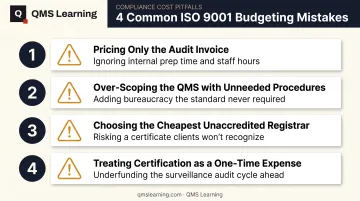
Common budgeting mistakes to avoid:
- Pricing only the audit invoice while ignoring internal staff hours
- Over-scoping the QMS with procedures you don't actually need
- Choosing the cheapest registrar without verifying accreditation
- Treating certification as a one-time expense instead of a 3-year commitment
Before committing to a provider, request itemized quotes from 3-4 accredited certification bodies, covering Stage 1, Stage 2, travel, and the full 3-year surveillance cost, not just the headline audit fee.
Conclusion
ISO 9001 certification cost swings widely based on company size, industry, and how much outside help you bring in. There's no single correct number, and anyone quoting you one figure without asking about your headcount, sites, and current processes is skipping steps.
Businesses that budget accurately look at the full three-year picture — initial audit, surveillance audits, and recertification — instead of fixating on the first invoice.
Budget for the cycle, not the kickoff:
- Initial certification audit and any gap-closure work
- Annual surveillance audits across years two and three
- Recertification at the end of the cycle
The smartest spend builds lasting internal quality capability. Certification then becomes a repeatable process your team owns, not a recurring bill for outside expertise.
Frequently Asked Questions
How long does it take to become ISO 9001 certified?
Timelines range from several weeks to over a year. Company size, scope, site count, and process maturity drive the difference, according to ANAB's certification FAQ. Most small-to-mid manufacturers land in the 3–6 month range.
Is ISO 9001 certification worth it?
Yes, for most manufacturers: it improves process control, builds customer trust, and often opens doors to contracts that require certification. The return typically outweighs the cost within the first certification cycle.
How much does it cost to get ISO 9001 certification in the USA?
Small single-site shops can expect roughly $6,000-$7,000 for initial certification. Mid-size and large or multi-site organizations need custom quotes, since costs scale with headcount, site count, and industry complexity.
Is the ISO 9001 certification cost a one-time payment?
No. Certification runs on a 3-year cycle that includes annual surveillance audits and a full recertification audit every three years. Budget for the recurring cost, not just the initial invoice.
How much do ISO 9001 consultants cost?
There's no reliably published national day-rate range for ISO 9001 consultants. Costs depend heavily on the consultant's experience and your project's scope, so request a gap-analysis quote before committing.
Can small businesses get ISO 9001 certified without hiring a consultant?
Yes. In-house certification is achievable with structured training and a solid gap analysis. Role-specific platforms like QMS Learning's General Manufacturing Quality pathway can help build internal auditing and CAPA skills without a full-time consultant.