Introduction
A prime contractor asks a machine shop for "AS9100." A commercial customer says ISO 9001 is fine. A parts distributor gets told AS9120 is the one that actually applies to them. Same alphabet soup, three different answers — and most quality managers have watched this confusion play out in a real RFQ.
The stakes aren't small. Pursuing the wrong certification can burn 6-12 months and a five-figure budget, only to fail an audit because the standard never matched the company's actual role in the supply chain.
This guide breaks down what ISO 9001, AS9100, and AS9120 each require, how they nest inside one another, and how to match the right standard to your role in the supply chain.
Key Takeaways
- ISO 9001 is the universal QMS foundation embedded word-for-word inside both AS9100 and AS9120
- AS9100 covers aerospace design, development, and manufacturing; AS9120 is built for distributors
- Your role in the aerospace supply chain determines which standard you need
- All three standards face revision around 2026-2027; certificate holders should track the transition timeline
What Is ISO 9001? The Foundation Standard
ISO 9001:2015 is the internationally recognized quality management system (QMS) standard, published by the International Organization for Standardization. It's sector-neutral by design, so the same requirements apply whether you're running a machine shop, a hospital, or a software company.
According to ISO, the standard is suitable for organizations of any size across manufacturing, services, healthcare, education, and government. It carries zero aerospace-specific requirements.
Three concepts anchor everything in ISO 9001:
- Annex SL structure: a harmonized 10-clause framework shared across all modern ISO management standards
- PDCA cycle: Plan, Do, Check, Act, applied to every process
- Risk-based thinking: building risk consideration into planning rather than treating it as a separate program
ISO 9001 isn't a "lite" version of AS9100. It's the literal base text embedded inside both AS9100 and AS9120. Neither aerospace standard removes anything from ISO 9001. They only add to it.
What Is AS9100? The Aerospace and Defense Extension
AS9100 (current revision D, aligned to ISO 9001:2015) is maintained by the International Aerospace Quality Group and published in the U.S. through SAE International. It applies to organizations that design, develop, and/or manufacture aviation, space, and defense products and services.
Why It Functions as a Market-Access Requirement
For most aerospace suppliers, AS9100 isn't optional. It's the price of entry. Major primes including Boeing, Lockheed Martin, Airbus, and Raytheon require their suppliers to hold AS9100 certification. No certificate, no purchase order.
What Gets Added on Top of ISO 9001
AS9100D layers aerospace-specific requirements onto the full ISO 9001 text, including:
- Product safety — formal awareness and control obligations
- Counterfeit parts prevention — sourcing and detection controls
- Configuration management — tracking product and process changes
- Structured risk management — identifying, prioritizing, and acting on operational risk
- First article inspection (FAI) and production process verification
- Special process control — validating processes like heat treat, welding, and NDT
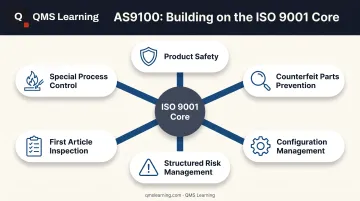
Most of these additions concentrate in Clause 8 (Operation), with performance evaluation requirements running through Clause 9.
Here's where most companies get tripped up: AS9100 auditors don't accept a polished quality manual as proof of compliance. They want evidence of effectiveness: records, traceability, sign-offs, and closed-loop corrective actions. A documented procedure with no evidence behind it is exactly where most nonconformities originate.
Audit-readiness is a training and execution problem. QMS Learning's Aerospace & Defense pathway targets that gap with an AS9100D Internal Auditor course covering Clauses 4 through 10, plus an AI Workbench that builds the audit-evidence records teams need.
What Is AS9120? The Standard for Aerospace Distributors
AS9120 (current revision B) is built for distributors and stockists: organizations that procure, store, split, and resell aerospace parts without altering their characteristics. If your team isn't changing the part, AS9120 is likely your standard, not AS9100.
What Gets Excluded
Because distributors don't manufacture, AS9120 deliberately drops several AS9100 sub-clauses that don't apply:
- Operational risk management (8.1.1)
- Product safety (8.1.3)
- Validation and control of special processes (8.5.1.2)
- Production process verification / FAI (8.5.1.3)
The clause numbering stays intact. These sections simply appear as "Not Used" placeholders, so the two standards remain cross-referenceable for anyone auditing across both.
What Gets Added Instead
AS9120B introduces distributor-specific definitions (including unapproved part) and one significant new requirement: Clause 8.1.5, Prevention of Suspect Unapproved Parts. That clause requires:
- Approved sourcing
- Traceability back to the original manufacturer
- Detection through verification or testing
- Segregation controls that stop suspect parts from re-entering the supply chain
In practice, AS9120 focuses on different controls than AS9100. Where AS9100 centers on production, AS9120 prioritizes:
- Traceability to the original manufacturer
- Inventory integrity and segregation
- Rigorous supplier evaluation
AS9100 vs AS9120 vs ISO 9001: Side-by-Side Comparison
| Criteria | ISO 9001 | AS9100 | AS9120 |
|---|---|---|---|
| Scope | General QMS, any industry | Aerospace design/manufacturing | Aerospace parts distribution |
| Applicable Organizations | Any sector | Design, development, manufacturing | Distributors, stockists |
| Base Standard | Standalone | ISO 9001:2015 (embedded) | ISO 9001:2015 (embedded) |
| Key Additions | None (sector-neutral) | Product safety, counterfeit parts, configuration management, FAI, special processes | Unapproved parts prevention (8.1.5), traceability, supplier evaluation |
| Typical Certificate Holders | Manufacturers, services, healthcare, education | OEMs, Tier 1/2/3 suppliers | Parts distributors, stockists |
Think of it as three concentric circles. ISO 9001 sits at the center. AS9100 wraps the full ISO 9001 text in the most sector-specific additions. AS9120 applies that same ISO 9001 base with a smaller, distributor-focused subset.
That nesting has a practical consequence: holding a separate ISO 9001 certificate alongside AS9100 or AS9120 is usually redundant, since the aerospace standards already contain every ISO 9001 requirement in full. It's not technically wrong, but it adds nothing unless a non-aerospace customer explicitly requires the ISO 9001 certificate on paper.
The IAQG's OASIS directory tracks certified organizations globally, and AS9100 certificates significantly outnumber AS9120 certificates in the U.S. — a reflection of how many more manufacturers exist relative to specialized aerospace distributors.
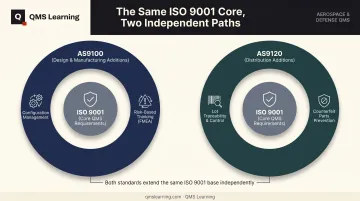
All three standards share the same backbone:
- Annex SL structure
- PDCA cycle
- Seven ISO quality management principles (customer focus, leadership, engagement, process approach, improvement, evidence-based decisions, and relationship management)
That shared foundation is why a mature ISO 9001 system makes upgrading to AS9100 or AS9120 much faster than starting from zero.
Which Standard Does Your Organization Need?
Use this simple decision path:
- Design or manufacture aerospace products? → AS9100
- Distribute or resell aerospace parts without altering them? → AS9120
- Perform MRO or repair work? → AS9110 (a sibling standard built specifically for maintenance organizations)
- No aerospace touchpoint at all? → ISO 9001 is sufficient
In practice, most companies don't choose freely. Customers and contracts decide. Flowdown from primes and Tier 1 suppliers makes the certification mandatory. Your scope of work sets the standard; the contract confirms it.
Holding the right certificate doesn't guarantee you'll pass the audit. Teams still need role-specific training and the ability to produce audit evidence on demand—not a binder of procedures nobody has practiced.
QMS Learning offers dedicated pathways for AS9100D and ISO 9001, so teams train to the exact standard they'll be audited against, not a generic quality course that skips the clauses that drive real findings.
Frequently Asked Questions
Is AS9120 the same as AS9100?
No. AS9120 shares AS9100's ISO 9001 base and much of its structure, but it's a distinct, lighter standard built for distributors. It excludes manufacturing-specific clauses like product safety and first article inspection.
What are the key differences between ISO 9001 and AS9100?
AS9100 contains the entire ISO 9001 standard plus over 100 aerospace-specific additions. These cover product safety, counterfeit parts prevention, configuration management, and first article inspection.
Is AS9100 being replaced?
AS9100 Rev D is being succeeded by IA9100, expected to publish alongside the revised ISO 9001 around 2026-2027. A multi-year transition window means current certificates remain valid in the meantime.
Can a company hold both ISO 9001 and AS9100 certifications?
Technically yes, but it's generally redundant since AS9100 already contains all ISO 9001 requirements. It only makes sense if a specific non-aerospace customer contractually requires the separate ISO 9001 certificate.
Which standard do aerospace distributors need?
AS9120 is the standard built for distributors and stockists. It focuses on traceability and supplier evaluation rather than the design or manufacturing controls found in AS9100.
How long does AS9100 or AS9120 certification take?
Timelines vary by organization, but building from scratch typically takes longer than upgrading an existing ISO 9001 system. Internal readiness — not certification body scheduling — is usually the real bottleneck.