Introduction
ISO 14001 and ISO 45001 rank among the most widely adopted management system standards worldwide, and most EHS teams end up managing both at once. That's not a coincidence. Both standards share the same Annex SL high-level structure, so clause numbers, terminology, and audit rhythm look nearly identical.
Getting this comparison right isn't academic. EHS teams already juggle competing environmental and safety priorities; choosing which standard to prioritize—or whether to run both at once—shapes audit prep timelines, resource allocation, and where legal exposure sits.
The 2024 ISO Survey reports 676,232 valid ISO 14001 certificates and 542,527 valid ISO 45001 certificates worldwide, according to ISO's official survey data. This guide breaks down definitions, key differences, real use cases, and a practical framework for deciding what to tackle first.
Key Takeaways
- ISO 14001 governs environmental management; ISO 45001 governs occupational health and safety
- Both share the same Annex SL structure, making integrated audits and documentation far more efficient
- ISO 14001 targets environmental impact and legal compliance; ISO 45001 targets hazard elimination and worker protection
- Most manufacturers and facility-heavy operations pursue both standards concurrently, not sequentially
- Your starting point depends on which risk is currently more urgent: environmental liability or workplace safety
ISO 14001 vs ISO 45001: Quick Comparison
Here's how the two standards compare side by side:
| Comparison Point | ISO 14001 | ISO 45001 |
|---|---|---|
| Primary Focus | Environmental performance and continual improvement | Worker health and safety management |
| Scope of Risk Managed | Waste, emissions, resource use, environmental legal obligations | Workplace hazards, injuries, illness, OH&S legal obligations |
| Who It Protects | The environment and affected stakeholders | Workers, contractors, and site visitors |
| Core Documentation | Environmental aspects register, legal compliance tracker | Hazard register, risk assessments, incident logs |
| Typical Certification Driver | Customer/tender requirements, ESG reporting pressure | Insurance costs, injury rates, safety citations |
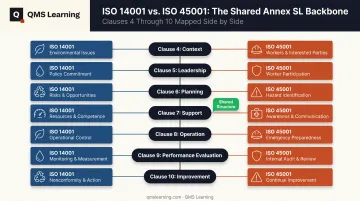
Both frameworks run on the same Annex SL structure (clauses 4–10): context, leadership, planning, support, operation, performance evaluation, and improvement. That shared architecture is exactly why so many companies build one integrated system instead of two separate ones.
What Is ISO 14001?
ISO 14001 is the internationally recognized standard for Environmental Management Systems (EMS). It gives manufacturers and facility operators a framework for managing waste streams, emissions, energy consumption, and resource use — all tied back to measurable environmental objectives.
The operational payoff is concrete:
- Lower energy and waste disposal costs through tighter resource tracking
- Fewer environmental violations and associated fines
- Stronger positioning with customers and investors who screen for ESG performance
A word on timing: ISO 14001:2026 was published on April 15, 2026, replacing the 2015 edition. Key changes include a life-cycle perspective in scope-setting, expanded leadership accountability beyond top management, a new Clause 6.3 requirement to plan for organizational change, and sharper internal-audit performance expectations.
Certificate holders on the 2015 edition typically get about three years to transition. The exact window depends on your certification body.
Use Cases of ISO 14001
EMS work shows up daily in a few specific places: the environmental aspects register, legal compliance obligation tracking, and life-cycle thinking built into procurement and design decisions. It's not a once-a-year audit exercise — it's a running log.
ISO 14001 dominates in industries where environmental footprint is inherent to the process:
- Manufacturing and industrial production
- Construction
- Energy and utilities
- Chemical processing
- Waste management
One documented food-manufacturer case found EMS practices cut the environmental-risk score from 10 to 5, with waste categorization and composting recovering material value that had been written off.
Results vary by facility, but the pattern holds: structured environmental management finds money that otherwise leaks out as waste.
What Is ISO 45001?
ISO 45001 is the international standard for Occupational Health and Safety (OH&S) management. Any organization with workers, contractors, or shop-floor operations can apply it. Hazard identification, risk assessment, and injury/illness prevention are the core mechanics.
The business case is straightforward:
- Fewer lost-time incidents and reduced downtime
- Lower workers' compensation premiums and insurance costs
- Better employee retention and morale on the floor
Why the OHSAS 18001 history matters: ISO 45001 replaced OHSAS 18001 back in 2018, and the migration deadline (extended to September 2021 because of COVID-19) has long since passed. If your organization is still referencing OHSAS 18001 internally, that's a sign your safety documentation needs a refresh. Registrars stopped recognizing it years ago.
Use Cases of ISO 45001
OH&S management lives inside worker participation programs, incident investigation procedures, hazard controls, and contractor/subcontractor safety oversight. It's less about paperwork and more about catching problems before someone gets hurt.
Industries where ISO 45001 carries the most weight:
- Construction
- Manufacturing
- Mining
- Transportation
- Aerospace and defense operations
The numbers back up the investment. An aluminum manufacturer profiled by ASSP implemented ISO 45001 after a gap analysis and folded safety processes into its existing management software.
The result was a 50% reduction in injuries, with injury severity also declining once high-risk hazards were addressed directly. That's the kind of outcome that changes how a plant manager talks to the CFO about training budget.
ISO 14001 vs ISO 45001: Which One Do You Need First?
There's no universal right answer here. The correct starting point depends on four factors:
- Current regulatory exposure: is environmental compliance or worker safety generating more citations or near-misses right now?
- Customer or tender requirements: does a contract explicitly demand one certification over the other?
- Industry risk profile: chemical plants skew environmental; construction sites skew safety-heavy.
- Your most pressing operational pain point: what's actually keeping your EHS team up at night?
- Prioritize ISO 14001 if environmental compliance, sustainability reporting, or ESG pressure is the loudest signal.
- Prioritize ISO 45001 if injury rates, near-misses, or safety citations are driving the conversation.
Most Organizations Don't Have to Choose
Because both standards run on the same Annex SL structure, they combine into a single Integrated Management System (IMS) without much friction. Shared clauses mean shared document control, internal audits, corrective actions, and management reviews — no need to run two parallel compliance programs.
Red Ambiental, a waste-management company operating across 20 Mexican states with roughly 4,500 employees, built an IMS covering both ISO 14001 and ISO 45001.
According to LRQA's case study, the integrated approach cut duplicated effort, reduced audit fatigue, and improved resource efficiency. That matters when an EHS team is stretched across two compliance obligations at once.
Where Training Fits Into the Decision
Most EHS managers aren't choosing between standards in a vacuum. They're building team capability against both at once, usually with limited headcount.
QMS Learning's Environmental & Safety Compliance pathway was built for that reality. It bundles EHS fundamentals, the ISO 14001:2026 transition, and ISO 45001 program content into one track, so plant managers aren't running separate certifications through separate vendors.
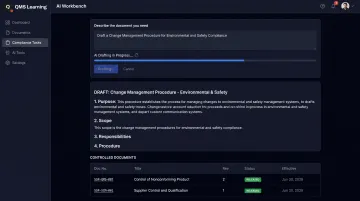
The pathway's AI Workbench is trained on ISO 14001:2026 and ISO 45001 requirements specifically. It can draft a Clause 6.3 change-management procedure one minute and build out a hazard analysis the next, without switching tools between environmental and safety tasks.
If your team is juggling environmental liability and injury-rate pressure at the same time, one pathway that covers both beats two disconnected training programs. See how the Environmental & Safety pathway works for teams carrying dual obligations.
Conclusion
The right answer to "ISO 14001 or ISO 45001?" depends on which risk is more material to your business right now. If environmental penalties or ESG scrutiny keep landing on your desk, start with ISO 14001. If injury rates or safety citations are the fire you're putting out, start with ISO 45001.
Either way, the outcomes look similar: fewer workplace incidents, avoided environmental fines, and stronger audit readiness. Many organizations share facilities, leadership teams, and audit calendars across both risks, so most certify against both eventually. Annex SL makes that dual path far easier than it used to be.
Prioritize the standard tied to your highest current exposure, then build the shared management-system habits—risk assessment, corrective action, and audit evidence—that transfer cleanly when you add the second.
Frequently Asked Questions
What are the key differences between ISO 14001 and ISO 45001?
ISO 14001 manages environmental impact, such as waste, emissions, and resource use. ISO 45001 manages occupational health and safety risks to workers. Both share the same Annex SL structure, which simplifies running them together.
What are the main elements of ISO 14001 and ISO 45001?
Both use the Annex SL 10-clause structure. Clauses 4–10—context, leadership, planning, support, operation, performance evaluation, and improvement—share the same numbers and titles in each standard.
What are ISO 9001, ISO 14001, and ISO 45001?
ISO 9001 covers quality management systems, ISO 14001 covers environmental management, and ISO 45001 covers occupational health and safety. All three now share the same Annex SL high-level structure.
Can a company be certified in both ISO 14001 and ISO 45001 at the same time?
Yes. Because both standards share the same high-level structure, organizations can build a single Integrated Management System and audit both simultaneously, cutting duplicated documentation and audit cycles.
Do I need ISO 14001 or ISO 45001 first?
It depends on which risk is more urgent for your organization: environmental compliance obligations or worker safety incidents. Customer and regulator pressure on either front often tips the decision.
What standard did ISO 45001 replace?
ISO 45001 replaced OHSAS 18001 in 2018 as the internationally recognized standard for occupational health and safety management systems.