In that moment, "EHS" stops meaning a laminated poster in the break room. It becomes a test of whether the organization actually has a functioning compliance system.
Environmental Health and Safety sits at the crossroads of pollution control, worker health, and workplace safety. Most organizations no longer treat these as three separate functions — they run them as one integrated compliance discipline, because regulators and auditors increasingly expect them to connect.
This article defines EHS, breaks down its three core pillars with real examples, covers the regulations that govern it, and explains what it actually takes to build a program that holds up when someone shows up unannounced.
Key Takeaways
- EHS pulls environmental protection, occupational health, and workplace safety into one managed compliance system
- OSHA's 2026 penalty caps reach $165,514 per willful violation, making noncompliance a direct financial risk
- Manufacturing and healthcare carry above-average injury rates—and most other industries still carry EHS obligations
- Written policies alone fail audits; programs need documented training and inspection records
- Role-specific training helps teams generate audit-ready evidence in minutes instead of days
What Is Environmental Health and Safety (EHS)?
EHS is the organizational function responsible for protecting employees, the public, and the environment from operational hazards while meeting legal and regulatory obligations. The work is ongoing—not a one-time checklist you file away.
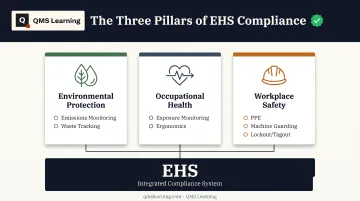
It's a discipline that spans hazard identification, pollution prevention, occupational illness prevention, and the recordkeeping regulators expect to see on demand. Three pillars hold it together.
Environmental Protection
This pillar limits pollution and hazards to air, water, soil, and surrounding communities. It's the piece most people associate with the "E" in EHS, and it carries real legal teeth under EPA jurisdiction.
Typical activities include:
- Emissions monitoring and reporting
- Hazardous waste management and disposal tracking
- Chemical storage compliance
- Stormwater management and spill prevention
Occupational Health
Occupational health focuses on exposures that cause chronic illness rather than acute injury: the slow-building risks that don't show up in an incident report the same day they happen.
Common program elements:
- Noise and chemical exposure monitoring
- Ergonomic assessments for repetitive-motion tasks
- Respiratory protection programs
Workplace Safety
This is the pillar most people picture first: preventing acute injuries and fatalities through hazard controls and emergency planning. It's also the area OSHA inspectors scrutinize most closely.
Core practices include:
- PPE programs
- Machine guarding
- Lockout/tagout procedures
- Job hazard analyses
- Emergency action plans
Why EHS Compliance Matters for Your Organization
Noncompliance is a line item on your budget.
For calendar year 2026, federal OSHA's maximum penalties are $16,550 per serious violation and $165,514 per willful or repeated violation, according to OSHA's 2026 civil penalty adjustment memo. Multiply that across multiple citations from one inspection, and the number gets large fast.
The human stakes are just as stark. BLS recorded 5,070 fatal work injuries in 2024 — a rate of 3.3 per 100,000 full-time workers. That's down slightly from 2023, but it's still thousands of families affected by preventable workplace incidents.
There's also a quieter cost most leadership teams underestimate: the National Safety Council estimates the average medically consulted work injury costs $48,000, once you factor in wage losses, medical expenses, and administrative burden.
Compliance pays off beyond avoiding fines:
- Lower workers' compensation and insurance premiums
- Stronger trust with customers, investors, and insurers
- Less operational downtime from incidents and shutdowns
- Fewer disruptions to production schedules from injury investigations
Examples of Environmental Health and Safety Practices in Action
What does EHS actually look like day-to-day? It varies by industry, but the underlying logic stays consistent everywhere: identify hazards, control them, and document the controls.
Manufacturing plant floors typically run on:
- Chemical inventory and Safety Data Sheet (SDS) management
- Routine machine guarding audits
- Hazardous waste tracking that matches what regulators see on paper
Construction sites prioritize:
- Fall protection programs
- Job hazard analyses before high-risk tasks begin
- Dust and silica controls on cutting and grinding
Office and healthcare settings still carry real exposure:
- Ergonomic assessments for desk workers
- Bloodborne pathogen controls in clinical areas
- Indoor air quality monitoring in older buildings
Across sectors, mature programs also share:
- Incident and near-miss reporting systems
- Scheduled EHS inspections and internal audits
- Emergency response drills on a fixed cadence
Key EHS Regulations and Governing Agencies
EHS compliance runs through a layered set of authorities, each with a distinct scope.
| Body | Scope | Type |
|---|---|---|
| OSHA | Workplace safety standards, enforcement, whistleblower protections | Federal, mandatory |
| EPA | Environmental protection laws and enforcement | Federal, mandatory |
| ISO 45001 | Occupational health and safety management systems | Voluntary international standard |
| ISO 14001 | Environmental management systems | Voluntary international standard |
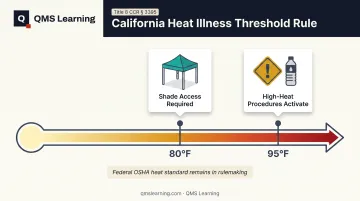
State programs can exceed federal baselines. California's heat illness rule (8 CCR 3395) requires shade access once temperatures pass 80°F and high-heat procedures at 95°F for outdoor industries like construction and agriculture.
That puts California ahead of federal OSHA, whose heat-specific standard is still in rulemaking rather than finalized.
Standards keep moving. Two recent updates that catch teams off guard:
- ISO 14001:2026 replaced the 2015 edition
- OSHA's Hazard Communication Standard (2024) aligned with GHS Revision 7, with new labeling and SDS requirements
Failing to track revisions like these is one of the most common causes of audit findings.
What Does an EHS Professional or Department Actually Do?
EHS professionals identify hazards, build and enforce safety and environmental policies, deliver training, and maintain the documentation regulators expect during inspections.
According to the Bureau of Labor Statistics, occupational health and safety specialists inspect and evaluate workplace environments for regulatory compliance. They design improvements and investigate incidents for root causes.
Role structure typically scales with organization size:
- EHS Specialist — handles fieldwork, inspections, and day-to-day monitoring
- EHS Manager — owns the overall program and reports on compliance status
- EHS Director — sets multi-site strategy across plants or regions
Here's the failure mode that shows up in nearly every audit finding review: EHS knowledge concentrated in one or two senior staff members.
When that person is on vacation, out sick, or leaves, institutional memory walks out the door. The next surprise inspection exposes the gap immediately.
Building an EHS Program That Survives an Audit
Having EHS policies written down isn't the same as having a program that produces auditor-acceptable evidence on demand. Auditors don't ask if you have a policy. They ask you to prove it's followed.
A mature program needs:
- Written procedures mapped to applicable standards
- Training and competency records by employee
- Inspection and audit schedules, tracked and current
- Incident and corrective action tracking with closure evidence
- Emergency response plans, tested and updated
The recurring gap? Teams complete generic EHS training, then freeze when they need to apply ISO 14001, ISO 45001, or OSHA requirements to a live nonconformity or an inspector standing in front of them.
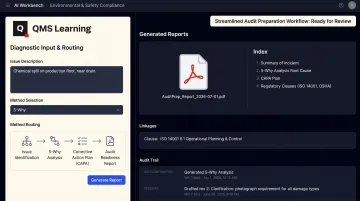
This is the problem QMS Learning built its Environmental & Safety Compliance pathway to solve. The pathway's EHS Fundamentals course covers ISO 14001, ISO 45001, OSHA general-industry requirements, and EPA reporting across 12 modules and 50 lessons.
A dedicated ISO 14001:2026 Transition course covers every clause change ahead of the standard's certification deadline. Paired with each course is an AI Workbench trained on ISO 14001:2026, ISO 45001, OSHA 29 CFR 1910, and two decades of real EHS audit findings.
The Workbench helps teams act under pressure:
- Diagnoses the real issue (process gap, isolated incident, or supplier change)
- Routes it to the right method: 5-Why, CAPA, FMEA, or Gap Analysis
- Generates a single, indexed, audit-ready PDF instead of a late-night scramble before the auditor arrives
Whatever training approach an organization chooses, the goal stays the same: build in-house capability that doesn't depend on an outside consultant showing up every time an auditor does.
Frequently Asked Questions
What does environmental health and safety do?
EHS identifies workplace hazards, sets protective policies, delivers training, and maintains the documentation regulators expect. This spans inspections, incident response, and regulatory reporting to agencies like OSHA and the EPA.
What are some examples of environmental health and safety practices?
Common examples include PPE programs, chemical and hazardous waste management, ergonomic assessments, machine guarding audits, and scheduled emergency response drills. Practices vary by industry but follow the same identify-control-document pattern.
What is the difference between EHS and HSE?
EHS and HSE cover the same three disciplines (environment, health, and safety) in a different letter order. EHS is the more common convention in North America, while HSE is widely used in the UK, Europe, and the oil and gas sector.
What industries need EHS programs the most?
Manufacturing, construction, energy, and healthcare carry the highest documented risk exposure. That said, nearly every workplace, including offices, has some level of EHS obligation, even when the scope is smaller.
What certifications should an EHS professional pursue?
Common individual credentials include the Certified Safety Professional (CSP) through BCSP and the Certified Industrial Hygienist (CIH) through the Board for Global EHS Credentialing. Organizational standards like ISO 45001 and ISO 14001 complement these individual credentials.
Is EHS the same as ISO 14001 and ISO 45001?
No. EHS is the broader discipline covering environmental, health, and safety management overall. ISO 14001 and ISO 45001 are specific certifiable management system standards organizations use to structure and prove that discipline.