Confuse the two and you might train staff on the wrong document, budget for a certification that doesn't exist, or scramble when a customer's RFQ asks for proof of ISO 9001 compliance while your team hands over the wrong paperwork.
ISO 9001 remains the most recognized quality management standard in the world, spanning manufacturing, aerospace, medical devices, and services. Knowing exactly which standard governs what — and what your team actually needs to do — keeps your certification timeline and audit prep on track.
This guide breaks down the real difference, where each standard fits in your quality system, and how to move from knowing the clauses to actually passing an audit.
Key Takeaways
- ISO 9000 defines quality management vocabulary and the seven QMPs; it's a reference document, not a certification
- ISO 9001 sets the auditable Clause 1–10 requirements that certification bodies assess against
- You don't choose between them: ISO 9000 builds shared understanding, ISO 9001 drives certification
- Passing an ISO 9001 audit takes structured training and internal audit competence, not only reading the standard
ISO 9000 vs ISO 9001: Quick Comparison
If you only remember one thing from this article, make it this: ISO 9000 explains, ISO 9001 requires. Here's how the two compare side by side.
| Attribute | ISO 9000 | ISO 9001 |
|---|---|---|
| Purpose | Defines terminology, concepts, and the seven quality management principles | Sets specific, auditable requirements (Clauses 1–10) for a QMS |
| Certifiable | No — informational and reference only | Yes — third-party certification available |
| Primary Audience | Training, onboarding, shared quality language across teams | Certification bodies, auditors, customers requiring proof of compliance |
| Structure | Vocabulary and principle-based guidance document | Structured clauses covering context, leadership, planning, support, operation, evaluation, and improvement |
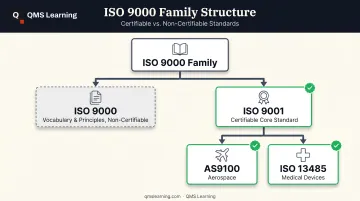
Neither document works alone. ISO 9000 gives your team a shared quality vocabulary; ISO 9001 gives auditors concrete requirements to verify.
What is ISO 9000?
ISO 9000 is the foundational member of the ISO 9000 family. It establishes fundamentals and shared vocabulary for quality management systems, so that "nonconformity," "corrective action," and "top management" mean the same thing to your production floor and your registrar.
That shared language matters more than it sounds. Without it, two departments can interpret "conformity" or "process" differently, and that gap shows up during audits as inconsistent documentation.
ISO 9000 also lays out the seven quality management principles (QMPs) that shape every requirement in ISO 9001:
- Customer focus: meet requirements and aim to exceed expectations
- Leadership: set a clear purpose so people can pursue quality objectives
- Engagement of people: competent, empowered staff at every level create and deliver value
- Process approach: manage work as interrelated processes for consistent results
- Improvement: keep getting better, not just staying compliant
- Evidence-based decision making: ground choices in data and analysis, not guesswork
- Relationship management: actively manage ties with suppliers and other interested parties
One thing to be clear on: you cannot get certified to ISO 9000. It functions as an educational and reference resource, not an audit standard. No registrar will show up to assess your compliance against it.
Use Cases of ISO 9000
ISO 9000 typically shows up early in an organization's quality lifecycle — during employee onboarding, quality awareness training, or planning before pursuing ISO 9001 certification.
A machine shop preparing for its first ISO 9001 audit, for example, might use ISO 9000 to train production and QA staff on what actually counts as a "nonconformity" and how continual improvement is supposed to work, before rolling out the formal ISO 9001 processes. That groundwork keeps everyone speaking the same language once the audit clauses come into play.
What is ISO 9001?
ISO 9001 is the certifiable standard within the ISO 9000 family. It is the only certifiable standard in the family, and it is structured around ten clauses:
- Scope
- Normative references
- Terms and definitions
- Context of the organization
- Leadership
- Planning
- Support
- Operation
- Performance evaluation
- Improvement
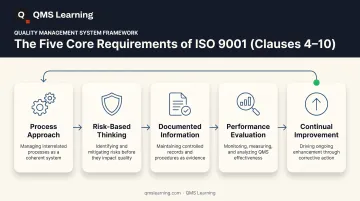
The substantive requirements live mostly in Clauses 4 through 10, and they cover:
- Process approach : treating your operations as interconnected systems, not isolated tasks
- Risk-based thinking : identifying what could go wrong before it does
- Documented information : the records and procedures that prove your QMS actually functions
- Performance evaluation : internal audits and management review that check whether the system works
- Continual improvement : closing the loop when something doesn't work
Certification itself delivers real, tangible payoff: consistent product quality, fewer defects and less rework, a competitive edge in RFQs, and access to customers who simply won't buy from uncertified suppliers.
Certification alone does not guarantee results. Reading the standard does not teach you how to close a nonconformity, run an internal audit that finds real problems, or keep the QMS alive between audit cycles. That is a skills gap, and structured, role-specific training is what closes it.
Use Cases of ISO 9001
ISO 9001 shows up across the manufacturing process: supplier qualification, production control, in-process inspection, and customer contracts. In machining, injection molding, fabrication, assembly, and packaging, certification is often the baseline customers expect before they issue a purchase order.
That application gap is what QMS Learning's General Manufacturing Quality pathway is built to close. It centers on ISO 9001 and is designed to move teams from knowing the clauses to becoming audit-ready, typically within 30 days of rollout, with practical internal-auditor training and tools for handling real nonconformities.
ISO 9000 vs ISO 9001: How They Work Together and Which You Need
These aren't competing standards you pick between. ISO 9000 provides the "why" and the shared language; ISO 9001 provides the "how" and the certifiable checklist. You need both concepts working together, even though only one gets audited.
Situational guidance:
- Use ISO 9000 when onboarding new hires or aligning cross-functional teams on quality language
- Pursue ISO 9001 certification when customers, contracts, or regulators require documented proof of a working QMS
A common misconception is that ISO 9000 has to be implemented first, as a formal prerequisite. It doesn't. ISO 9000 is recommended reading — it is the normative reference ISO 9001 uses for definitions. Nothing stops you from starting ISO 9001 implementation directly, with a knowledgeable consultant or trainer filling the vocabulary gap along the way.
The practical sequence most manufacturers follow:
- Understand ISO 9000 principles to establish shared quality vocabulary
- Define QMS scope per ISO 9001 Clause 4
- Build out Clauses 5–10 — leadership, planning, support, operation, evaluation, improvement
- Pursue certification through internal audits and a registrar assessment
Real-World Example: ISO 9001 Certification in Practice
New Berlin Plastics, a custom injection-molded-components manufacturer with roughly 140 employees, needed a rapid upgrade to ISO 9001:2015. Customers were demanding current certification, and staying competitive depended on it.
Working with the Wisconsin Manufacturing Extension Partnership, the company ran a gap analysis against the standard and moved through a structured upgrade project rather than starting from scratch.
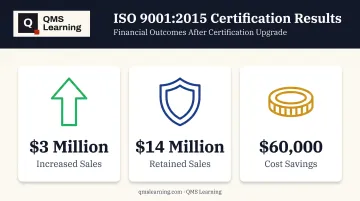
NIST-reported results tied directly to keeping the certification customers required:
- $3 million in increased sales
- $14 million in retained sales
- $60,000 in cost savings
That pattern shows up across general manufacturing. Certification is often the deciding factor in whether a customer keeps sending purchase orders at all.
Teams that pair standards knowledge with structured, role-specific training tend to reach audit-ready status faster. They also stop calling outside consultants for every finding. QMS Learning's General Manufacturing Quality pathway and AI Workbench close that gap so manufacturing teams build competence in-house instead of rebuilding it every audit cycle.
Frequently Asked Questions
What does ISO 9001 stand for?
ISO 9001 isn't an acronym. "ISO" is the short name for the International Organization for Standardization, and "9001" is the standard's reference number within the ISO 9000 family covering quality management requirements.
What is the difference between ISO 9001 and AS9100 (sometimes called "ISO 9100")?
AS9100 is the aerospace-specific interpretation of ISO 9001. It includes every ISO 9001 requirement plus additions like configuration management, counterfeit-parts prevention, and operational risk management for aviation, space, and defense organizations.
Can a company get certified to ISO 9000?
No. ISO 9000 is informational only and doesn't involve certification. Within the family, only ISO 9001 and industry variants like AS9100 or ISO 13485 can be certified.
Do I need to implement ISO 9000 before ISO 9001?
No. It isn't a formal prerequisite. Reviewing ISO 9000 first helps build shared terminology, but many organizations move straight into ISO 9001 implementation.
How long does it typically take to become ISO 9001 certified?
Timelines range from several weeks to more than a year, depending on organization size, scope, and how many facilities are involved. Structured training can compress this timeline compared to ad hoc, trial-and-error preparation.
Is ISO 9001 only for manufacturers?
No. ISO 9001 is a generic standard applicable to any industry, including services, IT, and healthcare, though manufacturing remains its heaviest adopter due to customer and contract requirements.