Yet most quality teams treat compliance like a classroom checkbox. They complete the training, file the certificate, and move on. Then an auditor asks, "show me the evidence," or a real nonconformity lands on someone's desk, and the room goes quiet.
This guide breaks down what regulatory compliance actually means inside a quality management system (QMS), the major frameworks by industry, how to build a working compliance program, the mistakes that sink audits, and how modern tools are closing the gap between finishing a course and performing under audit pressure.
Key Takeaways
- Regulatory compliance is legally mandatory; quality compliance is customer-negotiable
- AS9100D, ISO 13485, ITAR, OSHA, and CMMC each demand objective evidence, not assumptions
- Spreadsheet-based tracking is the leading cause of failed audits and repeat findings
- A living regulatory obligation registry beats an annual compliance checklist
What Is Regulatory Compliance in Quality Management?
Regulatory compliance in a QMS context means structured adherence to external laws, statutes, and industry-mandated standards that govern how you design, manufacture, and deliver a product. Think safety rules, environmental mandates, and export controls.
Here's the part teams miss: regulatory compliance leaves no room for tradeoffs. A product either meets the mandated requirement, or it cannot legally enter the market. There's no "close enough."
Regulatory Compliance vs. Quality Compliance
Quality compliance and regulatory compliance often get lumped together. They're not the same thing.
Quality compliance means meeting customer or internal expectations, such as workmanship, reliability, and functionality. Regulatory compliance means meeting externally mandated law, such as AS9100D, ISO 13485, ITAR, or OSHA.
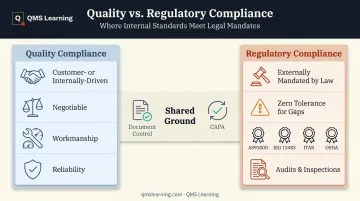
They overlap more than you'd think. Practices like Good Manufacturing Practice (GMP), document control, and CAPA satisfy both an external regulatory obligation and your internal quality culture at the same time. Build one, and you often satisfy the other.
Where Regulatory Compliance Lives Inside Your QMS
Standards don't just mention regulatory obligations in passing. They embed them directly into specific clauses.
- AS9100D requires statutory and regulatory requirements to be identified under Clause 8.2.2 (determining product requirements) and Clause 8.3.3 (design and development inputs)
- ISO 13485 requires a medical device file per device family under Clause 4.2.3, demonstrating regulatory conformity
- ITAR ties directly into document control and access control: technical data handling is legally mandated, not just a best practice
Document control, traceability, and your nonconformance/CAPA process are what produce the objective evidence auditors and regulators actually require. Without those three working together, "we're compliant" is just a claim, not proof.
Key Regulatory Frameworks and Standards Across Industries
Quality teams rarely deal with a single framework. Most manage several at once, and each one carries different clauses, cadences, and penalties.
| Sector | Primary Frameworks |
|---|---|
| Aerospace & Defense | AS9100D, ITAR (22 CFR Parts 120-130) |
| General Manufacturing | ISO 9001:2015 |
| Medical Devices | ISO 13485:2016, FDA 21 CFR Part 820 (QMSR) |
| Environmental, Health & Safety | ISO 14001:2026, ISO 45001, OSHA 29 CFR 1910 |
| Defense Cybersecurity | CMMC, NIST SP 800-171 |
An aerospace supplier, for example, might be managing three frameworks at once:
- AS9100D audits and surveillance cycles
- ITAR export-control recordkeeping
- ISO 14001 environmental evidence requirements
Three audit cycles, three sets of evidence, one quality team. That's exactly why a framework-by-framework approach creates blind spots. You end up strong on whichever standard you audited most recently and exposed everywhere else.
These frameworks change more often than most training programs account for. ISO 14001 is a clear example: ISO 14001:2026 replaced the 2015 edition, tightening requirements around resource use, biodiversity, and environmental performance. If your EHS training material still reflects the 2015 version, your team is studying for an exam that no longer exists.
Static, once-a-year training simply cannot keep pace with standards that revise on this kind of cycle.
Why Regulatory Compliance Matters: Benefits and Risks of Non-Compliance
Compliance is the prerequisite for market access. Registrars won't certify you without it, primes won't award contracts without it, and regulators won't clear product to ship. That directly affects revenue and contract eligibility, full stop.
Organizations that embed compliance into daily operations, rather than treating it as an annual scramble, see fewer repeat nonconformities and faster audit cycles. The evidence already exists when the auditor arrives, because it was built into the workflow rather than reconstructed the night before.
What Non-Compliance Actually Costs
The risk isn't theoretical. In April 2024, a federal court entered a consent decree against Philips Respironics after a massive recall of CPAP, BiPAP, and ventilator devices tied to quality system failures. According to the FDA's press release on the consent decree, Philips was ordered to:
- Stop manufacturing most sleep and respiratory devices at three Pennsylvania facilities
- Retain outside experts and demonstrate conformity with current Good Manufacturing Practice requirements
- Complete an FDA-approved recall-remediation plan, including device repairs, replacements, and partial refunds
- Obtain FDA authorization before resuming operations at those facilities
That's production halted, outside consultants on retainer, and a remediation plan that has to satisfy a federal regulator before the line restarts. No dollar figure was published, but the cost drivers (lost production, remediation, refunds, delayed restart) compound fast in a regulated industry.
Contract eligibility carries similar teeth in defense. Under the CMMC acquisition rule, a contracting officer cannot award a covered contract if the offeror lacks the required CMMC status. No certification, no contract, even if the work itself is flawless.
How to Build a Regulatory Compliance Program Within Your QMS
A working compliance program isn't a binder you update once a year. It's a living system. Here's the build sequence that holds up under audit scrutiny.
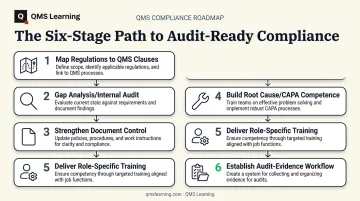
Map every applicable regulation to specific QMS clauses. Build a living regulatory obligation registry, not a one-time checklist. Every standard you carry should tie to the exact process it governs.
Run a gap analysis or internal audit against each mapped requirement. This is where you find out what current practice actually looks like versus what's mandated on paper.
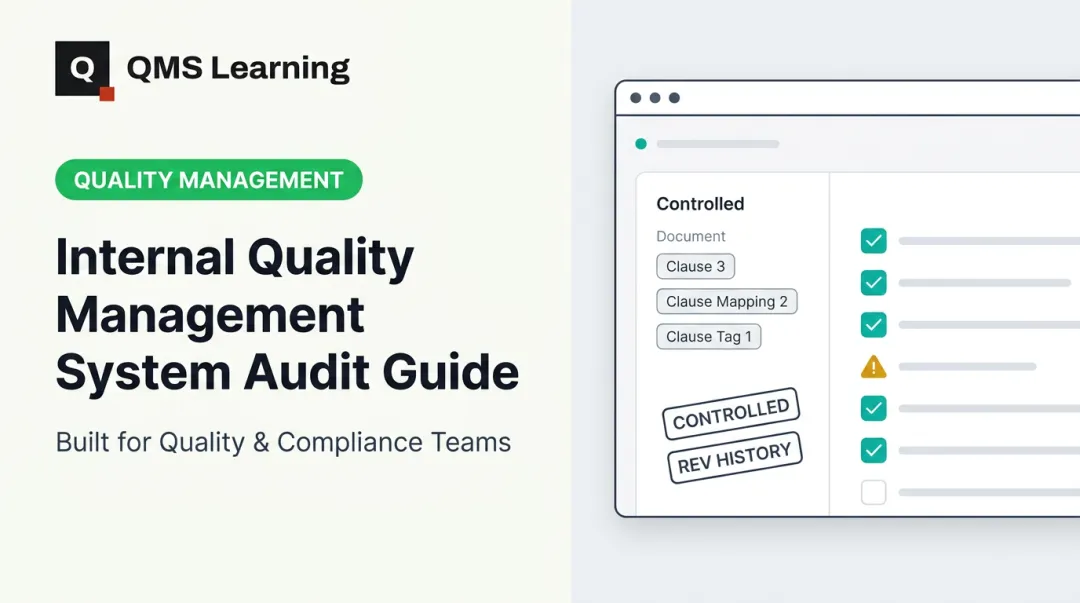
Strengthen document control and controlled records. Revision history, clause-mapped linkages, and traceability need to exist before an auditor ever asks for them, not get assembled that morning.
Build verified root cause and CAPA competence. Tools like 5-Why, FMEA, and Gap Analysis only help if your team knows which one applies to which problem. Misapplying FMEA to a recurring defect wastes time and doesn't close the loop. QMS Learning's AI Workbench closes that gap by routing each problem to the correct method and generating the supporting documentation automatically.
Deliver role-specific training scoped to what each employee is actually audited against. Generic compliance content doesn't hold up when the auditor asks a floor technician a clause-specific question.
Establish an audit-evidence workflow. A registrar-ready package should compile automatically from three inputs:
- Completed training records tied to each role
- Corrective action and CAPA documentation
- Time-stamped activity logs
QMS Learning's audit-evidence export assembles these into a single submission, replacing the scramble through email threads.
Skip step three or four, and you'll notice it immediately in your next surveillance audit: findings that keep reappearing because the root cause was never verified, just assumed.
Common Challenges Teams Face in Maintaining Compliance
Even well-intentioned teams run into the same three failure points, again and again.
- Keeping pace with evolving frameworks. Without a dedicated tracking process, teams often learn about updates like the ISO 14001:2026 revision months late, usually from an auditor.
- Single point of failure risk. When compliance knowledge sits with one or two senior staff, the organization's audit-readiness walks out the door the moment they do.
- Fragmented evidence. Spreadsheets, binders, and email threads turn audit prep into a last-minute scramble, and that's where findings fail: the work exists, but nobody can prove it fast enough.
None of these are exotic problems. They show up the same way on aerospace floors, in medical device cleanrooms, and on general manufacturing lines.
How QMS Learning Helps Teams Build Audit-Ready Compliance Capability
QMS Learning was built by Will Trikha, a 20-year quality and operations practitioner who wrote over 1,000 audit findings and closed twice that number as a quality manager. That background shapes the platform's core premise: completing a training course and actually performing under audit pressure are two different skills, and most training programs only address the first one.
The AI Workbench diagnoses a live compliance problem, selects the correct methodology, and generates the audit-ready artifact automatically.
Feed it a real scenario: "the same defect appeared on three different jobs from the same supplier this quarter." The Workbench recognizes a systemic issue, routes to 5-Why plus Supplier CAPA, and drafts a six-page Supplier CAPA report citing AS9100D §8.4.3, ready to submit.
A junior engineer using the Workbench can produce work that looks like it came from a seasoned auditor, on day one. That individual capability only matters if managers can verify it across the whole team.
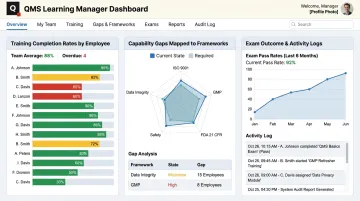
The Manager Dashboard gives visibility into:
- Training completion and standards fluency by employee
- Capability gaps mapped to specific frameworks
- Exam outcomes and time-stamped activity
It exports as a single Audit-Evidence Package PDF: training records, completed scenarios, generated artifacts, and acknowledgment logs, all indexed and ready to hand a registrar on first submission.
Pathways are scoped to the exact standards teams get audited against, not generic content:
- Aerospace & Defense — AS9100D, ITAR, Counterfeit Parts (AS6174/AS6081)
- Medical Device & Life Sciences — ISO 13485, FDA 21 CFR Part 820, ISO 14971 (pilot cohort Q3 2026)
- Defense Cybersecurity — CMMC, NIST 800-171, ISO 27001 (pilot cohort Q3 2026)
- EHS Compliance — ISO 14001:2026, ISO 45001, OSHA 29 CFR 1910
- General Manufacturing — ISO 9001
Teams using the platform report becoming audit-ready within 30 days of rollout, at 70-90% less cost than classroom alternatives. Capability stays in-house rather than walking out the door with a consultant.
Customers describe the same shift in their own words:
"The training exceeded our expectations" on depth and professionalism. — LG Machine CEO, after three years on the platform
COMAV's QA manager put it differently: a team that went from uncertain to confident applying complex regulations directly on the shop floor.
Frequently Asked Questions
What is compliance in quality management?
Compliance in quality management means your products, processes, and documentation consistently meet both internal quality standards and the external regulatory requirements for your industry. It requires objective evidence, not just a completed procedure.
What are examples of regulatory compliance?
Common examples include AS9100D, ISO 13485, FDA 21 CFR Part 820, ITAR, OSHA, and ISO 14001/45001. Which ones apply depends heavily on your industry and the countries you manufacture or sell in.
What are the 4 types of compliance?
Quality practitioners typically group compliance into four buckets: legal/regulatory (FDA, OSHA, ITAR), standards/certification (AS9100D, ISO), customer/contractual (specs and flow-downs), and internal policies.
What is the difference between quality compliance and regulatory compliance?
Quality compliance addresses customer and internal expectations, such as workmanship or reliability, where some negotiation is possible. Regulatory compliance addresses legally mandated external requirements with zero room for tradeoffs.
Who is responsible for regulatory compliance in an organization?
Quality directors and compliance officers typically own the compliance program, but effective compliance depends on cross-functional accountability. Engineering, operations, and every employee touching a regulated process share the responsibility.
How often should regulatory compliance training be updated?
Training should be reviewed continuously, not on a fixed annual cycle. Update it whenever a standard revises or a new regulation takes effect, such as the recent shift to ISO 14001:2026 or the FDA's QMSR update.