Quality managers face a real tension here. Clause 5.2 spells out specific content requirements, but auditors don't want employees reciting the policy word-for-word. ISO's own audit guidance tells auditors never to ask staff to recite it; the goal is genuine understanding, not memorization, according to the ISO/IAF guidance on auditing quality policy.
This guide covers what Clause 5.2 actually requires, how to write a compliant policy step-by-step, real examples across industries, and the mistakes that turn a routine audit into a nonconformity.
Key Takeaways
- Clause 5.2 requires a documented quality policy, but exact ISO wording isn't mandatory
- The policy must commit to meeting requirements, setting objectives, and driving continual improvement
- Short policies of 2-4 sentences stick with employees far better than long, jargon-heavy statements
- A manufacturer, a service provider, and a small business can satisfy this clause with entirely different wording
What Is an ISO 9001 Quality Policy?
An ISO 9001 quality policy is a formal statement of intent, approved by top management, that sets direction for the entire quality management system. Unlike a marketing tagline or a break-room values poster, it's the operational document your QMS is built to deliver on.
Clause 5.2.1 spells out four required elements. Your policy must:
- Fit your organization's purpose, context, and strategic direction
- Provide a framework for setting quality objectives
- Commit to satisfying applicable requirements (customer, regulatory, and internal)
- Commit to continual improvement of the QMS
Technically, only the last two are worded as formal "commitments" in the standard, but auditors expect all four elements to show up somewhere in your documentation.
Does ISO 9001 require a quality policy? Yes. The "shall" language in Clause 5.2 makes it mandatory, with no exceptions for company size or industry. What it doesn't require is copying the standard's exact phrasing. Registrars have debated this for years, and the current consensus is simple: the content matters more than the exact wording.
Quality policy vs. quality manual vs. mission statement vs. objectives. These get conflated constantly:
- A quality manual may contain the policy, but it isn't required by ISO 9001:2015 and isn't the same document
- A mission statement only counts as your quality policy if it independently satisfies all four Clause 5.2.1 elements
- Quality objectives (Clause 6.2) are specific, measurable targets. The policy is the framework those targets live inside
The 7 Quality Management Principles Behind Every Policy
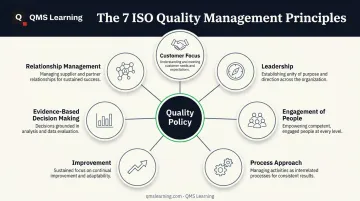
Every strong quality policy is grounded in ISO's seven quality management principles. Policies that reflect these hold up better under audit scrutiny because they connect to the standard's underlying logic, according to ISO's official quality management principles guide:
- Customer focus - meet and aim to exceed customer requirements
- Leadership - unity of purpose and direction from the top
- Engagement of people - competent, empowered staff at every level
- Process approach - managing activities as interrelated processes
- Improvement - an ongoing, organization-wide focus on getting better
- Evidence-based decision making - decisions grounded in data, not guesswork
- Relationship management - managing supplier and stakeholder relationships for the long haul
Who Writes and Signs Off the Quality Policy
Top management owns this document, full stop. A quality manager can draft it, gather input, and format it, but Clause 5.1 puts leadership commitment on the highest-ranking executive rather than the quality department. In practice, that means a CEO, plant manager, or managing director signature demonstrating the policy wasn't delegated and forgotten.
Auditors will ask leadership directly about the policy during interviews. If they can't speak to it, that signals a leadership commitment problem, and no amount of paperwork fixes it.
How to Write an ISO 9001 Quality Policy (Step-by-Step)
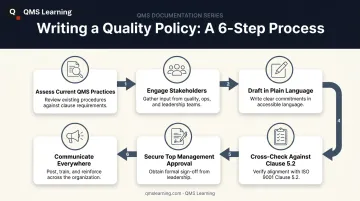
Writing a policy that passes audit and actually gets used takes more than filling in a template. Follow this process:
Assess your current QMS practices. Review customer feedback, complaint trends, and organizational context before drafting a single word. A policy built on assumptions instead of reality won't survive audit scrutiny.
Engage stakeholders. Pull input from leadership, department heads, and frontline employees. People who help write it are far more likely to remember and apply it later.
Draft in plain language. Most policies work best at 2-4 sentences. Skip marketing language that has nothing to do with quality; terms like "world-class" don't satisfy Clause 5.2.
Cross-check against Clause 5.2's four requirements. Run the draft against this checklist:
- Fits your organization's context and purpose
- Provides a framework for setting objectives
- Commits to meeting applicable requirements
- Commits to continual improvement
If any box stays empty, revise before moving forward.
Secure top management approval. The policy needs formal sign-off from the highest-ranking executive, not just a quality manager's stamp.
Communicate it everywhere it matters. Onboarding packets, shop floor boards, the company intranet. Posting alone isn't enough. A policy on a notice board with no follow-up doesn't count as effective communication, according to TUV SUD's ISO 9001:2015 quality guidance.
Proving communication happened matters as much as doing it. A controlled document system that tracks revision history and acknowledgment logs, like QMS Learning's Document Management System, keeps that proof ready for registrar review instead of scrambling it together the night before an audit.
ISO 9001 Quality Policy Examples
Every example below is illustrative, not a template to copy. A policy only carries weight when it reflects what your organization actually does and measures.
Manufacturing Example
"[Company Name] is committed to manufacturing safe, consistent products that meet or exceed customer and regulatory requirements. We provide the resources, training, and process controls necessary to prevent defects, and we review our quality objectives annually to drive continual improvement across every production line."
This works because it names specific mechanisms, like resources, training, and process controls, instead of vague promises.
Small Business / Service Example
Small businesses don't need enterprise-length policies. Two to three sentences is plenty:
"[Company Name] delivers reliable, on-time service that meets our clients' requirements and expectations. We continually review our processes, listen to client feedback, and improve how we work to raise our standard of quality."
Yes, a small business can and should have an ISO 9001 quality policy. Registrars expect one regardless of headcount.
Regulated / High-Compliance Example
Aerospace, defense, and medical device organizations typically add traceability and compliance language:
"[Company Name] is committed to producing components that meet all applicable regulatory, customer, and contractual requirements, including full material and process traceability. We maintain a culture of continual improvement, risk-based decision making, and strict configuration control across our supply chain."
Mix-and-Match Themes
Build your own policy by combining themes relevant to your business:
- Customer needs and satisfaction
- Leadership engagement and accountability
- Regulatory and contractual compliance
- Employee engagement and competence
- Risk management and prevention
- Continual improvement of processes and products
The recall test: Ask a random employee during an internal audit to explain the policy in their own words. If they can't, the policy is too long or abstract for daily use — the problem is how it's written, not whether anyone studied it.
Once the wording is right, treat the policy as a controlled document rather than a plaque on the wall. QMS Learning's document management system logs revisions and employee acknowledgments automatically, so that proof is already in place the moment an auditor asks for it.
Common Mistakes and Quality Policy vs. Quality Objectives
Two mistakes show up in nearly every failed Clause 5.2 finding.
Generic, vague language is the first. Phrases like "committed to quality" carry no measurable tie to leadership action, and auditors flag them immediately.
The second is treating it as the quality manager's project. A policy that lives in a binder, gets approved once, and never gets discussed again fails the "understood and applied" requirement in Clause 5.2.2, no matter how well it's worded.
Quality Policy vs. Quality Objectives
The distinction trips up a lot of teams:
| Quality Policy | Quality Objectives | |
|---|---|---|
| Scope | Broad, strategic direction | Specific, measurable targets |
| Review cycle | Annually or on major change | Quarterly (typical) |
| Format | 2-4 sentences | SMART targets with owners and deadlines |
| Owner | Top management | Department/process owners |
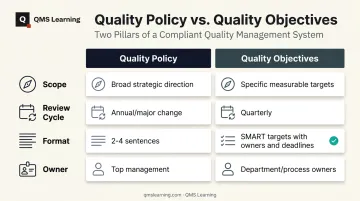
The policy is the umbrella. Objectives are the numbers-driven targets underneath it, such as on-time delivery rate, defect PPM, or complaint closure time. If your objectives don't trace back to something in the policy, that's usually the first thing an auditor notices.
Maintaining, Reviewing & Communicating Your Quality Policy
A policy isn't a 'set it and forget it' document. Clause 9.3 requires top management to review the QMS at planned intervals. Most organizations tie this to an annual management review, though a major shift like a new facility, new market, or ownership change should trigger a review sooner.
Three signals tell you whether the policy is actually working:
- Audit findings - repeat nonconformities tied to the same root cause suggest the policy isn't driving the behavior it promises
- Customer satisfaction scores - a policy committed to "meeting requirements" should track alongside actual satisfaction trends
- Employee recall during interviews - not verbatim recitation, but whether staff can explain how the policy connects to their job
Gathering that proof manually is where most quality teams lose hours before a registrar visit, pulling training logs from spreadsheets and chasing down sign-off emails.
QMS Learning's General Manufacturing Quality pathway pairs ISO 9001 training with an AI Workbench and Manager Dashboard that keep policy-linked training records and objective evidence organized year-round. Compiling proof of communication becomes a quick export instead of a last-minute scramble.
Frequently Asked Questions
Does ISO 9001 require a quality policy?
Yes. Clause 5.2 makes a documented, top-management-approved quality policy mandatory. You don't need to copy the standard's exact wording; the content requirements matter, not verbatim phrasing.
Can a small business have an ISO 9001 quality policy?
Absolutely. Small businesses need one just like larger organizations, typically in a shorter, simpler format, often just 2-3 sentences covering the same core commitments.
What is an example of ISO 9001 quality policy?
A compliant short-form policy commits to meeting customer and regulatory requirements, provides a framework for objectives, and pledges continual improvement. See the examples above for manufacturing, service, and regulated-industry versions.
What are the 7 basic principles of ISO 9001?
Customer focus, leadership, engagement of people, process approach, improvement, evidence-based decision making, and relationship management. These principles underpin every requirement in the standard, including the quality policy.
How often should a quality policy be reviewed?
Most organizations review it during annual management review meetings under Clause 9.3. Major changes, such as new facilities, ownership changes, or shifts in strategic direction, trigger a sooner review.
Who is responsible for writing the quality policy?
Top management holds accountability for establishing and approving the policy, though most teams gather input from department heads and frontline staff to improve buy-in and accuracy.