It's also one of the most heavily audited sections of the standard, and one of the most inconsistently executed. Teams write clean NCRs, then stall at root cause analysis or close the record without ever verifying the fix actually worked.
This article breaks down what nonconformance and corrective action means, how the process runs step by step, what determines whether it actually works, and when it's overkill for the problem in front of you.
Key Takeaways
- A nonconformance is any failure to meet a requirement; corrective action eliminates its root cause so it can't recur.
- ISO 9001 audits classify findings as major or minor, and this determines urgency and certification risk.
- Genuine root cause analysis, not symptom-patching, is what separates effective corrective action from paperwork.
- Closing an NCR without verifying effectiveness is the single most common failure point auditors catch.
- Not every deviation needs a full investigation; disproportionate responses waste time that real systemic issues need.
What Is Nonconformance and Corrective Action in ISO 9001?
Under Clause 10.2, a nonconformance is a failure to meet a requirement, whether that requirement comes from the ISO 9001 standard itself, a customer contract, a regulatory body, or your own documented procedure. The nonconformity and corrective action process exists to do three things:
- Contain the immediate issue
- Find and eliminate the true root cause
- Stop the same failure from resurfacing
Nonconformance vs. Non-Compliance
These terms get used interchangeably, but they're not the same thing. Non-compliance usually refers to failing a broader legal, regulatory, or contractual obligation. Nonconformance is narrower: it's specifically about failing a defined requirement inside your QMS.
Major vs. Minor Nonconformity
Auditors classify findings by severity, and the distinction matters for how fast you need to move.
| Classification | What it means | Certification risk |
|---|---|---|
| Major | A systemic breakdown that threatens the QMS's ability to meet ISO 9001 requirements, or a cluster of related minors | Can jeopardize certification |
| Minor | An isolated deviation or single procedural lapse that still needs correction | Low on its own, but compounding |
Left unaddressed, a pattern of minor findings can escalate into a major nonconformity at the next audit cycle. Auditors watch for repeat findings because they signal that the underlying system, not just one instance, is broken.
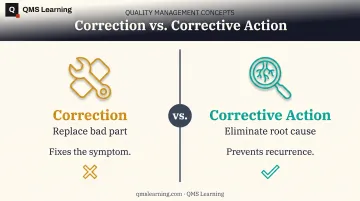
Correction Is Not Corrective Action
This is where most teams trip up. A correction eliminates the detected nonconformity, such as replacing a bad part or reprinting a document. Corrective action eliminates the cause behind it and requires determining that cause first, according to ISO/IAF's Auditing Practices Group guidance.
ISO 9001 explicitly requires both. Treating them as interchangeable is why the same nonconformities keep recurring.
How the Nonconformance and Corrective Action Process Works
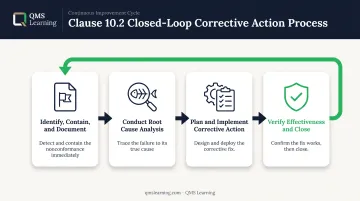
Clause 10.2 runs as a closed loop, from the moment an issue surfaces to a documented, verified closure. It's typically triggered by:
- An internal or external audit finding
- A customer complaint
- A production deviation
- A supplier nonconformance
Once triggered, the process moves through containment, root cause investigation, a corrective action plan, and effectiveness verification. It's controlled through an NCR or CAPA record, tracked to closure, and fed into management review and risk registers.
What comes out the other side: updated procedures, retrained staff, revised risk assessments, and a documented history that shows auditors you're actually improving—not just filing paperwork.
Step 1: Identify, Contain, and Document (NCR)
The NCR needs to state three things clearly:
- The specific requirement that was violated
- What actually went wrong
- The immediate containment action taken to stop further impact
Vague language here poisons everything downstream.
Step 2: Conduct Root Cause Analysis
This is where organizations most often go wrong, usually by picking the wrong method for the problem. Common tools include:
- 5 Whys — for straightforward, single-cause issues
- Fishbone/Ishikawa — for problems with multiple contributing factors
- FMEA — for evaluating failure modes in new or changing processes
Applying the wrong tool, or skipping structured analysis altogether, is a leading cause of repeat nonconformities. QMS Learning's AI Workbench closes that gap: feed it a plain-English problem description, and it diagnoses whether you're facing an isolated incident, a process gap, or a systemic supplier issue, then routes you to the right method.
In one documented case, a defect across three jobs from the same supplier in a single quarter led the Workbench to select 5 Whys plus a Supplier CAPA rather than FMEA. Recurrence pointed to an existing systemic issue, not a new process needing risk mapping. It also generates the audit-ready artifact as you go.
Step 3: Plan and Implement Corrective Action
A corrective action plan needs three components to hold up under audit:
- Clear ownership
- A realistic timeline
- Resources to eliminate the root cause
The goal is to remove the cause, not just patch what's visible on the surface.
Step 4: Verify Effectiveness and Close
ISO 9001 requires reviewing whether the action actually worked, through a follow-up audit, direct observation, or a data trend, before the NCR can be formally closed. According to NQA's closed-loop framework, verifying implementation (the fix was put in place) is not the same as verifying effectiveness (the problem stopped recurring). Both need to be documented as objective evidence.
Common Nonconformance Examples and Where the Process Applies
Real-world nonconformances tend to cluster around a handful of familiar patterns:
- Failure to follow a documented procedure
- Missing or incomplete training and inspection records
- Product that fails to meet specifications or customer requirements
- Inadequate or outdated risk assessments
- Unauthorized changes to controlled documents
NQA's registrar-published examples make this concrete. One case traced repeated late deliveries to quotes that never allowed enough lead time. Another linked a burned CNC circuit board to a missing preventive-maintenance schedule, not a one-off mechanical fault.
Those same triggers show up across the QMS lifecycle:
- Internal audits
- External certification and surveillance audits
- Customer complaints
- Incoming or in-process inspection
- Supplier nonconformance management
Some triggers are scheduled and tied to your audit calendar. Others fire the moment a complaint or inspection failure lands on your desk.
Key Factors That Affect Effectiveness and Common Mistakes to Avoid
Documentation quality drives everything downstream. A vague NCR ("part was wrong") makes root cause analysis nearly impossible. Specific, objective evidence ("dimension X measured 0.015 in. outside tolerance on lot 4471") points investigators toward a real answer.
Root cause competency is usually the actual bottleneck. Most organizations lean on one or two senior staff to correctly diagnose issues. When those people are out, or a junior engineer gets handed a finding solo, results get inconsistent fast, and that inconsistency is exactly what shows up as recurring nonconformities at the next audit.
A few other patterns worth watching for:
- Treating correction as corrective action — the symptom gets patched, the cause survives, and the issue comes back
- Closing NCRs on completed fixes alone — without documented proof of effectiveness, auditors will flag it
- Over-investigating one-off human error — a full root-cause investigation is often the wrong tool when the event is accidental and shows no systemic pattern
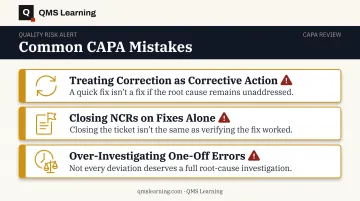
ISO/IAF guidance notes that a correction or a documented Opportunity for Improvement can be more appropriate in those cases. Risk-based thinking means matching the response to actual severity—not running every deviation through the same heavy process.
Conclusion
Nonconformance and corrective action isn't a form you fill out once and file away. It's a closed loop:
- Identify the issue
- Contain the impact
- Investigate the cause
- Correct the process
- Verify the fix held
Skip verification and you haven't closed anything, no matter what the record says.
Getting this right protects certification, cuts repeat findings, and builds continuous improvement you can verify. Match the response to severity, and spread root-cause competence across the quality team instead of leaving it with whoever has the most tenure.
That gap is what QMS Learning's General Manufacturing Quality pathway and AI Workbench are built to close—ISO 9001 Internal Auditor training paired with root cause and CAPA method practice—so junior staff can work real findings without waiting on a senior engineer.
Frequently Asked Questions
What is an ISO 9001 nonconformance?
A nonconformance is a failure to meet a specified requirement—from ISO 9001, a customer, a regulator, or an internal procedure. Auditors classify each finding as major or minor based on severity.
What are some examples of nonconformance?
Common examples include:
- Failing to follow a documented procedure
- Missing training or calibration records
- Product specs that miss customer requirements
- Inadequate risk assessments
What is the difference between non-compliance and non-conformance?
Noncompliance generally means failing a broader legal or regulatory obligation. Nonconformance is narrower: failing a defined requirement inside your own QMS.
What is the difference between corrective action and preventive action in ISO 9001?
Corrective action fixes the root cause of a nonconformance that has already occurred. ISO 9001:2015 removed standalone preventive action and replaced it with risk-based thinking across planning.
How long does an organization have to close a corrective action?
ISO 9001 sets no fixed deadline. Timelines are typically defined in your own procedure, scaled to risk, and expected to close before your next audit cycle.
Who is responsible for identifying and closing nonconformances in a QMS?
Quality managers typically own the overall process, but ISO 9001 expects any employee who spots a deviation to report it. Closure should be verified by a designated quality role before the record is finalized.