Introduction
Most quality teams only discover their QMS gaps when a registrar points them out. An ISO 9001 internal audit checklist is the structured, clause-based question set you use to catch those gaps first—and verify the system does what your documentation claims.
Run one properly, and your Stage 2 or surveillance audit becomes a formality. Run it as a rubber-stamp exercise, and the registrar finds the gaps for you.
Internal audits aren't optional prep work. Clause 9.2 of ISO 9001:2015 requires them at planned intervals, backed by a documented program covering methods, responsibilities, and reporting. Skip that structure, and you walk into the external audit carrying the same weak spots a registrar is trained to find.
This article covers what you need for a credible internal audit, three methods auditors use in practice, how to read what you find, and the mistakes that quietly erode audit credibility.
Key Takeaways
- Gather a clause-mapped checklist, the current ISO 9001:2015 standard, process records, and an independent auditor for Clause 9.2
- Match method to situation: clause-by-clause for full reviews, turtle diagrams for process depth, risk-based for known trouble spots
- Classify findings into four categories: conformance, opportunity for improvement, minor nonconformity, or major nonconformity
- Watch for the errors registrars catch most: auditor bias, tick-box reviews, and unverified CAPA closures
What You Need to Conduct an ISO 9001 Internal Audit
Having the right documentation and access lined up before day one is what separates a credible internal audit from a rushed exercise that looks good on paper and falls apart under questioning.
Tools and Documents Required
Before you schedule anything, gather:
- A checklist mapped to ISO 9001:2015 clauses 4 through 10
- A current copy of the standard itself
- Prior internal and external audit reports, plus open CAPA logs
- Procedures, work instructions, and records for the specific process being audited
A well-built checklist phrases every "shall" requirement as a yes/no or scored question tied to objective evidence, not an auditor's memory.
There's no fixed rule for how many questions a comprehensive checklist should contain. ISO's own Auditing Practices Group guidance on checklists treats the checklist as one flexible tool, sized to the scope and process, not a document with a universal length. A checklist built for a 12-person machine shop should look nothing like one built for a multi-site manufacturer.
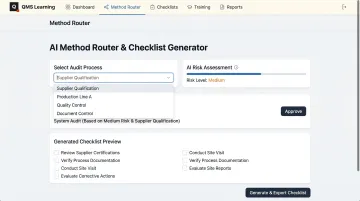
Teams without a mapped checklist or a trained internal auditor often lean on structured platforms to close that gap. QMS Learning's AI Workbench, for example, includes a Method Router that walks auditors through selecting the right audit approach for the process in scope and generates a checklist to match. That helps when nobody on staff has run a formal audit before.
Preconditions and Setup
Get these in place before the audit starts, not during it:
- Confirm auditor independence — no one may audit their own work or their direct reports
- Schedule in advance — notify process owners so records and personnel are ready when you arrive
- Hold a brief opening meeting — confirm scope, objectives, and timeline with the process owner
- Secure access — systems, files, and physical areas needed to sample records and observe the process live
Skipping the live observation step is a common shortcut. Documents can look compliant on a screen while the shop floor does something entirely different.
Methods to Conduct an ISO 9001 Internal Audit
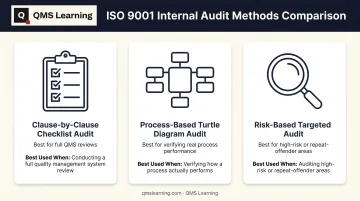
Auditors typically pick a method based on available time, whether the process has a history of problems, and whether the goal is broad compliance coverage or deep verification. Most mature audit programs rotate between all three depending on what's being reviewed.
Method 1: Clause-by-Clause Checklist Audit
Systematically checks each ISO 9001 clause against documented requirements. Best suited to full QMS reviews or a first-time internal audit where you need broad coverage fast.
Tools needed: Master checklist mapped to clauses 4–10, standard reference copy.
Steps:
- Select the clause or process to review
- Compare the documented procedure against the requirement, and ask the process owner to demonstrate it
- Record conformity status and supporting evidence for each question
Thorough and easy for new auditors to follow. The downside: it can turn into a paperwork exercise if you only check boxes against the procedure and never sample real evidence.
Method 2: Process-Based (Turtle Diagram) Audit
Traces one process end-to-end (inputs, outputs, resources, competence, performance criteria) to test whether it works in practice, not just on paper. NQA describes the turtle diagram as a one-page visual mapping process owners, participants, requirements, resources, methods, and effectiveness measures.
Tools needed: Turtle diagram template, process map, a live sample transaction such as a work order or purchase order.
Steps:
- Map the process using the turtle diagram elements
- Select a live transaction and trace it through the process
- Verify each element (who, what, how, with what result) against actual practice
Reveals whether a process genuinely functions as intended. It takes longer per process and needs an auditor comfortable with the process approach, not just clause language.
Method 3: Risk-Based (Targeted) Audit
Focuses limited audit time on the highest-risk processes or repeat-offender areas, using audit history and CAPA trends to decide where to look. ISO 19011:2018 formally added guidance on this approach, directing audit programs to weigh risk when planning scope and depth.
Tools needed: Risk register, prior audit findings, KPI or nonconformity trend data.
Steps:
- Identify high-risk processes from prior findings, complaints, or KPI trends
- Sample multiple transactions within that process instead of spreading thin across the whole QMS
- Drill into root cause wherever deviations appear
Efficient use of audit hours, and it catches recurring problems before they become a trend the registrar spots. Used as your only method, it leaves lower-risk areas under-audited.
How to Interpret Internal Audit Results
Misreading a finding's severity is its own kind of risk. Overreact to a minor gap and you waste resources; underreact to a systemic breakdown and the external auditor finds it first.
| Category | What it means | Required action |
|---|---|---|
| Conformance | Evidence clearly meets the requirement | Document the evidence and close the item |
| Opportunity for Improvement (OFI) | Requirement is met, but a minor inefficiency exists | Log for continual improvement tracking, no formal CAPA |
| Minor Nonconformity | An isolated lapse in an otherwise compliant process | Assign an owner; require root cause, CAPA, and a deadline; verify at the next audit |
| Major Nonconformity | A systemic absence of a required process, or related minors sharing one root cause | Immediate CAPA plan; escalate to management review; consider a follow-up audit before the external audit |
Watch for this pattern: several minor nonconformities against the same requirement, in different areas, often point to one underlying major issue. Don't log them as three unrelated minors and move on. Dig into whether they share a root cause.
Common Errors and Best Practices in ISO 9001 Internal Audits
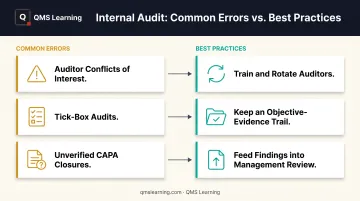
Common Errors
- Auditor conflicts of interest — assigning someone to audit their own department or work compromises the objectivity clause 9.2 requires
- Tick-box audits — marking items "conforming" without sampling actual records or watching the process happen
- Unverified CAPA closures — closing a corrective action without confirming it worked, so the same nonconformity resurfaces at the external audit
Best Practices
- Train and rotate auditors rather than relying on one or two people. Size the pool by scope, process risk, available time, and sector knowledge—not a headcount formula.
- Keep an objective-evidence trail for every finding—records, photos, or system exports the external auditor can independently verify.
- Feed findings into management review well ahead of certification or surveillance so corrective actions close before the scramble week.
Structured programs like QMS Learning's General Manufacturing Quality pathway build that evidence-first habit into junior auditors early. A single indexed audit-evidence export—training records, completed audits, and time-stamped activity in one file—makes the trail far easier to produce when the registrar asks for proof.
Conclusion
A well-run internal audit, guided by a clause-mapped checklist and the right method for each process, is the single best predictor of a clean external audit. Classify each finding correctly (conformance, OFI, minor, or major) and you know instantly whether it needs a quick log entry or an urgent corrective action plan.
Consistent, evidence-backed internal audits build audit-readiness into the organization itself. That capability doesn't disappear the day a key auditor leaves.
Frequently Asked Questions
What is an ISO 9001 audit?
An ISO 9001 audit is a systematic check of whether a quality management system meets the standard's requirements and follows its own documented processes. It's performed either internally by trained employees or externally by a certification body.
What is the ISO 9001 audit checklist?
It's a structured list of questions mapped to ISO 9001:2015 clauses 4-10, used to assess whether each requirement is implemented and maintained. It typically covers context, leadership, planning, support, operation, performance evaluation, and improvement.
How often are ISO 9001 audits required?
Internal audits follow the cycle set by the organization's audit program, typically annually or more often. External surveillance audits happen yearly, with full recertification every three years.
Who is qualified to perform an ISO 9001 internal audit?
Internal auditors need training on ISO 9001 requirements and audit techniques, and they must be independent of the area they're auditing. They can be employees or trained subcontractors.
What's the difference between an internal and external ISO 9001 audit?
Internal audits are checks run by the organization required by clause 9.2 to catch gaps early. External audits are conducted by an accredited certification body and determine whether certification is awarded or maintained.
What happens if an internal audit finds a nonconformity?
The finding gets logged, a root cause and corrective action are assigned with a deadline, and the fix is verified for effectiveness before the item closes, ideally well before the external audit.