Here's the uncomfortable truth: most findings don't come from a genuinely broken process. They come from evidence that exists but can't be located, matched, or produced fast enough. Will Trikha, founder of QMS Learning, wrote over 1,000 findings as an auditor and closed twice that number as a quality manager. That vantage point from both sides of the table shapes this checklist.
This article breaks down exactly what auditors sample, category by category, so your team can walk in prepared instead of scrambling.
Key Takeaways
- Audit readiness is a continuous operating state, not a pre-visit scramble
- Most findings trace back to missing or disorganized evidence, not process failure
- Documentation, training, and CAPA records need to be traceable on demand
- The 5 C's framework helps write and understand defensible audit findings
- Rolling internal audits catch gaps before a registrar or customer does
What Is Audit Readiness?
Audit readiness means your organization can demonstrate, at any moment, that documented processes are actually being followed. It's the ability to produce objective evidence without notice — not just describe what should be happening.
Passing an audit is a single event with a pass/fail outcome. Audit readiness is the ongoing condition that makes passing likely every time — whether the visitor is a registrar, a customer quality engineer, or your own internal auditor.
Manufacturers who treat readiness as a once-a-year cram session tend to show it. Documents get updated the week before the registrar arrives. Training records get backfilled. Nonconformance logs get "cleaned up." Auditors notice these patterns quickly.
The cost of poor readiness isn't abstract:
- Production holds while missing calibration or inspection records get resolved
- Corrective action burden that pulls quality staff off other priorities for weeks
- Customer escalations when second-party audits surface the same gaps twice
- Certification risk when registrars escalate from a corrective action request to suspension or withdrawal
None of this requires a broken manufacturing process. It just requires evidence that isn't ready when someone asks for it.
Types of Audits Manufacturers Must Prepare For
Not every audit works the same way, and the notice you get varies a lot depending on who's asking.
Certification and Surveillance Audits
These are third-party registrar audits against standards like ISO 9001, AS9100D, or IATF 16949. They maintain your facility's certificate. Initial certification typically runs in two stages: a document review, then a full implementation audit. A three-year certificate cycle follows, with annual surveillance visits in between.
Customer and Supplier Audits
OEMs and prime contractors audit their supply chain directly. These second-party audits often come with less warning than a scheduled registrar visit.
A customer's supplier quality team can show up based on performance data, a recent nonconformance, or a program-specific risk review. There is no universal notice period; timing follows the customer's own risk assessment.
Internal and Regulatory Audits
Internal QMS audits are self-conducted and required by standards like ISO 9001. Frequency is not fixed by the standard; it should be risk-based.
Regulatory inspections, like OSHA visits, follow different rules. OSHA inspections are normally conducted without advance notice, with limited exceptions capped at 24 hours when special equipment is needed on-site (OSHA inspection fact sheet).
The common thread: whether it's a registrar, a customer, or a government inspector, the evidence discipline required is identical.
The Manufacturer's Audit Readiness Checklist
Regardless of which standard applies, auditors sample the same categories. This is the working checklist to run before any audit — registrar, customer, or internal.
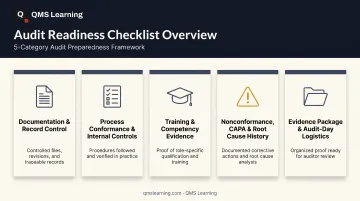
Documentation & Record Control
- Confirm controlled documents (quality manual, procedures, work instructions) are current, approved, and match what's actually used on the shop floor
- Verify revision history and change control records exist for every document updated since the last audit
- Check that calibration records, supplier certifications, and incoming inspection records are complete and traceable to specific lots or jobs
Documents that look fine in the system but don't match the floor are one of the most common findings auditors write. A revision control system should show one clearly identified live version, with superseded versions preserved but unmistakably retired — not deleted, not floating around in a shared folder.
Process Conformance & Internal Controls
- Confirm process control records (travelers, routers, in-process inspection logs) match the documented process flow for the parts being audited
- Verify the internal audit schedule has been completed for the required scope and frequency, with objective evidence of each audit
- Check that management review meetings are documented on schedule, with inputs and outputs tied to the standard's requirements
Auditors will pull a job traveler and trace it backward through every step. If the paperwork tells a different story than the process, that's a finding — even when the part itself is perfectly good.
Training & Competency Evidence
- Confirm training records exist for every employee performing a function affecting quality, tied to the specific procedure or work instruction version
- Verify records show competency evaluation, not just attendance, especially for special processes requiring certification
- Check that retraining is documented whenever a procedure changes or a repeat nonconformity points to a competency gap
A sign-in sheet proves someone was in the room. It doesn't prove they can perform the task correctly. Auditors increasingly probe for the difference, asking operators direct questions about the procedure they supposedly completed.
Nonconformance, CAPA & Root Cause History
- Confirm every nonconformance has a documented disposition, root cause analysis, and corrective action with verified effectiveness
- Verify that repeat findings from the prior audit cycle have closed corrective actions — auditors specifically check for recurrence
- Keep a running log that ties each nonconformance to the job, lot, or process it originated from
Recurrence is one of the fastest ways to escalate a minor finding into a major one. If the same defect shows up again after a CAPA was supposedly closed, the auditor's next question is whether the root cause analysis was ever real in the first place.
Evidence Package & Audit-Day Logistics
Even with solid records, teams often lose audit time simply locating and assembling what already exists. It's rarely a documentation problem — it's a retrieval problem.
- Confirm all evidence above can be compiled quickly into a single package mapped to each clause or requirement being audited
- Assign a single point of contact to manage auditor requests during the audit so responses stay consistent and traceable
QMS Learning's Audit-Evidence Package addresses that retrieval gap. It compiles training records, completed scenarios, generated compliance documents, and time-stamped platform activity into one indexed PDF you can hand a registrar without hunting through folders while the clock runs.
The 5 C's of Auditing
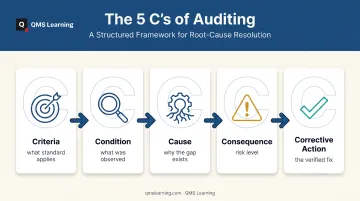
Quality professionals often use a simple framework to write and evaluate a complete, defensible finding. It centers on five questions that together make the finding hold up under scrutiny.
Criteria
What was the process measured against? Criteria are the specific requirement: a standard clause, a procedure, or a customer specification. Without clear criteria, a finding has no foundation.
Condition
What did the auditor actually observe? Condition is the factual, documented state of what was found: no interpretation, no assumption, just what happened.
Cause
Why does the gap exist between criteria and condition? Cause is where surface fixes fail. Blaming "operator error" without digging further almost guarantees the same finding reappears next cycle.
Consequence
What's the risk if this gap goes uncorrected? This determines priority. A missing signature on a low-risk form isn't the same as an inspection gap on a flight-critical part.
Corrective Action
What's the documented fix, and how was it verified? Corrective action closes the loop: not only fixing the immediate issue, but preventing recurrence and proving the fix worked.
Common Reasons Manufacturers Fail Audits
A few patterns show up again and again across manufacturing QMS audits.
Outdated or uncontrolled documents still in use on the floor remain one of the most frequently cited findings. An operator working from a printed copy that's two revisions behind is a documentation control failure, even if the work itself is technically correct.
Training records without competency verification create a recurring gap, especially in multi-site operations or facilities using temporary and contract staff. A completion certificate that was never tied to an actual skills check doesn't hold up under questioning.
Planning-related nonconformities are also widespread. A recent analysis of more than 25,000 companies and 250,000 audit results found that over half of organizations audited between 2023 and 2025 had ISO 9001 Chapter 6 (Planning) findings (DNV, 2025).
Clause 6.1 (actions addressing risks and opportunities) alone accounted for 35.4% of those planning-related findings. That makes it one of the most commonly cited nonconformities across all ISO 9001 audits.
Calibration and measurement equipment control ranks among the top finding categories for AS9100-certified aerospace suppliers. Published data does not give a precise share, but auditors flag it often enough that it belongs on every readiness checklist.
Building Continuous Audit Readiness
The shift that actually works: stop treating audit prep as an annual scramble and start treating it as a monthly discipline. Assign a named owner for every control area:
- Documents
- Training
- CAPA
- Calibration
Run a rolling internal audit and gap-analysis cadence. ISO 9001 doesn't mandate a fixed quarterly schedule. It calls for risk-based planning that considers process importance, organizational change, and prior audit results (ISO 9001 Auditing Practices Group guidance). In practice, that means auditing higher-risk areas more often, not waiting for a calendar reminder.
Those audits only stay useful if the team can close gaps without a senior manager in every loop. One recurring bottleneck: junior quality engineers usually assemble evidence under pressure, and they often freeze or escalate every ambiguous issue upstairs.
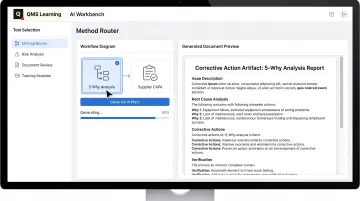
QMS Learning's AI Workbench addresses this directly. It diagnoses the problem, selects the right method (5-Why, fishbone, FMEA, CAPA, or gap analysis), and drafts the artifact in the applicable standard's voice. When the same supplier defect showed up on three jobs, the Method Router selected 5-Why plus Supplier CAPA, rejected FMEA as the wrong tool for an existing failure, and generated a six-page AS9100D §8.4.3 artifact automatically.
A Manager Dashboard tracking training completion, capability gaps, and exam outcomes in real time turns audit prep into a status check instead of a document hunt. Instead of asking "where's that training record?" a quality manager can just look.
Standards don't sit still, either. ISO 14001 and IATF revisions arrive on their own schedule. Continuous readiness means training content stays current so teams pick up the change without a full manual re-certification cycle every time a clause shifts.
Frequently Asked Questions
What is audit readiness?
Audit readiness is the continuous ability to demonstrate compliance and produce objective evidence on demand. It's an ongoing operating condition, not a one-time effort before the auditor arrives.
What are the 5 C's of auditing?
Criteria, Condition, Cause, Consequence, and Corrective Action. Together they form a framework for writing a complete, defensible audit finding.
How long does it take a manufacturer to become audit-ready?
It depends heavily on current documentation maturity. With a structured program, manufacturers often build internal audit competence, CAPA ownership, and gap-analysis skills within a focused 30-day rollout.
What documents does an auditor typically ask for first?
Most auditors start with the quality manual, the internal audit schedule, and the most recent nonconformance/CAPA log. These three quickly reveal how mature the QMS is.
How often should manufacturers run internal audits or gap assessments?
A rolling, risk-based schedule works better than a single annual internal audit crammed in before the registrar visit. Higher-risk processes should get audited more frequently than stable, low-risk ones.
What's the difference between an internal audit and a certification audit?
Internal audits are self-conducted checks used for continuous improvement and are required by standards like ISO 9001. Certification audits are third-party registrar assessments that determine whether your certificate is issued, maintained, or at risk.