Introduction
Your ISO 14001 internal audit checklist is the mechanism Clause 9.2 requires to prove your environmental management system actually works — before an external auditor finds out otherwise.
Many EHS teams run internal audits the same way every cycle: same checklist, same convenient processes, same rubber stamp.
Then a surveillance auditor walks the floor, asks one follow-up question, and finds the exact gap that's been sitting there since last year. Except now it's a major nonconformity instead of a quiet fix.
ISO published ISO 14001:2026 on 15 April 2026, and checklists built only against the 2015 clause structure are already falling behind.
This guide covers what a reliable internal audit actually needs: the documentation and auditor competence required before you start, three practical audit methods, how to classify findings so real risk doesn't slip through, and the mistakes that quietly sink internal audit programs.
Key Takeaways
- Clause 9.2 requires audits to cover your whole EMS across a planned cycle, not just the easy processes
- A working checklist maps to Clauses 4–10, with heaviest scrutiny on aspects, operational controls, and compliance evaluation
- ISO 14001:2026 adds climate change integration and a new Clause 6.3 on planning changes
- Misclassifying a systemic gap as a minor finding lets real environmental risk run unresolved
- Auditor judgment, not checklist completion, is what catches problems before certification does
What You Need for an ISO 14001 Internal Audit
An audit is only as strong as what you set up before walking in. Skipping the prep (clear scope, the right documents on hand, auditors who know what they're looking at) is the single biggest reason internal audits produce weak findings that miss real issues.
Tools and Documentation Required
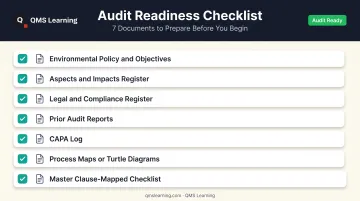
Before scheduling anyone's time, pull together:
- Environmental policy and current objectives/targets
- Aspects and impacts register
- Legal and compliance obligations register
- Prior internal and external audit reports
- CAPA log with open/closed status
- Process maps or turtle diagrams for significant operations
- A master ISO 14001 clause checklist mapped to Clauses 4–10
Missing even one of these turns the audit into guesswork instead of verification.
Auditor Competence and Independence
Clause 9.2 requires auditors to be objective and independent of the area they're assessing. ISO 19011 guidance, as summarized in NQA's implementation resources, frames this as avoiding audits of your own work wherever practicable.
Here's the problem most organizations don't see coming until it's too late: someone completes a two-day generic internal auditor course, gets added to the audit schedule, and then can't trace a symptom back to its root cause. They can confirm a document exists. They can't explain why the same nonconformity keeps reappearing.
Closing that gap — course completion versus catching a real implementation failure — takes structured, role-specific auditor training, not another generic certificate.
Preconditions and Setup
Define these before the audit starts, not during it:
- Scope, objectives, and criteria — including whether you're auditing against ISO 14001:2015 or the 2026 revision during the transition window. DNV notes the transition period runs three years, with 2015 certificates needing to convert before May 2029.
- Audit frequency — weighted toward risk. Hazardous waste and emissions-heavy operations warrant tighter intervals than administrative processes.
- Advance notice to the areas being audited.
- Confirmed access to physical operations, records, and personnel — enough to sample multiple examples, not just one tidy one.
Methods to Conduct an ISO 14001 Internal Audit
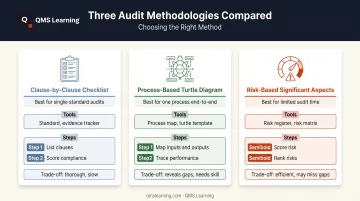
The right method depends on EMS maturity, available time, and whether you need full clause coverage or deep verification of what's actually happening on the floor. Most mature programs blend clause-by-clause, process-based, and risk-based audits across the cycle.
Method 1: Clause-by-Clause Checklist Audit
Works systematically through Clauses 4–10, verifying documented evidence against each "shall" requirement in the standard.
Tools needed: master clause-mapped checklist, EMS manual, legal register
Typical sequence:
- Select a clause and pull the applicable documented evidence
- Interview the process owner and observe the related activity
- Record objective evidence and classify the finding against the exact clause number
Trade-off: Guarantees full standard coverage and is easy for newer auditors to follow. Without cross-checking evidence against actual practice, though, it turns into a tick-box exercise fast.
Method 2: Process-Based (Turtle Diagram) Audit
Traces one operational process end-to-end — waste handling, chemical storage, wastewater discharge — instead of jumping clause to clause.
Tools needed: process maps, turtle diagrams, operational control procedures
Typical sequence:
- Select a significant environmental aspect or process to trace
- Follow it physically from input to output, checking controls and monitoring points along the way
- Cross-reference findings back to relevant clauses (6.1.2, 8.1, 9.1)
Trade-off: Surfaces real implementation gaps that clause-only questioning misses. Pair it with a clause checklist anyway, or you'll leave coverage gaps elsewhere in the EMS.
Method 3: Risk-Based (Significant Aspects) Audit
Prioritizes audit time on the highest-risk environmental aspects and compliance obligations, rather than spreading time equally across every clause.
Tools needed: significance-rated aspects register, legal register with compliance-status tracking
Typical sequence:
- Rank aspects and compliance obligations by severity and likelihood
- Audit operational controls and monitoring for the top-ranked items first
- Verify compliance evaluation under Clause 9.1.2 by confirming how you know your compliance status, not just that a legal register exists
Trade-off: Most effective when audit time is limited and risk exposure is uneven. It can under-audit lower-risk areas that still generate findings, so rotate coverage across cycles.
How to Interpret ISO 14001 Internal Audit Findings
Misclassifying a finding has real consequences. Call a systemic gap "minor," and the environmental compliance risk keeps running until an external auditor catches it, usually at the worst possible moment.
| Classification | What it means | Required action |
|---|---|---|
| Conformance | Evidence matches the documented procedure and produces the intended result | Log it as objective evidence the EMS works, not just where it fails |
| Observation / OFI | Practice conforms but shows minor drift or room to strengthen | Track it; no formal corrective action required |
| Minor Nonconformity | An isolated lapse that does not undermine overall EMS results, such as a single missed training record | Documented correction and root cause review before the next audit cycle |
| Major Nonconformity | A systemic failure, missing required process, or a lapse affecting legal compliance or a significant environmental aspect | Immediate corrective action plan with root cause analysis (5-Whys) before the next surveillance or certification audit |
The line between minor and major usually comes down to reach:
- Minor: One missed calibration record
- Major: A calibration program broken for six months across three lines, even if only one record surfaces on paper
Common Errors in ISO 14001 Internal Audits
Three mistakes account for most of the findings that resurface at certification:
- Treating the checklist as the audit itself. Mechanically confirming boxes without observing practice or asking a single follow-up question that would expose what's actually happening.
- Skipping abnormal and emergency aspects. Registers that only capture normal operations miss startup, shutdown, and emergency conditions—exactly where real environmental risk tends to live.
- Closing corrective actions at "correction," not root cause. Retraining one operator without asking why the system allowed the gap means the same nonconformity reappears at the next surveillance audit.
Each of these is a judgment failure. The auditor knew the rule. They just didn't dig past the first answer.
Best Practices for a Successful ISO 14001 Internal Audit Program
- Build a full-cycle schedule. Cover the entire EMS across your certification cycle, weighting frequency toward hazardous waste, emissions, or other regulated processes.
- Trace at least one significant aspect end-to-end every audit. From identification through operational control to monitoring and review, not just clause-by-clause questions.
- Invest in judgment, not just checklist familiarity. A generic internal auditor certificate teaches the rules. It doesn't teach someone to trace a missed inspection back to a broken calibration schedule three steps upstream.
That's the gap QMS Learning's Environmental & Safety Compliance pathway is built to close. It pairs EHS Fundamentals with an ISO 14001:2026 Transition course on clause changes, gap analysis, and the new Clause 6.3 change-management procedure.
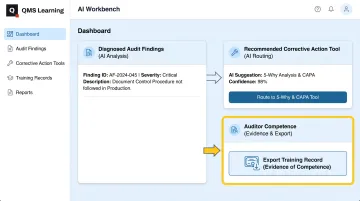
The AI Workbench is trained on ISO 14001:2026, ISO 45001, OSHA 29 CFR 1910, and two decades of real audit findings. Instead of leaving method selection to whoever is on shift, it routes a diagnosed problem to the right tool (5-Why, CAPA, or gap analysis) and exports a training record auditors can present as objective evidence of competence.
Conclusion
An internal audit is only as reliable as the checklist behind it, and the judgment applied while using it. Full clause coverage matters. So does tracing evidence back to what's actually happening on the floor, not just what's written on paper.
A genuinely reliable audit does three things: covers the whole EMS across the cycle, verifies practice against evidence instead of assuming it, and classifies findings honestly so minor drift doesn't become next year's major nonconformity.
None of that creates value while it sits in a report. Audit results only matter once they feed root cause analysis, corrective action, and real readiness for the next surveillance or certification visit.
Build the checklist discipline and auditor judgment your team needs before that visit arrives—not after the finding is written.
Frequently Asked Questions
What are the 5 elements of ISO 14001?
The five elements often taught are policy, planning, implementation and operation, monitoring and measurement, and review and improvement. They map to the PDCA cycle, but they’re a teaching shorthand—not the current clause structure (Clauses 4–10).
What are the 10 clauses of ISO 14001?
Scope, Normative References, Terms and Definitions, Context, Leadership, Planning, Support, Operation, Performance Evaluation, and Improvement. Only Clauses 4–10 carry auditable "shall" requirements; the first three are introductory.
Is ISO 14001 being updated in 2026?
Yes. The 2026 revision keeps the Annex SL structure and tightens expectations around climate change, life-cycle thinking, and supplier oversight. Plan for a multi-year transition window after publication—typically through about 2029.
What should be included in an ISO 14001 internal audit checklist?
Cover Clauses 4–10 with checks for:
- Policy, aspects/impacts, and compliance obligations
- Competence, operational controls, and monitoring
- Internal audit and management review
Add Clause 6.3 change management for the 2026 revision.
How often should ISO 14001 internal audits be conducted?
Run a planned program covering the whole EMS at least annually, auditing higher-risk areas like hazardous waste, emissions, or regulated processes more frequently, often quarterly.
Who is qualified to perform an ISO 14001 internal audit?
Auditors must be competent and independent of the area they’re assessing, per ISO 19011. Role-specific training helps build that competence and gives you records a registrar can review.