Introduction
Environmental aspects and impacts are the foundation clause of ISO 14001. Get this wrong, and your entire EMS turns into a paperwork exercise that collapses the moment an auditor starts asking real questions.
Many EHS managers can rattle off the aspects they identified years ago. Far fewer can explain the significance criteria behind them, or produce a register that holds up when an auditor probes Clause 6.1.2. That gap is exactly where surveillance audits go sideways.
This guide covers what environmental aspects and impacts mean under ISO 14001 and the four-step process for identifying and evaluating them. It also shows how to categorize aspects so they're manageable, and how to turn that work into documentation a registrar will actually accept.
Key Takeaways
- Aspect = interaction with the environment; impact = the resulting change, positive or negative.
- Aspects are direct (controlled) or indirect (influenced) and assessed across the full life cycle.
- ISO 14001 requires a documented, repeatable method to identify aspects and score significance.
- Significant aspects must link to controls, objectives, targets, and audit-ready evidence.
- Role-specific training and AI tools help teams build a defensible register faster than manual methods.
What Are Environmental Aspects and Impacts in ISO 14001?
Under ISO 14001, an environmental aspect is "an element of an organization's activities or products or services that interacts or can interact with the environment," according to the U.S. Technical Advisory Group to ISO/TC 207.
A significant aspect is one with the potential to cause a significant impact—adverse or beneficial.
The environmental impact is the change that results. One aspect often triggers several impacts at once.
Two examples make the distinction concrete:
- Cleaning agent in facility maintenance → potential water pollution if it reaches stormwater drains
- Solvent-based coatings in manufacturing → VOC emissions to air, plus soil contamination risk from leaks or spills
Direct vs. Indirect Aspects
ISO 14001 doesn't formally define "direct" and "indirect" as separate terms. Instead, it asks organizations to distinguish between aspects they control and aspects they can only influence.
- Direct aspects are within your operational control, such as onsite emissions, energy use, wastewater discharge, and waste generation.
- Indirect aspects sit outside your control but within your influence, such as a contractor's hazardous waste disposal practices, a supplier's packaging choices, or how a customer disposes of your product at end of life.
The Life-Cycle Requirement
Clause 6.1.2 requires organizations to think beyond the fence line. Identify aspects across the full chain:
- Raw material sourcing
- Design and production
- Transportation and use
- End-of-life disposal
This isn't a formal life-cycle assessment under ISO 14040. It's a life-cycle perspective woven into how you identify aspects.
Not every aspect is a problem. Recycling programs, LED retrofits, and renewable energy purchases are aspects too, and they belong in the register right alongside the negative ones.
The 4-Step Process for Identifying and Evaluating Environmental Aspects
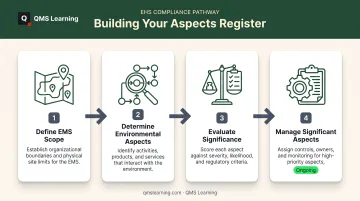
Building a defensible aspects register comes down to four repeatable steps.
Define the EMS scope. Decide whether the EMS covers the whole company or a specific site, product line, or business unit. Scope must match where you have authority and control—and cannot exclude activities with real environmental impact just to simplify the audit.
Determine environmental aspects. Analyze every activity, product, and service for air emissions, releases to water and land, resource use, waste, and biodiversity effects. Useful techniques include:
- Process flow mapping across each core operation
- Input-output or material balance analysis
- Value chain analysis extending through procurement, delivery, use, and disposal
- Cross-functional walkthroughs with operations, maintenance, and EHS staff
Identification also has to account for reasonably foreseeable emergencies, such as a chemical spill, a fire, or a tank rupture, because these introduce aspects that don't exist during normal operations.
Evaluate significance. ISO 14001 doesn't hand you a formula. Organizations set their own criteria, applied consistently across the whole register. Common criteria include:
- Severity or potential harm to the environment
- Frequency or scale of the activity
- Legal and permit requirements
- Stakeholder or community concern
- Potential for pollution prevention or resource recovery
Manage significant aspects. Once an aspect scores significant, assign a responsible person, build a training plan, and put procedures, checklists, or maintenance schedules in place that match the level of risk. A high-severity aspect earns tighter controls than a minor one.
How Often the Register Needs a Second Look
ISO doesn't set a universal review interval. EPA's foundry-industry EMS implementation guide, however, recommends reviewing aspect forms annually and immediately before or after any new or modified process, then re-running significance evaluation on the same schedule (EPA EMS Implementation Guide). That's an industry practice, not an ISO mandate, but it's a reasonable floor for most manufacturers.
The register is never "done." Revisit it when any of these occur:
- Annual review cycle (minimum floor for most manufacturers)
- New or modified process, equipment, or product line
- New supplier or material with different environmental profile
- Discontinued activity that should come off the register
- After a spill, near-miss, or other emergency event
Categorizing and Classifying Environmental Aspects
Most organizations organize their register using categories similar to ISO 14001's informal Annex A guidance:
- Emissions to air
- Releases to water
- Waste management, hazardous and non-hazardous
- Contamination of land
- Consumption of natural resources: energy, water, raw materials
- Other local issues, such as noise or odor
Categories describe what kind of aspect you're looking at. Classification tells you what to do about it. Layer tags on each category for control, significance, and impact direction:
- Controlled: you own the process end to end
- Influenced: a supplier or contractor is involved
- Significant: meets your significance criteria and needs active management
- Non-significant: tracked, but no dedicated controls required
- Positive: beneficial aspects worth reporting, such as recycling or renewable energy use
This two-layer structure is where many registers fall apart. NQA's aspects and impacts guidance stresses a method that stays systematic, consistent, and documented. Categories are rarely the problem. Teams apply classification tags inconsistently from one facility to the next.
ISO 14001 doesn't mandate this exact framework. Expand it, shrink it, or rename it. As long as the method is documented and repeatable, an auditor has no basis to object.
Common Environmental Aspects by Business Area
Every business area generates aspects, including the ones EHS teams tend to forget about.
| Business Area | Typical Environmental Aspects |
|---|---|
| Office & administration | Electricity consumption, paper and e-waste, water use in restrooms and break areas |
| Manufacturing & production | Process emissions, hazardous waste generation, raw material and chemical consumption, scrap |
| Support functions | Boilers and HVAC systems, maintenance shops, fleet vehicles, contractor activity on site |
| Emergency & abnormal conditions | Chemical spills, equipment failure, fire events, startup/shutdown releases |
Support functions are the ones EHS teams most often miss. The boiler nobody's inspected since installation, the fleet vehicle idling in the yard, the subcontractor hauling scrap off-site: these count as aspects just as much as the primary production line does.
From Aspects to Action: Objectives, Targets, and Audit-Ready Evidence
Significant aspects aren't the finish line. They're the input to everything else in your EMS.
Once an aspect is flagged significant, it should trace into an objective (a broad goal, like reducing hazardous waste) and a target (a measurable, time-bound commitment, like cutting solvent use 15% within twelve months). That chain mirrors the Plan-Do-Check-Act cycle that underpins ISO 14001 and many EPA programs.
Clause 8.1 then requires operational controls tied to each significant aspect:
- A named responsible person
- Training records proving competency
- Documented procedures, checklists, or maintenance schedules sized to the risk
A facility with significant solvent emissions, for example, might assign an EHS coordinator, require monthly VOC monitoring, and mandate operator training before anyone runs the coating line.
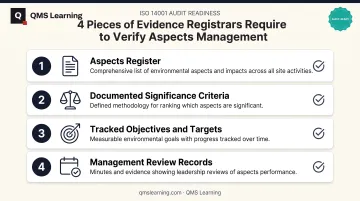
Registrars don't accept a policy statement as proof any of this happened. They expect to see:
- The aspects register itself
- Documented significance criteria, applied consistently
- Tracked objectives and targets with measurable progress
- Management review records showing the EMS is actually being reviewed
This is where most teams get stuck. Not because they don't understand the concepts, but because building all four pieces from scratch, and keeping them synchronized, takes time most EHS departments don't have.
QMS Learning's Environmental & Safety Compliance pathway was built around that gap. The EHS Fundamentals course (12 modules, 50 lessons) trains teams to identify aspects, apply lifecycle thinking, and score significance the way a registrar expects it documented.
The AI Workbench then turns that training into evidence:
- Builds the environmental aspects register from ISO 14001:2026 and two decades of real EHS audit findings
- Ties significant aspects to objectives, targets, and operational controls
- Compiles a single audit-evidence package so teams aren't assembling one the week before surveillance
Keeping the register—and the reasoning behind it—in-house matters. When a consultant leaves, institutional knowledge often leaves with them, and the same gaps resurface at the next audit.
Frequently Asked Questions
What is meant by environmental aspects and impacts?
An aspect is the element of an activity, product, or service that interacts with the environment, like a solvent used in production. The impact is the resulting change, such as air emissions or soil contamination.
What are the 5 elements of ISO 14001?
Most EMS programs describe five PDCA-aligned elements: environmental policy, planning (including aspects and impacts), implementation and operation, checking and corrective action, and management review. Each element feeds the next in a continuous improvement loop.
What are the environmental objectives of ISO 14001?
ISO 14001 does not prescribe fixed targets. Your organization sets measurable, time-bound goals from its significant aspects and policy—for example, cutting hazardous waste by a set percentage within a defined period.
What is the difference between a direct and an indirect environmental aspect?
Direct aspects fall within your organization's own operational control, like onsite emissions. Indirect aspects come from suppliers, contractors, or customer use of your product, and you can only influence them.
How often should an organization update its environmental aspects register?
Update it whenever activities, products, or services change, and at minimum during management reviews or internal audits. Many manufacturers also complete a full annual review.
What criteria are used to determine if an aspect is "significant"?
Common criteria include severity of harm, scale or frequency, legal obligations, and stakeholder concern. Each organization sets its own thresholds and applies them consistently across the register.