That gap has teeth. Without a data classification policy, teams either lock down low-risk internal memos like export-controlled blueprints (wasting time and budget) or leave genuinely sensitive CUI sitting in an unmarked folder (creating audit findings, DFARS violations, and real breach exposure).
This guide covers the classification levels most organizations actually use, who owns each step, how the policy ties into ISO 27001 and CMMC, and how to build something that survives an audit instead of decorating a policy binder.
Key Takeaways
- Classification policies align security controls with actual data risk, not guesswork
- Common tiers: Public, Internal, Confidential, and Restricted
- Owner, Steward, Custodian, and User roles decide if policies stick
- ISO 27001, NIST 800-171, CMMC, and ITAR each require data classification
- CUI and ITAR data legally require a Restricted tier, regardless of risk appetite
What Is a Data Classification Policy?
A data classification policy is a documented framework that sorts organizational data into categories based on sensitivity, business value, and regulatory exposure. Each protection rules: a marketing brochure and an ITAR-controlled drawing should never be treated the same way, and a policy is what forces that distinction into writing.
The CIA Triad Sets the Bar
Most classification schemes borrow their logic from the CIA triad. NIST's FIPS 199 defines confidentiality, integrity, and availability as three distinct security objectives: preserving authorized access restrictions, guarding against improper modification, and ensuring reliable access when it's actually needed.
In practice, this plays out as:
- Disclosure risk pushes data toward Confidential or Restricted, such as unpublished engineering data or employee PII
- Tampering risk raises integrity requirements: a flight-critical drawing needs version control, not just secrecy
- Downtime cost raises availability requirements, even for data that isn't sensitive
A dataset can be low-confidentiality but high-availability. Production schedules aren't secret, but if they go dark for a day, the line stops.
Classification Isn't the Same Thing as Governance
Once you've mapped confidentiality, integrity, and availability, a related distinction matters just as much. These two terms get used interchangeably, and that's a mistake. Classification is the act of categorizing what you have. Governance is the broader program, managing quality, access, retention, and lifecycle across the entire data estate.
Classification answers "what is this, and how sensitive is it?" Governance answers "who can touch it, how long do we keep it, and how do we know it's accurate?" A classification policy feeds into governance. It doesn't replace it.
The Four Data Classification Levels
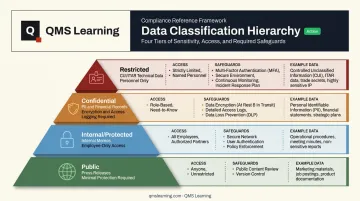
Classification schemes vary by organization, but most converge on four tiers. This is the standard model people usually mean when they ask about "the four types of data classification":
| Level | Typical Data | Protection Required |
|---|---|---|
| Public | Press releases, published research, marketing material | Minimal, safe for open release |
| Internal/Protected | Internal memos, budget drafts, staff directories | Limited to employees and contractors |
| Confidential | PII, financial records, proprietary engineering data | Encryption, access logging, need-to-know access |
| Restricted | CUI, ITAR technical data, PHI, PCI data | MFA, named authorized personnel only |
Public data needs almost no gatekeeping; it's already meant for the outside world.
Internal/Protected data isn't secret, but it's not for public consumption either: think a draft budget or an org chart. Neither tier should require heavy security overhead, and treating them like Restricted data is exactly the kind of over-protection that wastes budget and slows teams down.
Confidential is where real risk starts. Disclosure of PII, unpublished research, or proprietary engineering data could cause genuine harm to the business, customers, or individuals. This tier needs encryption, access logging, and a documented need-to-know basis, not just a password on a folder.
Restricted is the top tier, and it's not optional for regulated industries. Current ITAR regulations define technical data under 22 CFR 120.33 as information required for the design, development, production, or repair of defense articles — blueprints, drawings, and technical documentation included. That definition applies whether or not your internal policy has a "Restricted" box to check.
A note for aerospace, defense, and government contracting environments: classification has to explicitly account for CUI and export control markings. These carry independent legal handling requirements that exist on top of your company's internal tiers. A drawing marked ITAR-controlled doesn't stop being ITAR-controlled just because your internal scheme calls it "Confidential." This is why QMS Learning's Controlled Document Management System maps ITAR and CUI markings directly to clause-level requirements, keeping export-control status intact through revision control.
Roles and Responsibilities in Data Classification
Without named owners, a classification scheme is just paperwork. Auditors know this, and it's usually the first thing they probe.
- Data Owner: typically a department head or functional leader, accountable for making sure data in their domain gets identified, classified, and reviewed on schedule
- Data Steward: manages day-to-day classification decisions, validates what creators tag, and maintains the documentation trail for their domain's data assets
- Data Custodian: implements the technical and physical safeguards (storage, backups, access controls, encryption) that each classification level demands, usually alongside IT/security
- Data Creator/User: classifies data at the point of creation or follows the existing tag; typically the front-line quality engineer, program manager, or contracts staff member who first generates or receives it
Unclear ownership is one of the most common reasons classification programs stall before they ever get used.
TDWI's research on data governance failure points to ownership skirmishes and job-title conflicts as recurring conditions that sabotage governance initiatives before they mature, and classification programs fail for the identical reason.
RACI-style role clarity is specifically what auditors look for. A policy that names "Data Owner" as a concept without naming an actual person is a common audit finding, because nobody can prove the review actually happened.
If your document says "the Data Owner reviews classification annually" and can't produce a name, a date, or a signature, that line item is functionally decorative.
Data Classification and Compliance Frameworks: ISO 27001, CMMC, and ITAR
Data classification is a named or implied control in nearly every major framework regulated industries operate under, from ISO 27001 to CMMC to ITAR.
ISO 27001 makes this explicit. Under the 2022 revision, Annex A control 5.12 requires organizations to classify information according to confidentiality, integrity, availability, and relevant legal requirements. Control 5.13 requires a matching labeling procedure.
Together, these two controls define what an "ISO 27001 data classification policy" actually needs to contain: a defined scheme, and a documented way to mark data according to it.
CMMC and NIST 800-171 build on top of that logic by requiring defense contractors to specifically identify and protect CUI as its own defined data type, with handling and marking rules distinct from general business data. This isn't theoretical.
A 2023 DoD Inspector General audit reviewed a nonstatistical sample of DoD-component documents and found:
- 46% of the sampled DoD-component documents lacked proper CUI headers and footers
- Only 3% of a sampled 103 contractor-created documents lacked proper markings
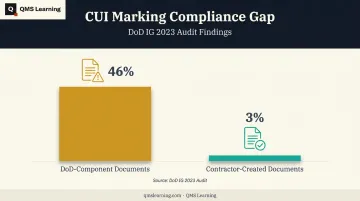
Marking discipline, not contractor competence, is what determines disclosure risk here.
ITAR and export control regulations effectively create a mandatory Restricted tier for technical data. Classification decisions here can't just weigh business sensitivity; they have to weigh legal transferability, including whether a foreign national on the project team can even see the file.
AS9100D's documented information control clauses don't name "classification" outright, but they implicitly require organizations to determine and control the sensitivity of records, drawings, and quality data, tying classification into everyday quality management practice rather than treating it as a separate IT project.
For teams that need staff to move past simply knowing the four tiers to correctly applying them under audit pressure, QMS Learning's Defense Cybersecurity Readiness pathway covers CMMC, NIST 800-171, ISO 27001, and SOC 2.
The included AI Workbench drafts SSP sections that document the CUI boundary, builds POA&M entries for protection gaps, and functions as a 24/7 mentor for CUI and USML classification questions. This pathway opens as a pilot cohort in Q3 2026.
Best Practices for Building and Maintaining Your Policy
Building a classification policy that actually holds up starts before you pick a single tier name.
- Start with a regulatory and risk assessment. Align your categories to the laws, contracts, and standards that actually apply to your organization, such as HIPAA, ITAR, CMMC, or PCI DSS, instead of copying a generic template off the internet.
- Keep the tier count small. Overly granular schemes cause classification fatigue, and staff start guessing instead of following a rule they can't remember.
- Build in a documented review cycle. Annual reviews, plus ad hoc triggers like new regulations, new contracts, or M&A activity, keep the scheme current. Require re-classification whenever data changes context or ownership.
Even a well-designed policy falls apart without evidence behind it. Auditors most often flag classification policies that exist on paper but leave no trail: no record of who classified what, when, or why.
QMS Learning's Document Management System closes that gap. It provides:
- An append-only audit trail for every classification decision
- Clause-mapped linkages to standards like AS9100D and NIST 800-171
- One-click evidence export for classified records
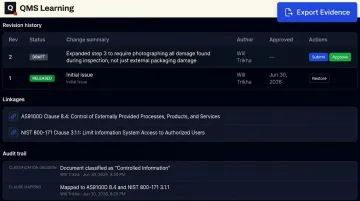
This means audit evidence is ready before the auditor ever asks for it.
Frequently Asked Questions
What are the four types of data classification?
Most organizations use Public, Internal/Protected, Confidential, and Restricted. Regulated industries often add CUI or export-controlled data as a distinct sub-category within Restricted.
What is ISO 27001 data classification policy?
ISO 27001 (Annex A 5.12/5.13) requires organizations to classify information based on confidentiality, integrity, availability, and legal requirements. Each classification level then gets matching labeling and handling procedures.
Who is responsible for classifying data in an organization?
Data Owners are ultimately accountable for their domain. Data Creators typically apply the initial classification at the point of creation, which a Data Steward then validates and documents.
How often should a data classification policy be reviewed?
At minimum annually, plus ad hoc reviews triggered by regulatory changes, mergers, or the introduction of new data types into the environment.
What is the difference between data classification and data governance?
Classification categorizes data by sensitivity level. Governance is the broader framework for managing data quality, access rights, and lifecycle across the entire organization.
How does data classification apply to CUI and ITAR-controlled data?
CUI and ITAR technical data carry handling rules set by federal regulation, not internal risk tolerance. That makes them a mandatory Restricted-equivalent tier no matter what your internal policy calls it.