Introduction
If you sell to the Department of Defense or handle federal data, you've felt the pressure ramp up.
Primes now ask for proof of cybersecurity maturity before they'll even open a bid. NIST's publications, especially SP 800-171, SP 800-53, and the Cybersecurity Framework, have become the default language for that proof.
The problem: these documents run hundreds of pages, packed with control families and assessment objectives that read like they were written for someone with a law degree and a computer science PhD.
Most quality and compliance teams don't have that combination on staff, so they call a consultant and hope for the best.
This guide breaks down what NIST compliance actually means, which standards matter most, how the CSF's six functions work, and a practical path toward building this capability inside your own team.
Key Takeaways
- NIST doesn't audit or certify anyone; DFARS and CMMC just treat its publications as the baseline
- SP 800-171 protects CUI, SP 800-53 governs federal systems, and the CSF offers voluntary guidance for any organization
- CSF 2.0 added a sixth function, Govern, making risk management a leadership responsibility
- Federal contract eligibility now hinges on demonstrated 800-171/CMMC readiness, not just a signature
- In-house capability beats a one-time consultant engagement for staying audit-ready long term
What Is NIST Compliance?
NIST compliance means aligning your organization's security processes with guidelines published by the National Institute of Standards and Technology. In practice, that usually means one of three publications: SP 800-171, SP 800-53, or the Cybersecurity Framework (CSF).
Here's the part that trips people up: NIST itself doesn't audit anyone. It's not a regulator, and it doesn't hand out certificates. Instead, other rules and contract clauses point to NIST publications as the technical yardstick: FISMA references SP 800-53, DFARS and CMMC reference SP 800-171, and FedRAMP builds its baselines on SP 800-53 Rev. 5.
What Is NIST?
The National Institute of Standards and Technology is a non-regulatory agency inside the U.S. Department of Commerce, founded in 1901. Its mission is to "advance measurement science, standards, and technology in ways that enhance economic security and improve our quality of life," according to NIST's official mission statement.
Cybersecurity is just one part of a much broader portfolio that includes everything from atomic clocks to manufacturing standards.
What Does NIST Do?
For compliance purposes, NIST's job is to write and maintain the SP 800 series and the CSF, then update them as threats change. It also:
- Conducts research supporting emerging technology, including post-quantum cryptography
- Publishes implementation guidance used by government agencies and private companies alike
- Maintains informative references mapping its frameworks to standards like ISO 27001
Who Needs to Comply with NIST?
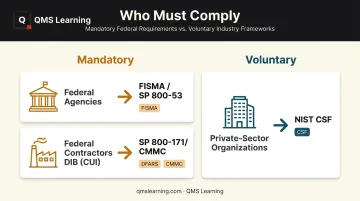
Compliance obligations split into two camps.
Mandatory:
- Federal agencies, bound by FISMA and required to select controls from SP 800-53
- Federal contractors and Defense Industrial Base companies handling Controlled Unclassified Information, bound by SP 800-171 and, increasingly, CMMC certification
Voluntary: Private-sector organizations adopt the CSF to strengthen security posture or prepare for future contract requirements.
This isn't a legal requirement for most private companies, but plenty adopt it anyway because it's become the common language buyers expect.
Common NIST Standards and Frameworks You Should Know
NIST publishes dozens of special publications, but only a handful show up in most compliance conversations. Here's how the big three, plus two runners-up, differ in scope.
NIST SP 800-171
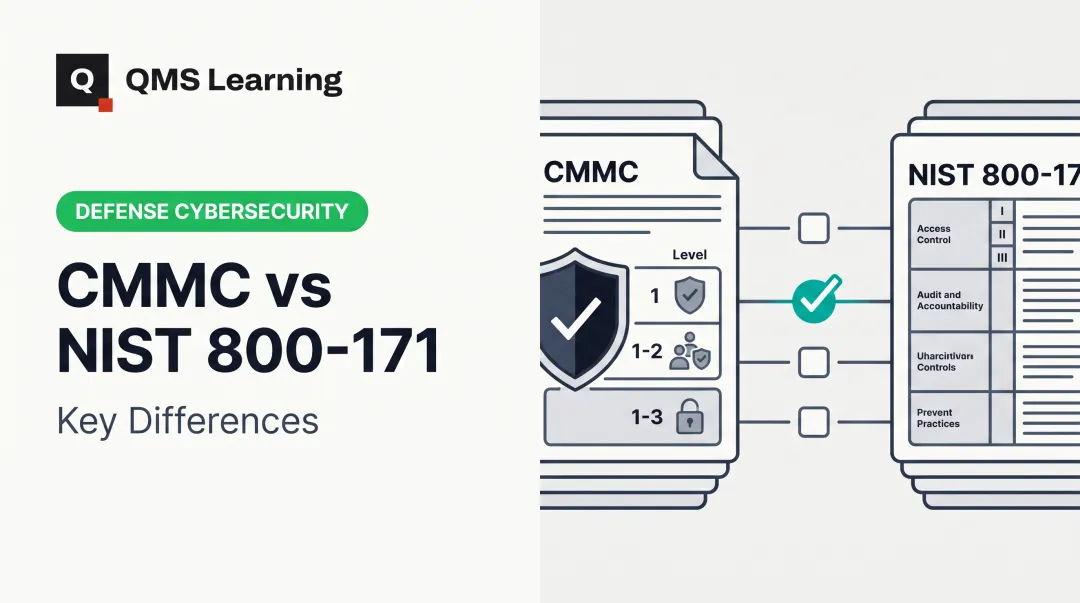
SP 800-171 protects Controlled Unclassified Information (CUI) in nonfederal systems. If you're a defense contractor storing, processing, or transmitting CUI, this is the publication your contract clauses likely reference.
NIST published Rev. 3 in May 2024, restructuring requirements into 17 families. But the familiar 14-family, 110-requirement structure still comes from the older Rev. 2, and CMMC Level 2 builds on that Rev. 2 baseline.
Don't assume the newest revision automatically changes what your contract requires. Check the actual clause and CMMC guidance first.
NIST SP 800-53
SP 800-53 is a sprawling catalog of security and privacy controls for federal information systems. Agencies select controls based on impact level (low, moderate, or high), as categorized under FIPS 199 and directed by FIPS 200. SP 800-53B then provides the actual baseline for each tier.
FedRAMP, the program that authorizes cloud services for federal use, builds its Rev. 5 baselines directly on SP 800-53 Rev. 5 and 800-53B.
NIST Cybersecurity Framework (CSF)
The CSF is voluntary and flexible enough for an organization of five people or five thousand. It doesn't prescribe specific technical controls; instead, it organizes cybersecurity outcomes into functions and categories that any sector can adapt.
CSF 2.0 launched in February 2024, alongside a Small Business Quick-Start Guide aimed at organizations with little or no formal cybersecurity plan in place.
Two other publications round out the essentials:
- FIPS (Federal Information Processing Standards) cover cryptographic requirements, including FIPS 197 (AES encryption) and FIPS 140-3 (cryptographic module security)
- SP 800-207 describes Zero Trust Architecture, a model that verifies every access request instead of trusting anything by default based on network location
The NIST Cybersecurity Framework: Core Functions Explained
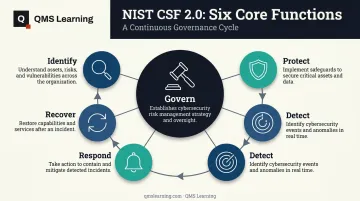
For years, the CSF was built around five functions. CSF 2.0, released in February 2024, added a sixth: Govern, according to NIST's announcement of the release. That addition matters because it puts cybersecurity risk management on leadership's desk, not just the IT department's to-do list.
Govern
Govern establishes, communicates, and monitors your organization's cybersecurity risk management strategy and accountability structure. It's the function that asks who owns this, and whether the rest of the business knows the rules. In practice, that means naming a risk owner and setting a regular reporting cadence with leadership.
Identify
Identify builds an inventory of assets, data, and systems so you understand where risk actually lives. You can't protect what you haven't mapped, and this is where most gap analyses start. For a contractor handling Controlled Unclassified Information, that means mapping every system NIST 800-171 assessors will check first.
Protect
Protect covers the safeguards that keep systems running safely: access control, encryption, employee training, and backup practices. It typically holds more subcategories than any other function, since safeguards touch nearly every system you just identified.
Detect
Detect establishes monitoring processes that catch unauthorized access or unusual activity quickly, before a small anomaly turns into a full incident. Think automated alerts flagging a login attempt from an unfamiliar location within minutes, not weeks.
Respond
Respond requires a documented incident response plan covering containment, internal and external communication, and regulatory reporting obligations. Having the plan matters less than having tested it — an annual tabletop exercise usually exposes gaps a written plan alone won't.
Recover
Recover focuses on restoring systems and operations after an incident, then feeding lessons learned back into Identify and Protect so the same gap doesn't reopen.
Benefits of Achieving NIST Compliance
Compliance work often gets framed as a cost center. It's more accurate to call it risk reduction with a side benefit of new revenue.
Improved security posture. Structured risk management, the kind CSF and 800-171 both demand, correlates with faster detection and lower breach costs. IBM's 2025 Cost of a Data Breach report found the global average breach cost dropped to $4.44 million, a 9% decrease from 2024. The drop was driven largely by faster identification and containment, exactly what Detect and Respond are built to deliver.
Federal contract eligibility. Beyond stronger security, DoD suppliers face a harder requirement: 800-171 and CMMC readiness isn't a nice-to-have. DFARS clauses can make a current assessment or CMMC status a condition of contract award. No documented compliance, no bid.
Competitive trust and simplified compliance. Beyond winning federal contracts, clients increasingly ask for proof of a security program before signing. NIST alignment also cuts duplicate work when pursuing ISO 27001 or SOC 2 next, since many underlying controls overlap.
How to Build NIST Compliance Capability: A Practical Checklist
Consultants can get you across the finish line once. Building the capability in-house is what keeps you compliant every year after, without the invoice.
- Run a gap analysis. Benchmark current controls against the target publication, whether that's 800-171, 800-53, or the CSF, and document every gap, not just the obvious ones.
- Implement access control and authentication safeguards. Least-privilege permissions and multi-factor authentication should map directly to the relevant control families so auditors can trace each safeguard back to its specific requirement.
- Document incident response, contingency, and physical security procedures. Then set a continuous monitoring cadence so evidence is collected before an audit is scheduled, not scrambled together the week before.
- Build internal training and capability, not just a binder of policies. This is where most teams underinvest. A one-time consultant engagement produces documents; it doesn't produce people who can defend those documents under questioning.
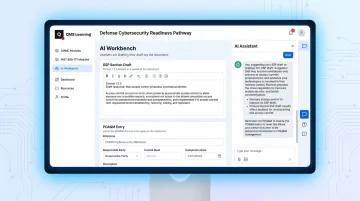
That fourth step is the gap that QMS Learning's Defense Cybersecurity Readiness pathway is being built to close, with a pilot cohort opening Q3 2026. The pathway pairs a CMMC & NIST 800-171 course with an AI Workbench.
The course covers all 14 control families, gap assessment methodology, System Security Plan development, and POA&M management. The AI Workbench is trained on 800-171, CMMC assessment guides, and DFARS flow-down requirements. Instead of learning theory, teams draft real SSP sections and POA&M entries as they go, and early enrollees get design-partner pricing.
Common NIST Compliance Challenges and Best Practices
Key Challenges to Anticipate
Two problems come up again and again:
- Interpreting dense publications with thin staff. Small and mid-sized contractors rarely have a dedicated cybersecurity team, so someone in quality or IT ends up translating 800-171's requirement language into daily practice on top of their regular job.
- Keeping subcontractors aligned. Your compliance posture is only as strong as your supply chain's. Flow-down clauses mean your subcontractors' gaps can become your finding.
Best Practices for Long-Term Compliance
- Automate evidence collection. A controlled document system, like QMS Learning's platform, maps procedures directly to control families and logs acknowledgments per revision, turning audit prep from a weeks-long scramble into a same-day export.
- Maintain living documentation. Standards change; CSF 1.1 became CSF 2.0, and 800-171 Rev. 2 is giving way to Rev. 3. Documentation tied to specific clauses, with change-impact flags when one procedure updates, keeps the rest of your QMS from silently drifting out of sync.
Frequently Asked Questions
What is the NIST standard?
"The NIST standard" usually refers to a specific publication, most often SP 800-171, SP 800-53, or the Cybersecurity Framework, depending on context. There isn't one document that covers everything.
What are the most common NIST standards?
SP 800-171 (CUI protection for contractors), SP 800-53 (federal system controls), and the CSF (voluntary risk guidance for any organization) are the three most referenced, each applying to a different audience.
What are the 5 principles of NIST?
These are actually the CSF's core functions, not principles: Identify, Protect, Detect, Respond, and Recover. CSF 2.0 added a sixth function, Govern, in February 2024.
Is NIST compliance mandatory for private companies?
It's mandatory for federal agencies and contractors handling federal data or CUI. For most private-sector organizations, it's voluntary, though increasingly expected by customers and partners.
How does NIST compliance differ from ISO 27001 or SOC 2?
NIST publications are U.S.-government-oriented and control-specific. ISO 27001 is an internationally certifiable management system standard, while SOC 2 focuses on trust principles for service providers.
How long does it take to become NIST compliant?
Timelines vary by framework and organization size. A focused CSF assessment might take a few months, while full SP 800-171 or CMMC readiness often takes closer to a year, depending on the size of your gaps.