The cost of getting this wrong is substantial. According to IBM's 2025 Cost of a Data Breach Report, the average breach costs $4.44 million globally and a record $10.22 million in the United States. Many of those breaches exploit gaps that a well-executed compliance audit would have surfaced first.
This guide is written for CISOs, compliance officers, IT directors, program managers, and quality leads at defense contractors and regulated organizations navigating frameworks like CMMC, NIST 800-171, ISO 27001, or SOC 2. It covers what a cybersecurity compliance audit actually is, how to execute one step by step, what auditors evaluate, and where most teams fall short.
Key Takeaways
- A cybersecurity compliance audit is a formal, evidence-driven evaluation — distinct from a vulnerability scan or general security assessment
- Define scope before collecting evidence; starting without it guarantees the wrong documentation
- Auditors look at whether controls are actually practiced, not just documented
- Evidence must be organized, timestamped, and traceable to specific framework requirements
- CMMC, ISO 27001, and NIST 800-171 all require ongoing monitoring — compliance is maintenance, not a finish line
What Is a Cybersecurity Compliance Audit?
A cybersecurity compliance audit is a structured, evidence-based review that determines whether an organization's cybersecurity policies, controls, and practices align with the specific requirements of a compliance framework — CMMC, NIST SP 800-171, ISO 27001, SOC 2, HIPAA, or FedRAMP. For defense contractors, CMMC and NIST 800-171 are typically the primary drivers.
This is distinct from two things people often conflate with it:
- A general security assessment evaluates overall risk posture without mapping findings to a specific regulatory standard
- A penetration test actively attempts to exploit vulnerabilities to find weaknesses — it tests whether defenses hold, not whether they're documented and operating as required
The Three Components Auditors Expect
Auditors don't just want paperwork. They evaluate three layers:
- Documented controls and policies — written procedures that define how security requirements are met
- Evidence of implementation — proof that those controls are operating as written (logs, screenshots, signed records)
- Ongoing compliance management — evidence that controls are monitored continuously, not just functional on audit day
Internal vs. External Audits
| Audit Type | Who Conducts It | Primary Purpose |
|---|---|---|
| Internal | Organization's own team | Surface gaps before an external reviewer does — a controlled run-through on your own terms |
| External | Accredited third party | Formal assessment against the framework standard; findings carry regulatory weight |
For CMMC Level 2 (when C3PAO assessment is required by the solicitation), assessment must be performed by an authorized C3PAO. For SOC 2, attestation requires a licensed CPA firm.
Understanding which type applies to your situation determines the scope, timeline, and evidence standard you'll need to meet — which is where the audit process begins.
Why Cybersecurity Compliance Audits Matter
The stakes vary by framework, but they're real across all of them.
Regulatory and contractual consequences include:
- Loss of DoD contract eligibility for defense contractors who fail CMMC requirements
- HIPAA enforcement actions — HHS OCR settled with BST & Co. CPAs for $175,000 over failure to conduct a proper risk analysis
- False Claims Act exposure — Georgia Tech Research Corporation paid $875,000 to resolve allegations involving an allegedly missing System Security Plan and inaccurate NIST SP 800-171 assessment score
- Contract termination or customer loss for SaaS vendors who fail SOC 2 attestation
Penalties are one side of the equation. Audits also surface the operational gaps that quietly grow into security incidents:
- Undetected access control gaps (accounts that shouldn't exist, permissions that haven't been reviewed)
- Undocumented incident response procedures that leave teams improvising during an actual event
- Shadow IT assets outside the compliance boundary — unmanaged devices or cloud services that carry real data but no controls
- Configuration drift where live systems no longer match their documented security baseline
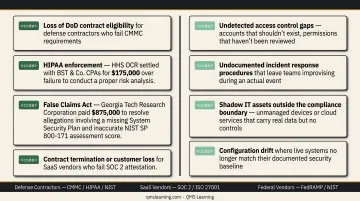
The trigger differs by organization. Defense contractors, healthcare organizations, and federal vendors face legally or contractually required audits under CMMC, HIPAA, and FedRAMP/NIST respectively. SaaS companies pursuing SOC 2 or ISO 27001 typically audit on market demand — though in practice, enterprise customers now treat attestation as a procurement requirement, not a differentiator. Either way, the audit finds the gaps before an adversary or regulator does.
How to Conduct a Cybersecurity Compliance Audit
A compliance audit follows a defined sequence. Skipping or compressing any phase creates compounding problems downstream.
Step 1: Define Scope and Select the Applicable Framework
Identify which framework or frameworks apply — CMMC 2.0, NIST SP 800-171, ISO 27001, SOC 2 Type II, HIPAA — then map which systems, data types, personnel roles, and physical locations fall inside the compliance boundary.
Scope errors cut both ways:
- Over-scoping inflates audit complexity and evidence burden unnecessarily
- Under-scoping creates liability when a breach occurs in a system that should have been covered
For CMMC, DoD's scoping guide distinguishes CUI Assets, Security Protection Assets, Contractor Risk Managed Assets, Specialized Assets, and Out-of-Scope Assets — each category must be documented in the System Security Plan (SSP) and network diagram.
Step 2: Conduct a Gap Assessment Against Framework Requirements
Compare each framework requirement against current implemented controls and documentation. Mark each control as:
- Fully met — implemented, documented, and operating
- Partially met — some evidence exists but gaps remain
- Not addressed — no implementation or documentation
This gap assessment becomes the remediation roadmap. Complete it before any evidence collection begins — collecting evidence before knowing what you're missing wastes time and creates false confidence.
Step 3: Build and Organize the Asset Inventory
The asset inventory lets auditors verify that scope is accurate and every in-scope system has tested controls behind it. At minimum, it must include:
- Endpoints and devices
- Applications and cloud services
- Data repositories
- User accounts
Undocumented or shadow IT assets discovered during an audit are automatic findings. An assessor who finds a cloud storage service containing CUI that wasn't in the SSP doesn't need to look for other problems — that one finding can carry significant weight.
Step 4: Collect and Organize Audit Evidence
Organize evidence by control requirement, timestamped and traceable. Assessors will not search through unstructured file shares — if they can't locate it quickly, it effectively doesn't exist.
Common evidence types include:
- Configuration screenshots showing security settings
- Access control logs proving least-privilege enforcement
- Policy documents with full revision history
- Training completion records tied to specific requirements
- Incident response test results (tabletop or live)
- Vendor security agreements
Teams using a clause-mapped document management system can compile a submission in minutes rather than days. When a C3PAO assessor requests evidence for a specific NIST 800-171 control family, the relevant documents — revision history, acknowledgment logs, and all — should surface immediately. QMS Learning's Document Management System is built specifically for this: each controlled document links directly to the framework clauses it satisfies, with one-click audit-export capability.
Step 5: Remediate Gaps and Document Corrective Actions
Prioritize remediation in this order:
- Address controls that are completely unimplemented before refining partially-met ones
- Focus first on requirements that carry the highest risk or are most frequently probed during external audits
- Document the corrective action process — the full trail: how the finding was identified, who it was assigned to, and how it was closed
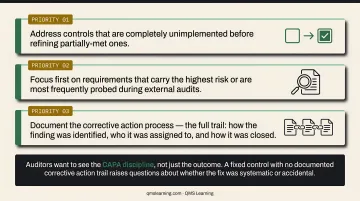
Auditors want to see the CAPA discipline, not just the outcome. A fixed control with no documented corrective action trail raises questions about whether the fix was systematic or accidental.
Step 6: Conduct an Internal Audit Before External Review
Run an internal audit that mirrors what an external assessor will actually do:
- Review evidence for completeness against each requirement
- Interview key personnel to confirm they can speak to their responsibilities
- Test whether response workflows function as documented
This step surfaces the most common source of external audit findings: the gap between what the policy says and what staff actually do when asked to explain it.
What Auditors Actually Evaluate
Auditors use sampling, not exhaustive review. They pull representative evidence from specific controls — a support ticket confirming an access change followed the documented change management process, a log verifying MFA is enforced.
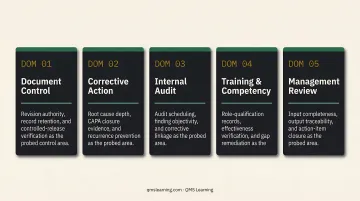
A clean policy document is not sufficient. Auditors will test whether the policy is followed in practice. That testing follows predictable patterns across five control domains.
Five Control Domains Consistently Probed
| Domain | What Auditors Look For |
|---|---|
| Identity & Access Management | MFA enforcement, least privilege, user lifecycle management |
| Data Protection | Encryption at rest and in transit, data classification |
| Incident Response | Documented plan, evidence of tabletop or live testing |
| Configuration & Patch Management | Current patch status, hardened configurations |
| Third-Party / Vendor Risk | Security requirements in vendor contracts, evidence of assessments |
The Personnel Interview Problem
Auditors will ask employees — not just security leads — to explain security procedures relevant to their role. IBM's research shows that organizations with low employee training levels average $5.10 million per breach, compared to $4.15 million for organizations with high training levels — a meaningful difference that extends to audit performance as well.
A team where only the CISO knows the answers will accumulate findings fast. Spreading compliance knowledge beyond the security function — so non-security staff can articulate their CUI handling responsibilities — is the practical difference between a clean pass and a conditional one.
Continuous Monitoring Evidence
NIST SP 800-171 requirement 3.12.3 requires ongoing monitoring of security controls to ensure continued effectiveness. ISO 27001 clause 9.1 requires evaluation of ISMS performance; clause 9.2 requires internal audits at planned intervals.
Auditors look for:
- Logging configurations showing what is captured
- Alert records showing anomalies were detected
- Periodic review documentation
- Evidence that detected anomalies were acted upon
Teams that maintain this monitoring posture year-round — not just during audit prep — need compliance knowledge distributed across roles, not concentrated in the security function. QMS Learning's Defense Cybersecurity Readiness pathway covers CMMC, NIST 800-171, ISO 27001, and SOC 2, with a pilot cohort opening Q3 2026.
Common Mistakes Teams Make
Treating the Audit as a Documentation Sprint
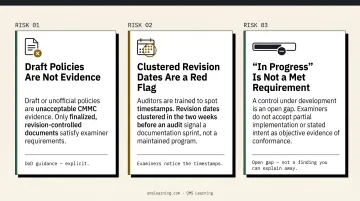
Teams that don't maintain updated policies, training records, and control evidence between audits spend weeks recreating artifacts under pressure. The timestamps show it — auditors notice when every document was revised in the two weeks before the audit. DoD guidance is explicit on this point:
- Draft or unofficial policies are unacceptable CMMC evidence
- Revision dates clustered in the weeks before an audit are a red flag examiners are trained to spot
- "In progress" is not a met requirement
Scope Boundary Errors
Organizations frequently over-scope or under-scope their compliance boundary:
- Over-scoping includes systems that should be segmented out, inflating evidence burden and cost
- Under-scoping excludes systems that clearly handle covered data, leaving real risks unaddressed and creating liability if a breach occurs in an "out-of-scope" area
Both errors are avoidable. A proper SSP and network diagram — completed at the start of the audit cycle, not after — should document exactly which systems touch CUI, how they're segmented, and why everything outside the boundary qualifies for exclusion.
The Single-Point-of-Knowledge Problem
Compliance programs built around one senior person are fragile. When that person is unavailable during the audit — or when an assessor interviews a junior engineer who can't explain the controls they operate — findings multiply.
The fix is distributing compliance knowledge through role-specific training and practiced evidence collection. Every control family needs a named owner who can speak to it — not just one CISO holding all the institutional memory.
Frequently Asked Questions
How much does a cybersecurity compliance audit cost?
Cost varies significantly by organization size, number of in-scope systems, framework complexity, and whether the audit is internal or third-party. For reference, DoD's 2024 final rule models CMMC Level 2 C3PAO assessment costs at approximately $101,752 initially for a small entity. SOC 2 audits typically range from $20,000 to $100,000 depending on scope and Type I vs. Type II.
What does a compliance audit include?
A compliance audit maps all findings to the specific framework requirements being assessed. Core activities include:
- Review of security policies and procedures
- Evidence collection for implemented controls
- Personnel interviews and configuration/log reviews
- Findings report with remediation recommendations
How often should a cybersecurity compliance audit be conducted?
At minimum, annually for most frameworks. ISO 27001 requires annual surveillance audits within a three-year certification cycle; CMMC Level 2 C3PAO status is valid for three years with annual affirmations; HIPAA sets no fixed interval but requires periodic evaluation; SOC 2 annual reporting is market practice, not an AICPA mandate.
What is the difference between a cybersecurity audit and an IT audit?
An IT audit covers all aspects of IT systems — governance, operations, reliability, and controls broadly. A cybersecurity compliance audit focuses specifically on whether security controls protecting data and systems meet the defined requirements of a regulatory framework like CMMC, ISO 27001, or HIPAA.
Do you need a third-party auditor for a cybersecurity compliance audit?
Internal audits are valuable for readiness assessment and can be self-conducted. Certain frameworks require independent review, though: CMMC Level 2 mandates an accredited C3PAO when the contract solicitation requires it, and SOC 2 attestation always requires a licensed CPA firm.
What frameworks does a cybersecurity compliance audit cover?
The most common frameworks by sector: CMMC and NIST SP 800-171 for defense contractors, SOC 2 for service organizations, ISO 27001 for globally operating companies, HIPAA for healthcare, and FedRAMP for vendors serving federal agencies. Many organizations must satisfy multiple frameworks simultaneously.
Conclusion
A well-executed cybersecurity compliance audit verifies that controls are not just documented but operational, surfaces gaps before regulators or adversaries do, and produces the evidence record that external auditors, customers, and contracting officers require.
A few outcomes separate teams that pass audits from teams that only prepare for them:
- Operational controls, not just documented ones — auditors test what actually runs
- A maintained evidence record that answers questions before they're asked
- Continuous posture, not a one-time certification sprint
Compliance isn't a credential you earn and file away. It requires the diagnostic judgment to recognize gaps early, the processes to close them, and the evidence infrastructure to prove it. Teams that build that capability — rather than buying a policy template and hoping — show up to every audit with answers already in hand.
For defense contractors working toward CMMC certification or NIST 800-171 compliance, QMS Learning's Defense Cybersecurity pathway (pilot cohort opening Q3 2026) pairs role-specific training with an AI Workbench that generates auditor-ready documentation and exports a single evidence package accepted by assessors on first submission.