Introduction
Most ISO 27001 programs don't fail because teams lack intent — they fail because implementation looks deceptively structured on paper and turns chaotic the moment scoping begins. The standard defines what your Information Security Management System (ISMS) must do. It doesn't tell your team how to sequence the work or where the real blockers hide.
Compliance officers, CISOs, quality managers, and defense contractors frequently encounter the same problem: they know ISO 27001 exists, they know they need it, and then they freeze when implementation begins. The gap between understanding the standard and operationalizing it is where most programs stall.
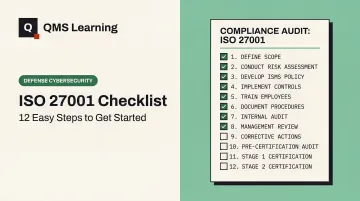
This checklist breaks the certification journey into 12 structured steps across three phases — Foundation and Planning, Risk Assessment and Controls, and Documentation, Auditing, and Maintenance — so your team moves from kickoff to certified auditor visit without losing momentum mid-sequence.
Key Takeaways
- ISO 27001:2022 has 7 mandatory clauses (Clauses 4–10) and 93 Annex A controls across four themes
- Implementation moves through three phases: Foundation, Risk Assessment, and Documentation/Auditing
- The Statement of Applicability (SoA) is heavily auditor-scrutinized: every inclusion and exclusion must trace back to your risk assessment
- Certification requires a Stage 1 documentation review and a Stage 2 implementation audit by an accredited body
- Valid for three years, but annual surveillance audits are required to maintain certification
What Is the ISO 27001 Compliance Checklist?
The ISO 27001 compliance checklist is a structured set of implementation activities that guides an organization from initial planning through external certification and ongoing ISMS maintenance. It is not a list of security controls — it's a map of the certification journey.
The checklist is built around ISO 27001:2022's mandatory requirements:
- Clauses 4–10 establish the ISMS framework — covering context, leadership, planning, support, operations, performance evaluation, and improvement
- Annex A provides 93 controls across four themes (organizational, people, physical, technological) that organizations select based on their specific risk profile
Those two pillars drive everything on the checklist. Not all 93 controls are required for every organization — but what is required is a written justification for every decision: which controls you selected, which you excluded, and why.
Phase 1 — Foundation and Planning (Steps 1–3)
Phase 1 sets the foundation. Organizations that skip it — or compress it to hit an arbitrary deadline — typically find the same gaps surfacing as audit findings six months later. Get the team, the knowledge, and the baseline right before touching a single control.
Step 1: Assemble Your ISMS Team and Implementation Plan
ISO 27001 requires demonstrable top management involvement — not just awareness. An auditor will ask whether leadership assigned resources, enforced policies, and stayed engaged. A functioning ISMS team typically includes:
- A project lead responsible for driving implementation milestones
- IT and information security representatives who own technical controls
- A management sponsor with authority to allocate budget and enforce policy
- In smaller organizations, one person often fills multiple roles
Once the team is in place, build a realistic project plan. According to NQA, well-resourced implementations with experienced internal staff can achieve certification in 2–3 months, while 6 months or more is common for most organizations. Structure the program using a Plan-Do-Check-Act (PDCA) framework from the start, which mirrors how ISO 27001 expects the ISMS to operate on an ongoing basis.
Step 2: Understand ISO 27001 Clause Requirements
Every mandatory clause drives a specific set of deliverables:
| Clause | What It Requires |
|---|---|
| 4 – Context | Define internal/external issues, interested parties, and ISMS boundaries |
| 5 – Leadership | Establish policy, responsibilities, and management commitment |
| 6 – Planning | Document risk methodology, objectives, and risk treatment approach |
| 7 – Support | Provide resources, competence, awareness, and controlled documents |
| 8 – Operation | Execute the ISMS and perform risk assessment and treatment |
| 9 – Performance Evaluation | Monitor, measure, audit, and conduct management reviews |
| 10 – Improvement | Address nonconformities through corrective action |
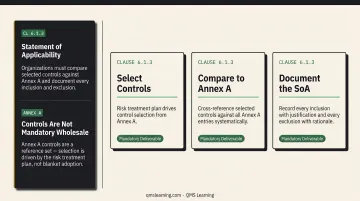
Annex A controls are not mandatory to implement wholesale. Clause 6.1.3 requires organizations to compare selected controls against Annex A and document every inclusion and exclusion in the Statement of Applicability.
Step 3: Conduct a Gap Analysis
A gap analysis compares your current security practices against ISO 27001 requirements to identify what exists, what's missing, and what needs to be built before implementation can begin. Done correctly, it surfaces the issues that would otherwise become audit findings.
A thorough gap analysis should document:
- Which controls from Annex A are already in place (even informally)
- Where processes exist but are undocumented or inconsistently applied
- Which risk areas have no coverage and require net-new controls
- The prioritized remediation list that feeds directly into your implementation plan
QMS Learning's AI Workbench — part of the Defense Cybersecurity Readiness pathway — includes Gap Analysis as a built-in method. The Workbench is trained on ISO 27001 Annex A and generates gap assessment documentation in the standard's voice, reducing the time and guesswork compared to manual reviews.
Phase 2 — Risk Assessment and Controls (Steps 4–7)
Phase 2 is the technical and operational core of ISO 27001 implementation. The quality of this phase directly determines how defensible your ISMS will be under audit.
Step 4: Define Your ISMS Scope
The scope document must clearly state which business units, locations, systems, data types, and third-party dependencies are included — and which are explicitly excluded with justification.
Avoid scope language like "all company systems." If the actual certification boundary is narrower, that language creates immediate audit exposure. Auditors routinely probe gaps around:
- Cloud infrastructure and SaaS platforms
- Outsourced processing and managed service providers
- Remote work environments and home office endpoints
Clause 4.3 requires the scope to be maintained as documented information. This is one of the first things a Stage 1 auditor will read.
Step 5: Perform a Risk Assessment
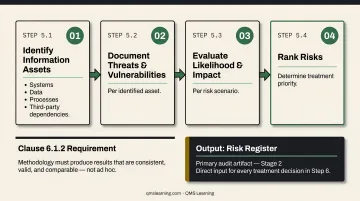
The risk assessment is the analytical foundation of the entire ISMS. The process:
- Identify information assets — systems, data, processes, and third-party dependencies
- Document threats and vulnerabilities for each asset
- Evaluate likelihood and impact for each risk scenario
- Rank risks to determine which require treatment
Clause 6.1.2 requires the methodology to produce results that are consistent, valid, and comparable — not ad hoc. Auditors will verify that the same approach was applied across all assets. The output feeds directly into the risk register — which becomes a primary audit artifact during Stage 2 and the direct input for every treatment decision in Step 6.
Step 6: Develop a Risk Treatment Plan
For each identified risk, ISO 27001 allows four treatment options:
- Mitigate — implement controls to reduce likelihood or impact
- Avoid — discontinue the activity that creates the risk
- Accept — acknowledge the risk and document the rationale
- Transfer — shift the risk to a third party (e.g., insurance, outsourcing)
For every risk, the treatment plan must capture:
- Which option was chosen and why
- Who owns the treatment
- The implementation timeline
- Which Annex A controls support it
This document bridges the risk assessment and the Statement of Applicability — auditors will trace these connections directly.
Step 7: Select and Implement Annex A Controls
ISO 27001:2022 Annex A contains 93 controls across four themes:
- Organizational — 37 controls covering policies, roles, supplier relationships, and incident management
- People — 8 controls covering screening, training, and disciplinary processes
- Physical — 14 controls covering physical access, equipment, and environmental security
- Technological — 34 controls covering access management, encryption, monitoring, and secure development
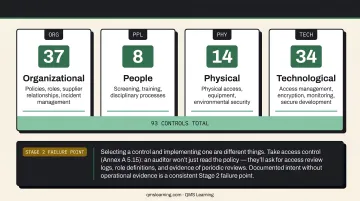
Organizations select applicable controls based on their risk treatment plan. Not every control applies — the selection must be justified in the Statement of Applicability.
Selecting a control and implementing one are different things. Take access control (Annex A 5.15): an auditor won't just read the policy — they'll ask for access review logs, role definitions, and evidence of periodic reviews. Documented intent without operational evidence is a consistent Stage 2 failure point.
Phase 3 — Documentation, Auditing, and Maintenance (Steps 8–12)
Phase 3 is where Phase 2 work becomes auditable. Many organizations underestimate the documentation burden and discover gaps only when the auditor arrives.
Step 8: Compile Mandatory Documents and Records
Mandatory documents (maintained):
- ISMS scope
- Information security policy
- Risk assessment methodology and criteria
- Statement of Applicability
- Risk treatment plan
- Information security objectives
Required records (retained):
- Evidence of competence (training records)
- Risk assessment and treatment results
- Internal audit program and results
- Management review results
- Nonconformity and corrective action records
- Monitoring and measurement results
Each document must be version-controlled, and auditors expect evidence of active use — not templates sitting in a shared folder. A corrective action record needs a completion date. A management review needs meeting minutes, not a blank template.
Step 9: Train Your Team on Information Security
ISO 27001 Clause 7 requires demonstrable competence, not just awareness. Organizations must document what training was delivered, to whom, when, and with what measurable outcome. Auditors frequently interview employees during Stage 2 and expect staff to explain their specific role in the ISMS — not just confirm they attended a session.
QMS Learning's Defense Cybersecurity Readiness pathway (covering ISO 27001, CMMC, and NIST 800-171) is designed specifically for this requirement and is currently enrolling pilot cohorts for Q3 2026. The platform's Manager Dashboard tracks training completion by employee, maps competency gaps by role, and exports a single Audit-Evidence Package PDF — consolidating training records, scenario logs, and AI-generated artifacts into one registrar-ready document.
Step 10: Complete the Statement of Applicability
The SoA is one of the most scrutinized documents in any ISO 27001 audit. It must:
- List all 93 Annex A controls
- State whether each is included or excluded
- Provide a documented rationale for each decision
- Reference the evidence or control owner for each applicable control
Boilerplate SoAs — ones that exclude controls without justification tied to the organization's actual risk assessment — are a common audit failure point. Every exclusion must trace back to your scope and risk assessment. If it can't, the auditor will note it.
Step 11: Conduct an Internal Audit, Then an External Certification Audit
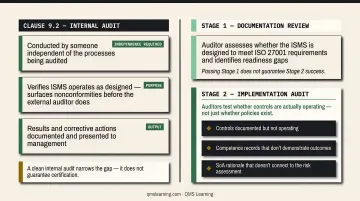
Internal audit (Clause 9.2): Must be conducted by someone independent of the processes being audited. Its purpose is to verify the ISMS operates as designed and to surface nonconformities before the external auditor does. Results — including any corrective actions — must be documented and presented to management.
A clean internal audit doesn't guarantee external certification, but it substantially narrows the gap. The external audit runs in two stages:
External certification audit:
- Stage 1: A documentation review. The auditor assesses whether the ISMS is designed to meet ISO 27001 requirements and identifies readiness gaps. Passing Stage 1 does not guarantee Stage 2 success.
- Stage 2: The implementation audit. Auditors test whether controls are actually operating as documented — not just whether policies exist. Common Stage 2 failures include controls that are documented but not operating, competence records that don't demonstrate outcomes, and SoA rationale that doesn't connect to the risk assessment.
Step 12: Maintain Continuous Compliance After Certification
ISO 27001 certification is valid for three years, maintained through:
- Annual surveillance audits — verify the ISMS continues to operate effectively
- Management reviews — conducted at planned intervals to assess ISMS performance
- Updated risk assessments and SoA — reflecting any significant changes in systems, organizational structure, or threat environment
Surveillance auditors specifically look for drift — controls that were operating at certification but have since been abandoned, undocumented changes, and risk assessments that haven't been revisited. Building a cadence for each of those three maintenance activities before certification ends is what makes the difference.
Common Mistakes That Derail ISO 27001 Implementation
Most ISO 27001 implementations don't fail on intent — they fail on the gap between documentation and demonstrable evidence. Three mistakes show up repeatedly in Stage 2 audits.
Treating the SoA and risk treatment plan as paper exercises. Organizations that copy control language from templates without connecting it to their actual risk assessment won't survive Stage 2 scrutiny. Every control inclusion and exclusion must trace to a specific risk decision — not a template default.
Writing policies and calling it implementation. A written access control policy does not satisfy Annex A 5.15. Auditors will ask for access review logs, role definitions, and evidence of enforcement. A document in a shared folder is a starting point, not a control.
Skipping competence verification under Clause 7.2. Organizations must demonstrate that personnel are competent to perform their security responsibilities — not just that they attended a session. Training records must be linked to roles and show outcomes. Attendance logs alone are a common nonconformity.
Frequently Asked Questions
What is the ISO 27001 compliance checklist?
The ISO 27001 compliance checklist is a structured set of activities — covering scoping, risk assessment, documentation, auditing, and ongoing maintenance — that guides an organization through implementing an ISMS and achieving certification under the standard.
What are ISO 27001 requirements?
ISO 27001:2022 has seven mandatory clauses (Clauses 4–10) that define how an ISMS must be structured, managed, evaluated, and improved. Annex A provides 93 controls organizations select based on their risk assessment — not all 93 are required, but every exclusion must be justified in the SoA.
What documents are required for ISO 27001?
Core mandatory documents include the ISMS scope, information security policy, risk assessment methodology, Statement of Applicability, risk treatment plan, and information security objectives. Required records — training logs, audit results, management review minutes — are equally mandatory and must show the ISMS is actively operating, not just designed on paper.
What are the 93 controls in ISO 27001?
ISO 27001:2022 Annex A contains 93 controls across four themes: organizational (37 controls), people (8), physical (14), and technological (34). Each theme addresses a distinct layer of information security risk — from governance and access policies to physical site controls and technical safeguards. Any control excluded must be justified in the Statement of Applicability.
How long does ISO 27001 certification take?
Timelines vary by organization size and complexity. Well-resourced implementations with experienced staff can achieve certification in 2–3 months; 6 months or more is common. The key time drivers are risk assessment thoroughness, documentation completeness, and evidence gathering for selected controls.
What is the difference between a Stage 1 and Stage 2 ISO 27001 audit?
Stage 1 is a documentation review where the auditor assesses whether the ISMS is designed to meet ISO 27001 requirements. Stage 2 tests whether those controls are actually implemented and operating — passing Stage 1 does not guarantee Stage 2 success if operational reality doesn't match what the documentation describes.