Introduction
Most cybersecurity professionals don't stall because they lack ambition — they stall because they're chasing the wrong credentials in the wrong order. With dozens of certifications spanning overlapping domains, the field makes it hard to know what to pursue next, or why.
According to ISC2's 2024 workforce study, the global cybersecurity workforce gap reached 4.8 million unfilled positions — up 19% year over year. That number reflects real demand, yet organizations still struggle to hire qualified professionals because credentials alone don't signal job-ready competency.
That gap between credential and competency is exactly the problem this guide addresses — for IT professionals starting out, mid-career practitioners choosing a specialization, and compliance-driven teams at defense contractors matching certifications to actual job responsibilities. It covers a four-stage progression, specialization tracks including defense and regulatory compliance paths, and a decision framework for choosing credentials without wasting time or money.
Key Takeaways
- A cybersecurity certification roadmap sequences credentials deliberately — foundational to specialized to advanced — not collected at random
- Certifications must align to a specific role or compliance obligation to produce real career or organizational value
- Each of the four career stages requires a different certification strategy, not just a harder exam
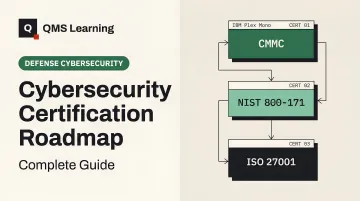
- CMMC, NIST 800-171, and ISO 27001 certifications are contractual requirements for defense contractors, not career electives
- Chasing trending credentials without a defined role wastes time and money — the most common roadmap mistake
What Is a Cybersecurity Certification Roadmap?
A cybersecurity certification roadmap is a deliberately sequenced plan that maps industry-recognized credentials to specific career stages, job roles, and skill domains — so each credential builds directly on the one before it.
That structure is what separates a roadmap from a certification list:
- A list tells you what credentials exist
- A roadmap tells you what to pursue, in what order, and why — based on where you are and where you need to go
The practical goal is closing the gap between credential collection and actual job-ready or audit-ready competency. Without that sequence, professionals often reach mid-career holding several certifications that don't reinforce each other and don't tell a coherent story to employers or assessors.
Why Cybersecurity Certifications Matter in 2026
The talent shortage driving certification demand isn't abstract. ISC2's 2025 workforce study found 59% of respondents reported critical or significant skills needs within their organizations — a measure of qualitative gap even as headcount figures shifted.
For defense contractors specifically, the staffing picture is sharper. NDIA's 2025 Vital Signs report found 38% of private-sector respondents cited a shortage of qualified IT personnel as a top NIST SP 800-171 implementation challenge, and more than 31% had less than one dedicated cybersecurity FTE. For organizations under CMMC scrutiny, that staffing gap is a direct compliance readiness barrier — one with contract consequences attached.
The CMMC Enforcement Context
In regulated and defense environments, uncertified staff create concrete organizational risk:
- CMMC assessments get delayed or failed without personnel who understand control requirements
- NIST 800-171 obligations go unmet when no one owns the 14 control families
- Generic IT staff cannot substitute for demonstrated cybersecurity competency during C3PAO reviews
Phase 1 enforcement began November 10, 2025. Phase 2 was suspended by DoD on July 13, 2026, while Phase 1 self-assessments remain in force. Both tracks require demonstrated cybersecurity competency — across technical and compliance roles alike — making a structured certification roadmap directly operational, not theoretical.
The Four-Stage Cybersecurity Certification Roadmap: Beginner to Expert
The four-stage framework is a decision structure. Each stage demands a different approach to what you learn, how you prove it, and what comes next — and treating it as a simple timeline is what causes stalled careers and credential clutter.
Stage 1: Entry Level — Building the Foundation
Entry-level certifications apply across all specializations. They establish vocabulary, baseline security knowledge, and employer-recognized proof of competency.
| Certification | What It Validates | Target Role |
|---|---|---|
| CompTIA Network+ (N10-009) | Networking fundamentals; 14% network security content | Foundation before Security+ |
| CompTIA Security+ (SY0-701) | General security concepts, threats, architecture, operations | Entry security/sysadmin roles; DoD 8570 IAT II baseline |
| ISC2 Certified in Cybersecurity (CC) | Security principles, access control, network security, incident response | Career changers; no work experience required |
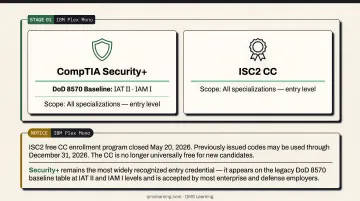
Note: ISC2's free CC enrollment program closed May 20, 2026. Previously issued codes may be used through December 31, 2026. The CC is no longer universally free for new candidates.
Security+ remains the most widely recognized entry credential — it appears on the legacy DoD 8570 baseline table at IAT II and IAM I levels and is accepted by most enterprise and defense employers.
Stage 2: Intermediate — Finding Your Specialization
This stage is where professionals must make a deliberate decision. Branching randomly across specializations leads to mid-career credential clutter — a stack of certs that signals breadth but proves nothing to hiring managers.
| Certification | Specialization | Target Function |
|---|---|---|
| CompTIA CySA+ (CS0-003) | Defensive analysis | SOC analyst, security operations |
| EC-Council CEH (v13) | Ethical hacking | Offensive security, SOC, vulnerability assessment |
| Cisco Cybersecurity Associate (200-201) | SOC operations | Security monitoring, intrusion analysis |
| Microsoft SC-200 | Microsoft security environments | Security operations analyst |
Before selecting the Cisco path, verify you're targeting the right exam. The CCNA Security (210-260) retired in 2020. The current SOC-focused credential is the Cisco Cybersecurity Associate (200-201) — renamed from CyberOps in January 2025. CCNP Security remains the dedicated professional-level network security track.
Stage 3: Advanced — Senior Technical and Leadership
Advanced certifications are experience-gated for a reason. Each serves a distinct function:
Professionals who pursue CISSP or CISM without intermediate specialization frequently find that employers expect applied capability their exam prep didn't build. The experience gates aren't bureaucratic hurdles — they're the only way to close that gap before it becomes a performance problem on the job.
Stage 4: Executive Leadership
The executive stage is defined by problem ownership, not exam accumulation. The credential most associated with this level is:
- CCISO (Certified Chief Information Security Officer) — Requires 5 years in 3 of 5 domains; covers governance, controls/compliance, management/operations, security competencies, and strategic planning. Associate CCISO provides a route for candidates not yet eligible.
At this stage, the credential is less important than what it represents: the ability to translate technical risk into business language, brief a board, and own decisions when a breach happens. The CCISO signals that readiness — but only when the experience behind it is real.
Cybersecurity Specialization Tracks and Role-Specific Certification Paths
Once foundational certifications are in place, professionals should follow a domain-specific progression rather than branching randomly. This approach — called credential stacking — separates a coherent career track from a scattered resume.
Governance, Risk, and Compliance (GRC) Track
Path: Security+ → CISA → CISM
CISA maps to audit, assurance, controls, and asset protection. CISM maps to governance, risk, program management, and incident management. This progression is particularly relevant for finance, healthcare, and government-adjacent roles where compliance accountability sits with non-technical managers rather than IT staff.
CyberSeek reported over 514,000 U.S. cybersecurity job listings in the year ending 2025, with concentrated demand in audit and governance functions. Both CISA and CISM carry five-year experience gates, so professionals should factor that timeline into their planning before targeting these credentials.
Defense and Regulatory Compliance Track
Path: Security+ → NIST 800-171 / CMMC competency → Organizational assessment readiness
Most certification roadmaps stop before reaching this track. For professionals at defense contractors and DIB organizations, CMMC 2.0 assessments, NIST SP 800-171, and ISO 27001 create requirements that individual certifications alone don't satisfy.
The central distinction: professional certifications validate individuals. CMMC governs organizational systems. A team where every member holds Security+ can still fail a C3PAO assessment if no one owns the 14 NIST control families or can produce a defensible System Security Plan.
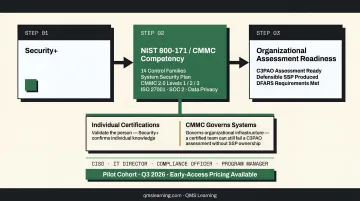
QMS Learning's Defense Cybersecurity Readiness pathway (pilot cohort opening Q3 2026) targets this gap directly, designed for CISOs, IT directors, compliance officers, and program managers at prime contractors, sub-suppliers, and DIB organizations subject to DFARS requirements.
Coverage includes:
- CMMC and NIST 800-171 (Levels 1, 2, and 3)
- ISO 27001, SOC 2, and Data Privacy frameworks
- An AI Workbench trained on the specific assessment guides a C3PAO will use
Early-access pricing is available for the pilot cohort.
Cloud Security Track
Path: Cloud fundamentals → AWS Security Specialty (SCS-C02) or Azure Security Engineer (AZ-500) → CCSP
Note: Microsoft has announced AZ-500 will retire August 31, 2026. Professionals targeting Azure should verify the current replacement path before enrolling. CCSP remains the vendor-neutral architectural-level credential for cloud governance.
Offensive Security / Penetration Testing Track
Path: Security+ → CEH → OSCP+ or CPENT
CEH v13 covers 20 modules and 550 attack techniques, with an optional 6-hour practical (CEH Master). OSCP+ is a fully practical exam: 23 hours 45 minutes, three standalone hosts plus a three-machine Active Directory set, 70/100 to pass, followed by a 24-hour report submission window.
This track requires consistent hands-on lab practice beyond exam preparation. Employers in red team and pen testing roles increasingly use skills-based assessments. ISC2's 2025 hiring survey found 84% of hiring managers used skills-based assessments, with hands-on IT experience ranking nearly as high as certifications (44% vs. 47%).
Common Mistakes That Derail Cybersecurity Certification Planning
The Certification Collection Trap
Pursuing credentials for resume value without anchoring them to a defined role or skill gap is the most common planning failure. QMS Learning's principle of capability over completion applies directly here: the credential proves nothing if it doesn't change what the holder can do under real conditions.
A CISSP holder who can't explain how the eight domains apply to their organization's specific architecture has passed an exam — not demonstrated a capability. Employers in defense and regulated industries increasingly know the difference, and they're testing for it in interviews.
Skipping Intermediate Stages
Professionals who pursue CISSP or CISM without intermediate specialization often pass the exam but lack the practical exposure employers expect. This isn't just an abstract concern — both credentials carry five-year experience requirements for certification (not just exam passage). Candidates without qualifying experience become Associates, not certified holders.
The intermediate stage exists to build the applied judgment that makes advanced certifications meaningful. Skipping it produces professionals who can cite frameworks but struggle to apply them when an auditor or incident actually arrives.
Confusing Certifications with Hands-On Competency
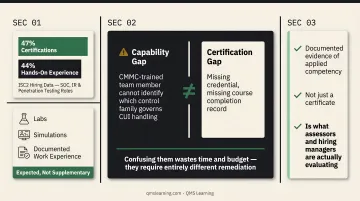
That shallow exposure gets exposed fastest in hands-on roles. In SOC, incident response, and penetration testing positions, demonstrated skills carry nearly as much weight as credentials — ISC2 hiring data puts certifications at 47% and hands-on experience at 44%. Labs, simulations, and documented work experience aren't supplementary; they're expected.
The same principle applies in compliance-focused roles at defense contractors:
- A team member who completed CMMC training but can't tell a C3PAO assessor which control family governs CUI handling has a capability gap, not a certification gap
- Capability gaps and certification gaps require entirely different remediation — confusing them wastes time and budget
- Documented evidence of applied competency — not just a certificate — is what assessors and hiring managers are actually evaluating
Frequently Asked Questions
What is the roadmap for cybersecurity certifications?
A cybersecurity certification roadmap is a structured sequence that begins with foundational credentials like Security+ and Network+, advances through domain-specific intermediate certifications (CySA+, CEH, SC-200), and culminates in advanced or leadership credentials aligned to a specific role or compliance obligation. Skipping foundational steps typically creates gaps that surface during employer screening or when sitting for exams that carry experience prerequisites.
Can you make $500,000 a year in cybersecurity?
Heidrick & Struggles' 2025 CISO compensation survey found a $510K median total cash for U.S. CISOs (base plus bonus), with a $400K median base salary across 148 respondents. That figure reflects top executive roles at large enterprises — not a universal ceiling for the field.
Is 25 too late for cybersecurity?
25 is far from late. Many successful cybersecurity professionals transition from adjacent IT or compliance roles in their late 20s and 30s. The field's workforce gap means entry-level and mid-career professionals are in genuine demand regardless of when they start.
What is the best entry-level cybersecurity certification for beginners?
CompTIA Security+ is the most widely recognized entry-level credential, accepted by DoD and most enterprise employers. ISC2's Certified in Cybersecurity (CC) was previously available at no cost, but free enrollment closed May 20, 2026 — it remains a viable option for absolute beginners, though fees now apply.
How long does it take to complete a cybersecurity certification?
Entry-level certifications like Security+ typically require 2–3 months of dedicated preparation. Intermediate credentials vary from 3–6 months depending on background. Advanced credentials like CISSP often require 6–12 months of study alongside qualifying work experience that can itself take several years to accumulate.
Do I need a degree to get cybersecurity certified?
Most cybersecurity certifications don't require a degree. They require passing an exam, meeting experience prerequisites for advanced credentials, and in some cases completing continuing education. Many practitioners enter the field through certification paths alone, particularly at the entry and intermediate stages.