Introduction
The numbers are hard to ignore. IBM's 2025 Cost of a Data Breach report found the U.S. average cost of a breach reached $10.22 million — and that's before accounting for contract consequences. For manufacturing, Verizon's 2026 DBIR recorded 3,627 incidents with 2,713 confirmed breaches, 95% involving external actors.
For defense contractors and regulated manufacturers, cybersecurity risk carries audit, contractual, and operational consequences — an audit finding, a DFARS clause obligation, a CMMC certification requirement, and a potential contract-termination event if a breach occurs.
Auditors and contracting officers don't want to hear that you have antivirus software. They want documented evidence of a structured, risk-based security program.
That structured process is a cybersecurity risk assessment. This guide explains what it is, why it matters in regulated environments, how to run one step by step, and what good looks like when the assessor arrives.
Key Takeaways
- A cybersecurity risk assessment is a formal, repeatable process for identifying threats, evaluating vulnerabilities, and prioritizing controls based on actual business risk.
- Six stages drive the process: scoping, asset inventory, threat identification, risk prioritization, control implementation, and monitoring.
- Vague scope and skipped residual risk documentation are where most assessments fail — not in the technical execution.
- CMMC Level 2, NIST 800-171, and ISO 27001 all require documented, risk-based assessments — documented compliance is a contract requirement, not optional governance.
- Regular assessments let organizations spend security budgets on real risk, not vendor assumptions.
What Is a Cybersecurity Risk Assessment?
A cybersecurity risk assessment is a structured, repeatable process for identifying threats and vulnerabilities across an organization's IT environment, evaluating their likelihood and potential business impact, and prioritizing the controls needed to reduce that exposure.
It's used across a wide range of contexts:
- Regulatory compliance — CMMC, NIST 800-171, ISO 27001, SOC 2, HIPAA, PCI-DSS
- Pre-audit preparation — building the documented evidence base before an assessor arrives
- Incident response planning — identifying critical exposure paths before a breach occurs
- M&A and contract due diligence — validating a target company's or supplier's security posture
The Three Main Approaches
Organizations typically use one of three methodologies — or a combination:
| Approach | How It Works | Best For |
|---|---|---|
| Qualitative | Descriptive risk scales (Low/Medium/High) | Faster, accessible, good for initial assessments |
| Quantitative | Financial loss modeling (annualized loss expectancy) | Executive reporting, budget justification |
| Compliance-driven | Mapped to specific frameworks (NIST CSF, ISO 27005) | Regulatory evidence, audit preparation |
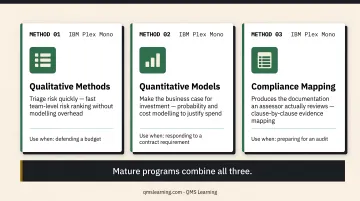
Mature programs combine all three. Qualitative methods triage risk quickly, quantitative models make the business case for investment, and compliance mapping produces the documentation an assessor actually reviews. Which mix you use depends on whether you're defending a budget, preparing for an audit, or responding to a contract requirement.
Why Cybersecurity Risk Assessments Are Critical
Without a risk assessment, security spending becomes reactive and fragmented. Organizations end up over-securing low-value systems while leaving critical assets exposed — because they have no structured view of what actually matters.
The data reflects this pattern. According to the 2026 Verizon DBIR, exploitation of vulnerabilities was the leading initial-access vector across breaches, accounting for 31% of all incidents. Third-party involvement reached 48% of breaches — a 60% increase from the prior year.
What Regular Assessments Actually Deliver
- Smarter spending — prioritizes controls based on measurable risk, not vendor pressure or gut instinct
- Full attack surface visibility — surfaces shadow IT, legacy systems, and dormant access that expand real exposure
- Regulatory compliance — satisfies CMMC, DFARS, and ISO 27001 requirements for documented, risk-based governance
- Faster incident response — pre-identified critical assets and exposure paths reduce response time when something goes wrong
- Credible business continuity planning — actual risk scenarios instead of generic outage models
That last point matters most for defense contractors and regulated manufacturers. The assessment isn't optional — it's the documented evidence auditors and contracting officers examine when verifying that a contractor's security program is deliberate, not improvised. CMMC Level 2 practices RA.L2-3.11.1 and RA.L2-3.11.2 require periodic risk assessment and vulnerability scanning as formal requirements — not recommendations.
How to Perform a Cybersecurity Risk Assessment: Step by Step
This is a practical six-stage process grounded in how assessments actually run in regulated environments. The most common failure points are rushing the scoping stage and skipping documentation of residual risk after controls are applied. Both are exactly what CMMC and NIST 800-171 assessors examine.
Step 1 — Define Scope and Objectives
Establish the assessment boundary before anything else. This could cover:
- The full organization
- A specific facility or business unit
- A CUI (Controlled Unclassified Information) enclave only
- A particular business process or application stack
Vague scope is the single most common reason assessments produce unusable results. The scope decision requires input from IT, operations, compliance, and senior leadership — not IT alone. Leadership sign-off on scope and timeline is not a formality; it's what makes the results actionable.
Step 2 — Identify and Inventory Assets
Build a complete inventory of everything within scope:
- Systems, servers, workstations, and network devices
- Applications and software
- Data repositories (including cloud storage and shared drives)
- Cloud accounts and SaaS integrations
- Third-party connections and vendors
For each asset, document data sensitivity (CUI, PII, financial records) and business criticality. Untracked assets — shadow IT, legacy systems, unmanaged endpoints — are the most common source of exploitable vulnerabilities. Assume nothing is absent; actively discover it.
Step 3 — Identify Threats and Vulnerabilities
Use a structured approach covering both dimensions:
Threats:
- External actors and ransomware groups
- Insider misuse and credential-based attacks
- Supply chain compromise
Vulnerabilities:
- Misconfigured systems and unpatched software
- Weak credentials and insecure remote access
- Legacy systems running end-of-life software
The MITRE ATT&CK framework and the National Vulnerability Database (NVD) are practical tools for this stage. Vulnerability scans, though, must be supplemented with manual review of configurations, access policies, and development practices. Automated scanners miss context-dependent weaknesses — the kind that matter most in CUI environments.
Step 4 — Analyze and Prioritize Risks
For each identified risk scenario, assess two dimensions:
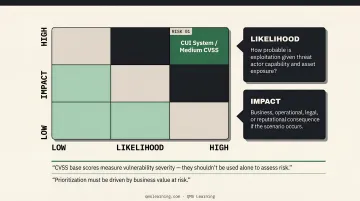
- Likelihood — how probable is exploitation given the threat actor's capability and asset exposure?
- Impact — what is the business, operational, legal, or reputational consequence if it occurs?
Use a risk matrix to score and rank findings. Prioritization must be driven by business value at risk. A medium CVSS score on a system processing CUI may legitimately outrank a critical score on a non-production server. As CISA notes, CVSS base scores measure vulnerability severity — they shouldn't be used alone to assess risk.
Step 5 — Implement Controls and Mitigation
Translate prioritized risks into specific, assigned remediation actions:
- Technical controls — MFA, encryption, network segmentation, patch management
- Policy controls — access management procedures, incident response plans
- Training-based controls — CUI handling awareness, breach notification procedures
Every control action needs an owner, a deadline, and a measurable success criterion. Without accountability, findings become shelfware. This is where most organizations stall — the risk register exists, but nobody owns the remediation.
Step 6 — Monitor, Document, and Iterate
Three frameworks set the baseline cadence:
- NIST SP 800-30 — reassess when risk factors change
- ISO 27001:2022 Clause 8.2 — reassess at planned intervals or after significant changes
- CMMC Level 2 — annual affirmation of continuous compliance
In practice, cloud infrastructure and SaaS-heavy environments need more frequent review. Stable legacy systems can run longer cycles — but still require review whenever new vulnerabilities surface.
Document everything:
- Risk register and assessment results
- Control decisions and assigned owners
- Residual risk acceptance rationale
- Evidence of implementation (screenshots, timestamps, configuration records)
This documentation is what auditors and contracting officers examine. Residual risk acceptance rationale is the piece most organizations skip — and the piece assessors look for first.
Cybersecurity Risk Assessment: Example Walkthrough
This is a realistic walkthrough for a mid-sized defense supplier operating under CMMC Level 2 requirements.
Stage 1 — Scoping: The organization defines its assessment boundary as the CUI enclave — systems that store, process, or transmit Controlled Unclassified Information. Non-CUI business systems are excluded from the initial pass. Leadership signs off on scope and a timeline is established.
Stage 2 — Asset inventory and threat identification: The team surfaces three immediate problems:
- Three untracked cloud storage instances used by engineers to share design files
- A legacy file server running an unpatched OS
- Remote access credentials shared across multiple users
Threats flagged: ransomware targeting defense suppliers, credential stuffing, and insider data exfiltration.
Stage 3 — Risk prioritization: Scoring focuses resources rather than spreading them thin:
- Critical — Legacy file server with shared credentials accessing CUI: high likelihood (known exploitation pattern), high impact (potential DFARS violation, contract termination)
- High — Unmanaged cloud storage instances with design file exposure
Both get remediation attention before lower-severity findings.
Stage 4 — Controls and documentation: MFA is implemented on all CUI system access. The legacy server is patched and access is segmented. Cloud storage instances are brought under the organization's controlled document policy. All actions are documented with timestamps, screenshots, and owner sign-off as audit evidence.
The common mistake here: Closing the remediation ticket without documenting residual risk or the rationale for accepting remaining gaps. CMMC and NIST 800-171 assessors look specifically for this — its absence turns a well-executed remediation effort into an audit finding.
How QMS Learning Can Help Build Your Team's Cybersecurity Readiness
A cybersecurity risk assessment requires more than a framework and a spreadsheet. It requires a team that can identify real gaps, score risk accurately, and produce audit-acceptable documentation under pressure. Most organizations fall short not because they lack tools — but because they lack trained people who know how to use those tools in a CMMC or NIST 800-171 context.
QMS Learning's Defense Cybersecurity Readiness pathway — currently enrolling pilot cohorts for Q3 2026 — is built for exactly this gap. The pathway bundles four courses: CMMC & NIST 800-171, ISO 27001 ISMS, SOC 2 Compliance, and Data Privacy.
It's designed for CISOs, IT directors, compliance officers, and program managers at defense contractors and DIB companies — roles that own the risk assessment process but rarely get training scoped to defense-specific requirements.
Three things set it apart from generic security training:
- Framework-specific content — every lesson maps to CMMC Level 1/2/3, NIST 800-171 control families, and DFARS clause requirements, not broad security awareness
- AI Workbench trained on defense cyber — the QMS Workbench drafts SSP sections, builds POA&M entries, generates incident response runbooks, and runs gap analyses against actual CMMC assessment guide language
- Manager Dashboard with audit-evidence export — training records, completed scenario outputs, AI-generated artifacts, and timestamps compile into a single indexed PDF designed for C3PAO assessment preparation
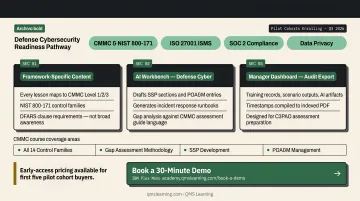
The CMMC & NIST 800-171 course covers all 14 control families, gap assessment methodology, SSP development, and POA&M management — the specific artifacts a C3PAO assessor opens first. Environment-specific documentation passes where generic templates don't, because assessors verify your actual system configurations, not a borrowed framework.
Early-access pricing is available for the first five pilot cohort buyers. To see the Workbench applied to a specific CMMC or risk assessment scenario, book a 30-minute demo at academy.qmslearning.com/book-a-demo.
Frequently Asked Questions
What is a cybersecurity risk assessment?
A cybersecurity risk assessment is a structured process for identifying threats and vulnerabilities across your IT environment, evaluating their likelihood and impact, and prioritizing controls to reduce exposure. It serves three purposes: risk reduction, compliance documentation, and informed security investment. It's an ongoing process, not a one-time project.
What are the 5 steps of a cybersecurity risk assessment?
The five stages are: (1) define scope, (2) inventory assets, (3) identify threats and vulnerabilities, (4) analyze and prioritize risks, and (5) implement controls with ongoing monitoring. Documentation runs through every stage — it's what auditors examine, not the technical work.
What are the top 5 cybersecurity risks?
The five most commonly assessed categories are credential-based attacks, ransomware and extortion, supply chain compromise, cloud misconfigurations, and insider threats. In manufacturing specifically, Verizon's 2026 DBIR found System Intrusion, Social Engineering, and Web Application Attacks account for 91% of breaches.
How often should a cybersecurity risk assessment be conducted?
Run a full assessment annually at minimum. CMMC Level 2 requires annual affirmation of continuous compliance, and NIST and ISO 27001 both call for reassessment whenever significant changes occur — new systems, acquisitions, major contract awards, or CMMC rollout milestones all qualify as triggers.
What is the difference between a qualitative and quantitative cybersecurity risk assessment?
Qualitative assessments use descriptive scales (Low/Medium/High) and are faster and more accessible — good for triage and initial assessments. Quantitative assessments assign financial values to risk scenarios (annualized loss expectancy) and are better suited for executive reporting and budget justification. Most organizations start qualitative and layer in quantitative methods as their program matures and executive reporting demands increase.
What frameworks are used in cybersecurity risk assessments?
The primary frameworks are NIST CSF 2.0, NIST SP 800-30 (Rev. 1), ISO/IEC 27005:2022, CMMC, and CIS Controls v8.1. Defense contractors and DIB companies work primarily within NIST 800-171 and CMMC — both mandate a documented System Security Plan (SSP) and risk assessment as evidence of compliance.