Here's the common failure pattern: quality managers memorize clause numbers for the audit, then watch employees describe a completely different process when the auditor asks a follow-up question. The paperwork says one thing. The floor does another. That gap is where nonconformities live.
This guide breaks down what ISO 9001 actually requires, clause by clause, the principles driving those requirements, what documentation you genuinely need to keep, and what's coming in the 2026 revision.
Key Takeaways
- ISO 9001:2015 has 10 clauses, but only Clauses 4-10 contain auditable requirements
- The standard no longer mandates a Quality Manual, but it does require specific retained records
- All 10 clauses trace back to 7 Quality Management Principles, and auditors test for those principles directly
- A 2024 climate change amendment already changed Clauses 4.1 and 4.2, ahead of a full 2026 revision
- Any organization type can use the standard — not just manufacturers
What Is ISO 9001?
ISO 9001 is the international standard for a Quality Management System (QMS), published by the International Organization for Standardization. The current edition is ISO 9001:2015, and it sits inside a broader family of related standards.
Here's how the three pieces fit together:
| Standard | Purpose | Certifiable? |
|---|---|---|
| ISO 9000 | Fundamentals and vocabulary | No |
| ISO 9001 | Auditable QMS requirements | Yes |
| ISO 9004 | Guidance for sustained success | No |
ISO 9001 is the only standard in this family an organization can actually be certified against. ISO 9000 gives you shared terminology; ISO 9004 gives you guidance for going beyond compliance into long-term performance. Neither one results in a certificate on your wall.
Voluntary in Name, Mandatory in Practice
Technically, ISO 9001 certification is voluntary. In reality, it's often a prerequisite disguised as a preference.
A 2019 Defense Logistics Agency supplier briefing, for example, states that contractors must fully comply with ISO 9001 requirements when the contract's higher-level quality clause calls for it. Automotive supply chains, aerospace primes, and large enterprise customers frequently apply the same logic during vendor qualification. If you want the contract, you need the certificate.
Breaking Down the 10 Clauses of ISO 9001:2015
Every modern ISO management standard, from ISO 14001 to ISO 45001, shares the same 10-clause skeleton. This is called the Annex SL high-level structure, and it's why "how many clauses does ISO 9001 have" always has the same answer: ten.
Clauses 1-3: Foundational Information
These three clauses set context but contain no requirements an auditor can cite you for:
- Clause 1 – Scope: Defines what the standard covers and its general applicability
- Clause 2 – Normative References: Points to other documents the standard depends on
- Clause 3 – Terms and Definitions: Establishes shared vocabulary across the standard
Think of these as the instruction manual's table of contents. Useful for orientation, useless as audit evidence.
Clauses 4-10: The Certifiable Requirements
These seven clauses hold the requirements auditors actually cite.
- Clause 4 – Context of the Organization: Identify internal/external issues, interested parties, and define your QMS scope
- Clause 5 – Leadership: Secure top management commitment, set a quality policy, and assign clear roles
- Clause 6 – Planning: Address risks and opportunities, set measurable quality objectives, plan changes properly
- Clause 7 – Support: Cover resources, competence, awareness, communication, and documented information
- Clause 8 – Operation: Plan operations, define product/service requirements, control design, manage external providers
- Clause 9 – Performance Evaluation: Monitor, measure, run internal audits, conduct management review
- Clause 10 – Improvement: Handle nonconformities, drive corrective action, pursue continual improvement
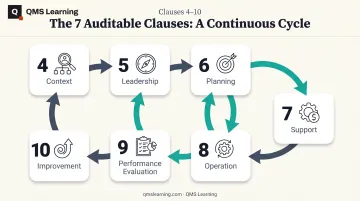
Auditors don't grade these clauses one at a time in isolation. They read them as a connected story: does your Clause 6 risk analysis actually inform your Clause 8 operational controls? Does your Clause 9 audit data feed your Clause 10 corrective actions?
Teams frequently ace individual clause reviews and still fail because the story doesn't hold together.
The 7 Quality Management Principles Behind ISO 9001
Every clause in ISO 9001 traces back to one or more of seven Quality Management Principles (QMPs). These principles are the philosophy the entire standard was built to enforce.
- Customer focus – Understanding and meeting, ideally exceeding, customer expectations
- Leadership – Unity of purpose and direction driven from the top
- Engagement of people – Competent, empowered staff at every level, not just management
- Process approach – Managing activities as interconnected processes, not isolated tasks
- Improvement – Treating continual improvement as a permanent objective, not a project
- Evidence-based decision-making – Basing decisions on data, not opinion or habit
- Relationship management – Managing supplier and partner relationships for mutual value
Auditors know these principles cold, and they probe for them directly. An auditor won't just check whether you have a documented customer complaint process.
They'll walk onto the floor and ask a machine operator: "How do you know what the customer requires for this part?" A policy statement on the wall doesn't answer that question. The operator's actual answer does.
Mandatory vs. Non-Mandatory Documentation Requirements
Here's a persistent myth: ISO 9001:2015 requires a Quality Manual and six specific procedures. It doesn't. That requirement disappeared with the 2015 revision. What remains is a requirement to control "documented information" wherever Clause 7.5 and related subclauses call for it.
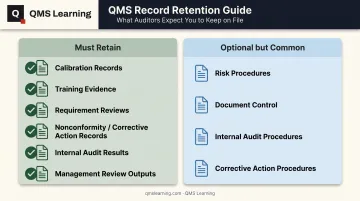
What You Must Retain
Based on ISO's implementation guidance, these categories of records are effectively mandatory:
- Calibration and monitoring equipment records
- Training and competence evidence
- Product/service requirement reviews
- Nonconformity records and corrective actions
- Internal audit results
- Management review outputs
What's Optional But Commonly Used
Most organizations still choose to maintain these, even though ISO doesn't require them by name:
- Risk and opportunity management procedures
- Document control procedures
- Internal audit procedures
- Corrective action management procedures
Required or optional, what usually fails the audit is not a missing file. It's a retrieval problem: the record exists, but nobody can produce it fast enough, or it doesn't match what the employee just told the auditor. That mismatch is a leading cause of nonconformities in certification and surveillance audits alike.
A controlled Document Management System closes that gap. QMS Learning's platform keeps an append-only audit trail so every revision stays visible with its status, change history, and release information. A superseded document can't be mistaken for the live one.
Documents also map to specific clauses, so evidence exports take minutes instead of the usual night-before scramble.
Is ISO 9001 Changing in 2026?
Yes, and it's already begun. ISO reviews every standard on a five-year cycle, and ISO 9001 is currently mid-revision, with Edition 6 targeted for publication in September 2026.
You don't have to wait for the full revision to see the direction of travel. A 2024 amendment already modified two clauses:
- Clause 4.1 now requires organizations to determine whether climate change is a relevant issue for their QMS
- Clause 4.2 clarifies that interested parties can have requirements tied to climate change
That amendment, ISO 9001:2015/Amd 1:2024, was published in February 2024 and makes environmental context a permanent part of quality management, not a side topic.
Past transitions offer a rough guide for what's coming. The 2008-to-2015 shift ran on a three-year transition window before old certificates expired. ISO hasn't published a fixed transition length for 2026 yet. Until it does:
- Track ISO/TC 176 updates as drafts and guidance are released
- Map likely clause changes against your current QMS
- Plan training and documentation updates before the final publication date
How QMS Learning Builds Real Clause-by-Clause Compliance Capability
Reading the clauses is one thing. Applying them consistently across a plant, or five plants, is another problem entirely.
QMS Learning's General Manufacturing Quality pathway is built for quality leaders running ISO 9001 across single-site or multi-site operations—injection molding, machining, fabrication, assembly, packaging, and consumer goods. It bundles four courses:
- ISO 9001 Internal Auditor (16 hours, every clause, 27 interactive scenarios)
- Root Cause Analysis & CAPA
- Internal Audit Program Management
- Management Review
The training was built by Will Trikha, a 20-year quality and operations practitioner who has written over 1,000 audit findings and closed twice that number in quality management roles. His aerospace and AS9100D audit background shapes a pathway built on real audit scenarios, not textbook summaries.
Two features do most of the heavy lifting day-to-day:
- AI Workbench — Diagnoses live compliance problems and routes them to the right method (for example, an unqualified supplier acceptance → process-control gap → 5-Why + CAPA with verified effectiveness)
- Manager Dashboard — Tracks training progress, capability gaps, and audit readiness, then exports one indexed, registrar-accepted PDF of records, scenarios, artifacts, and time-stamped activity
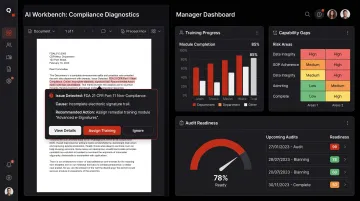
The practical result teams report is becoming audit-ready within 30 days of rollout. Qualified teams can evaluate the pathway through a free 2-seat pilot before committing to a full license.
Frequently Asked Questions
Are the ISO 9001 standards changing in 2026?
Yes. ISO reviews every standard on a five-year cycle, and a new ISO 9001 edition is expected in September 2026. The 2024 climate change amendment to Clauses 4.1 and 4.2 already hints at the revision's direction.
What are the ISO 9001 standards?
"ISO 9001 standards" usually refers to the requirements document itself. It sits within the ISO 9000 family alongside ISO 9000 (vocabulary and fundamentals) and ISO 9004 (guidance for sustained success), but only ISO 9001 is certifiable.
What are the 7 principles of ISO 9001?
Customer focus, leadership, engagement of people, process approach, improvement, evidence-based decision-making, and relationship management. See the detailed breakdown above for how each shows up in practice.
What are the 10 clauses of ISO 9001?
Scope, Normative References, Terms and Definitions, Context of the Organization, Leadership, Planning, Support, Operation, Performance Evaluation, and Improvement. Clauses 4-10 carry the auditable requirements.
How long does it take to get ISO 9001 certified?
Most organizations need 6–12 months from gap assessment to certificate, depending on readiness. NQA and other registrars typically require the QMS to run at least three months, with a completed internal audit and management review, before the certification audit.
Does ISO 9001 apply to service businesses or only manufacturers?
ISO 9001 is industry-agnostic. It applies to any organization regardless of size or sector, including police departments, hotel chains, and city governments that hold active certification today.