This guide is written for quality managers, process improvement leads, and compliance professionals working in regulated industries, manufacturing, aerospace, healthcare, where consistency, defect reduction, and audit-readiness aren't optional.
Here's what you'll get: how each phase actually works, where DMAIC gets applied in practice, and — just as important — when it's the wrong tool for the job.
Key Takeaways
- DMAIC fixes existing underperforming processes; DMADV designs new ones from scratch
- Each phase depends on verified data from the one before it — skipping Analyze is the most common failure mode
- Common triggers include recurring nonconformances, chronic complaints, and CAPA escalations
- DMAIC is overkill for simple problems with an obvious cause or a quick containment fix
What Is DMAIC?
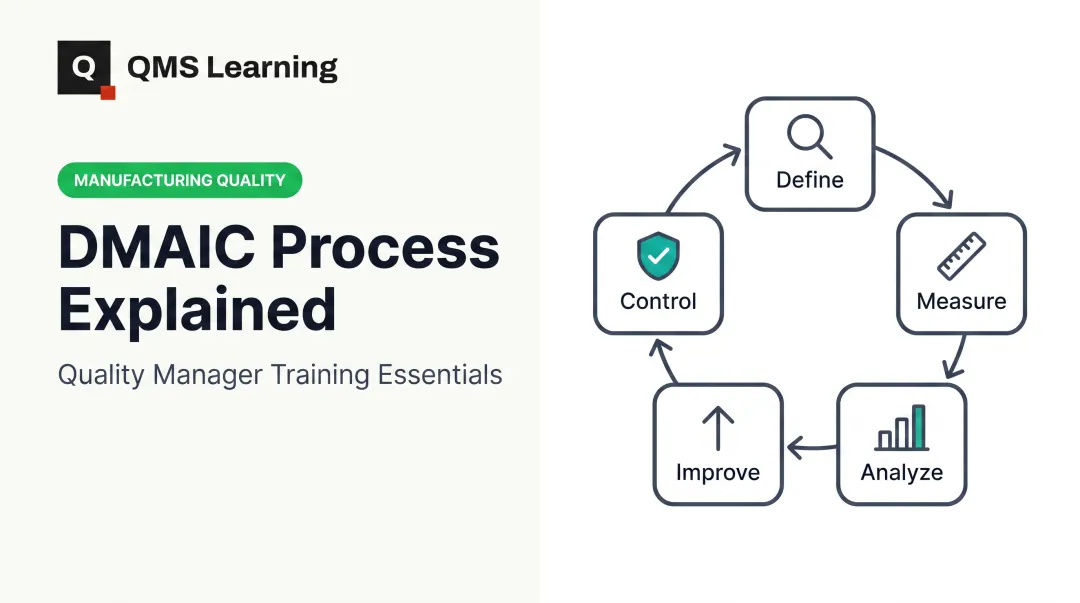
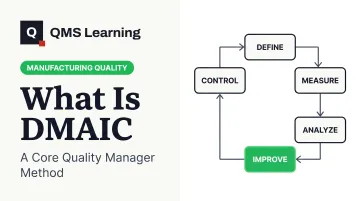
DMAIC (Define, Measure, Analyze, Improve, Control) is a five-phase, data-driven improvement roadmap built on the scientific method: observe, hypothesize, test, verify. ASQ defines it directly as a data-driven quality strategy used to improve processes that aren't meeting performance standards or customer expectations.
The outcome it's designed to produce is simple to state, even if it's hard to achieve: a measurable, sustained reduction in process variation or defects, tied to a specific business goal. Not a vague sense that things got better. A number that moved, and stayed moved.
DMAIC vs. DMADV — know the difference:
- DMAIC improves an existing process that's underperforming
- DMADV (Define, Measure, Analyze, Design, Verify) builds a new product, service, or process from scratch, according to Purdue University's Lean Six Sigma program
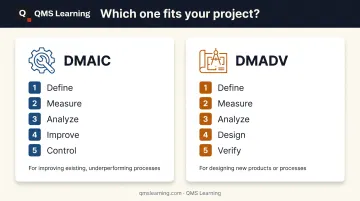
Applying DMAIC to a brand-new process design is one of the more common misfires teams make. There's nothing to measure a baseline against, which means the entire framework has nothing to stand on.
DMAIC is most associated with formal Six Sigma projects, but it doesn't require a belt certification to use. It works just as well as a standalone quality improvement procedure for tackling a stubborn nonconformance or a recurring audit finding.
Why DMAIC Is Used in Quality- and Compliance-Driven Industries
Teams in regulated environments adopt DMAIC for one specific reason: it forces analysis before action. That sounds obvious, but it's not how most teams naturally operate. Under pressure, the instinct is to fix the symptom fast and move on.
The problem is that fixes based on gut feel, rather than verified root causes, tend to address the wrong thing. The nonconformance comes back. The audit finding repeats. The customer complaint resurfaces three months later with a different part number attached.
Regulated environments such as AS9100, ISO 9001, and ISO 13485 demand three things DMAIC is built to deliver:
- Consistency across repeated executions of the same process
- Defect reduction that's measurable, not anecdotal
- Objective evidence of corrective action an auditor can actually verify
The Compliance Documentation Gap
Here's where things get tricky in practice. The root cause tools used inside DMAIC's Analyze phase (5-Why, FMEA, fishbone diagrams) aren't just problem-solving exercises in regulated settings. They have to produce documentation an auditor will accept on first read.
That's a different bar than "we figured out the problem." It means the artifact needs clause references, a clear causal chain, and evidence the fix was verified, not just implemented.
This is precisely the gap platforms like QMS Learning's AI Workbench are built to close. Rather than leaving a quality engineer to guess which root cause method fits a given problem, the Workbench's Method Router diagnoses the situation in plain English and routes it to the correct play.
In one documented example, a recurring supplier defect across multiple jobs was categorized as systemic rather than isolated. The Router selected 5-Why paired with a Supplier CAPA and generated a six-page artifact, tagged SUP-2026-014, mapped directly to AS9100D §8.4.3 and marked ready to send.
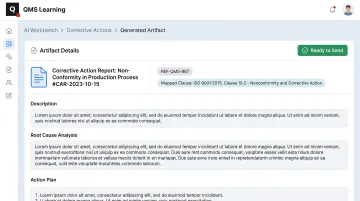
That's the difference between knowing DMAIC exists and having it produce something an auditor accepts under pressure.
ISO 9001, AS9100D, and ISO 13485 don't name DMAIC explicitly. Their continual improvement and corrective action clauses (10.2 and 10.3 in ISO 9001 and AS9100D; 8.5.2 and 8.5.3 in ISO 13485) still expect the documented cause analysis DMAIC produces. It has become a de facto standard even where it isn't a named requirement.
How DMAIC Works (Conceptual Flow)
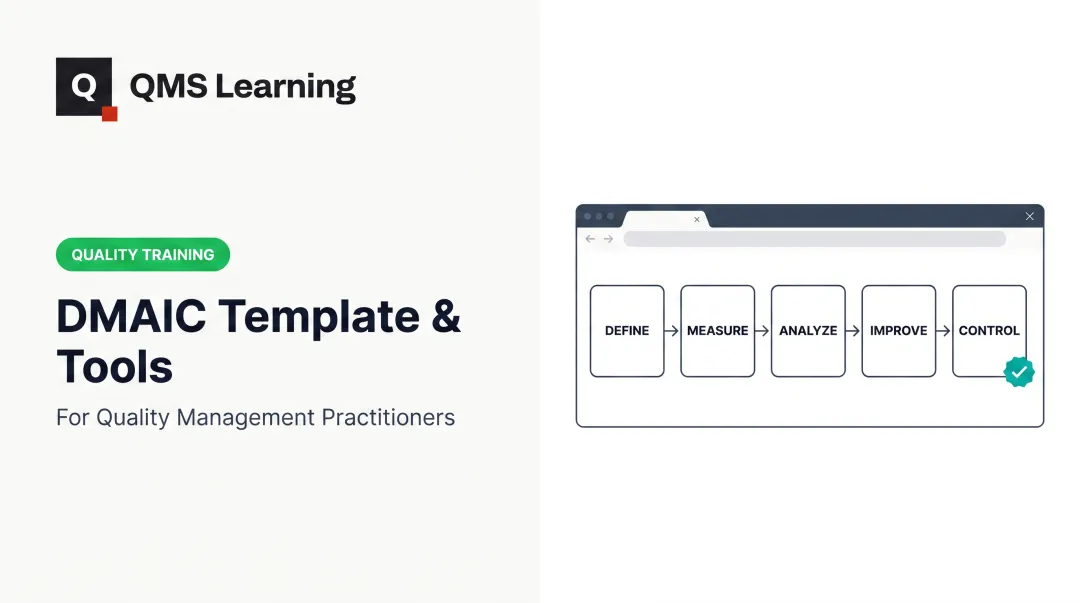
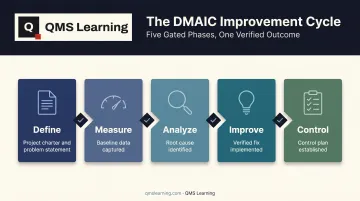
DMAIC moves sequentially through five gated phases. Teams review each phase, often through a formal tollgate, before advancing. That gating is the entire point: it stops teams from building solutions on unverified assumptions.
What goes into the process at the start:
- A defined problem statement with clear scope
- Available process data (or a plan to generate it)
- Stakeholder and customer requirements, sometimes called Voice of the Customer (VOC)
The core transformation happens in the middle three phases. Teams isolate root causes through actual data analysis, not speculation. They design targeted solutions, pilot them on a small scale, then roll them out.
Tollgate reviews, project charter checkpoints, and sponsor sign-off between phases keep the work anchored to scope. Without those checks, a project can quietly balloon into fixing five unrelated problems.
By the end, the process has shifted from an unverified baseline to a statistically confirmed, sustained improved state. Not "we think it's better." Confirmed.
Define
The Define phase produces a project charter, a high-level process map, and a clear problem and goal statement, validated against customer requirements. This is where you lock scope in. Skip this step or rush it, and the whole project drifts later.
Measure
Measure establishes a validated measurement system and collects baseline data to quantify the current state. Before drawing any conclusion, the team has to trust the numbers feeding it. That means checking the measurement system itself, not just the data it produces.
Analyze
Analyze is where root cause analysis, FMEA, and Pareto charts earn their keep. Teams use them to isolate and verify the true drivers of the problem before proposing any fix. This is also the phase teams skip most often — and the one that determines whether the eventual fix actually works.
Improve
Improve generates, pilots, and implements solutions targeting the verified root causes identified in Analyze, then confirms measurable improvement with data. A pilot matters here: rolling a fix out plant-wide before confirming it works is how good intentions turn into new problems.
Control
Control locks in the gains through a control plan, standard operating procedures, and ongoing monitoring, so the process doesn't quietly regress back to baseline six months later. This phase is frequently treated as an afterthought. It shouldn't be.
Where DMAIC Is Applied and What Affects Its Success
Where DMAIC Is Used
DMAIC shows up across a range of systems and workflows:
- Manufacturing production lines
- Healthcare processes and clinical workflows
- Government service operations
- Aerospace and defense quality systems
The trigger is usually specific: recurring nonconformances, chronic customer complaints, CAPA escalations, or cost and lead-time overruns. DMAIC isn't something teams run on a fixed quarterly schedule. It gets activated when a measurable, recurring problem shows up and the cause isn't already obvious.
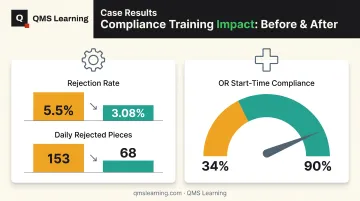
The results, when applied correctly, can be substantial. A 2023 case study on an Indian automotive weather-strip manufacturer, published in Heliyon via ScienceDirect, documented clear gains. Rejection rates dropped from 5.5% to 3.08%, and daily rejected pieces fell from 153 to 68 within three months.
A defense healthcare example tells a similar story. Navy Medicine's process improvement team used DMAIC to address first-patient operating-room start-time compliance, moving from 34% compliance to 90%.
Key Factors That Affect DMAIC's Effectiveness
Not every DMAIC project delivers those kinds of numbers. A handful of factors consistently separate the projects that work from the ones that stall out:
- Data quality and availability: without a reliable baseline, Measure produces a shaky foundation for everything that follows
- Team composition and skill level: junior staff without diagnostic training often misapply root cause tools, which slows Analyze to a crawl
- Leadership sponsorship: projects without an engaged process owner frequently stall right between Improve and Control
- Regulatory constraints specific to the industry: sectors under AS9100, ITAR, or ISO 13485 need every DMAIC artifact to double as audit evidence
That last point creates a real documentation burden, and it tends to fall on the most senior person in the room by default. QMS Learning's Method Router spreads that load by walking teams through the right compliance play for each problem, so documentation stops being a one-person bottleneck.
Common Pitfalls, Misconceptions, and When DMAIC May Not Be the Right Fit
Common Issues and Misconceptions
The biggest misconception about DMAIC is treating it like a checklist to complete quickly rather than a genuine analytical investigation. The goal is finding the actual cause, not filling in five boxes.
A few specific ways this goes wrong:
- Skipping Analyze — teams jump straight from Measure to proposing solutions, skipping the step that verifies what's actually causing the problem
- Confusing completion with resolution — finishing all five phases doesn't guarantee the root cause was correctly identified in the first place
- Underestimating Control — teams assume implementing a fix equals sustained improvement, without an active monitoring plan to catch regression
That third one is easy to miss. A 2022 peer-reviewed healthcare methods paper notes that Control is crucial to sustainable change and requires ongoing performance tracking, not a one-time implementation.
When DMAIC May Not Be Appropriate
DMAIC isn't the right tool for every problem, and forcing it onto the wrong situation wastes time without adding value.
Skip it when:
- The issue is simple and solvable through quick containment or basic PDCA
- Reliable data isn't available, and the real need is designing something new (that's DMADV territory)
- Time constraints call for a focused kaizen event rather than a full multi-week cycle
- Default or compliance-driven use, when a simpler approach already fits the problem
Whether DMAIC delivers value depends on correct application, not blind adoption. Running a five-phase framework on a five-minute problem adds overhead, not rigor.
Frequently Asked Questions
What is the difference between Six Sigma and the DMAIC methodology?
Six Sigma is the broader quality management philosophy and set of statistical tools. DMAIC is the specific five-phase problem-solving framework used to execute Six Sigma projects on the ground.
What are the five pillars of Six Sigma?
There is no single standardized list, but a commonly cited version includes: everything is a process, customer focus, reducing variation, data-driven decision-making, and continuous improvement.
What are the five stages of the DMAIC methodology?
Define the problem and goals, Measure the current process, Analyze data to find root causes, Improve by testing and implementing fixes, and Control to sustain the gains.
Who developed the DMAIC methodology?
DMAIC traces back to Motorola's Six Sigma program, which the company deployed starting in 1987. General Electric later popularized it broadly in the mid-1990s under Jack Welch.
What tools are commonly used in each DMAIC phase?
Define typically uses Voice of the Customer and a project charter; Measure uses process mapping; Analyze uses FMEA or root cause analysis; Improve uses pilot testing; Control uses control plans and SPC charts.
Can DMAIC be used outside of Six Sigma projects, such as in quality or compliance management?
Yes. DMAIC works well as a standalone improvement procedure for nonconformances, audit findings, or recurring compliance issues, with no formal Six Sigma certification required.