DMAIC fixes what already exists. DMADV builds what doesn't exist yet. In regulated industries, that distinction isn't academic. Apply DMAIC to a clean-sheet product design, or DMADV to a broken production line, and you burn engineering hours, audit cycles, and possibly walk into a nonconformity finding of your own making.
This guide breaks down both methodologies phase-by-phase, shows where each one wins, and gives you a fast way to decide when a real compliance problem lands in your inbox.
Key Takeaways
- DMAIC (Define-Measure-Analyze-Improve-Control) repairs an existing, measurable process
- DMADV (Define-Measure-Analyze-Design-Verify) engineers a new one from customer requirements
- DMAIC reacts to defects already occurring; DMADV prevents them before launch
- Both share the same DMA foundation but split hard at phase four
- Wrong framework choice costs months; wrong root-cause tool inside DMAIC is where most compliance teams get stuck
DMAIC vs DMADV: Quick Comparison
Before diving into each phase, here's the side-by-side that most quality teams keep pinned to their desk.
| Factor | DMAIC | DMADV |
|---|---|---|
| Objective | Improve and stabilize an existing process | Design a new product, service, or process from scratch |
| Starting Point | A live process with a documented gap against a KPI | Voice of the Customer (VOC) translated into Critical-to-Quality (CTQ) requirements |
| Core Tools | 5-Why, Fishbone/RCA, FMEA, SPC, Control Plans | QFD/House of Quality, DFMEA, Design of Experiments, Verification protocols |
| Defect Handling | Reactive — removes defects already in production | Proactive — engineers defects out before launch |
On timelines: most practitioners report DMAIC projects wrapping up faster than DMADV, largely because the process already exists and the unknowns are limited to root cause. DMADV projects run longer because they involve concept selection, prototyping, and formal verification against requirements that don't have historical data behind them yet.
Neither framework has a fixed clock. A supplier-defect DMAIC could close in six weeks, while a multi-site DMADV rollout could stretch past a year.
The real dividing line isn't speed. It's whether a measurable process already exists. ASQ's DMAIC framework assumes a live process you can measure and improve. If that process exists, you're in DMAIC territory. If you're starting from a blank sheet, DMADV is your framework.
What is DMAIC?
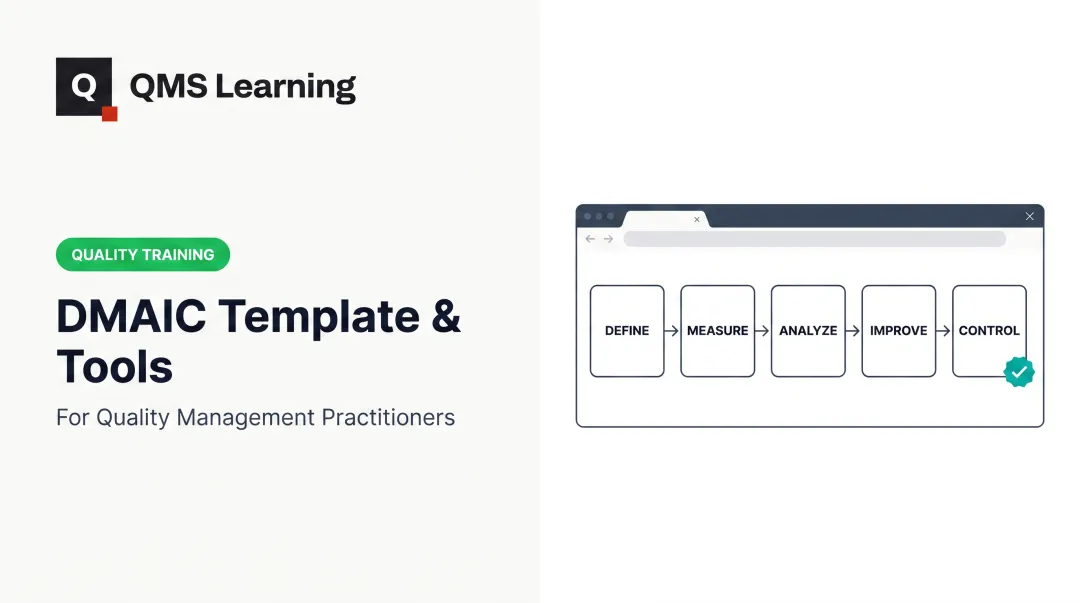
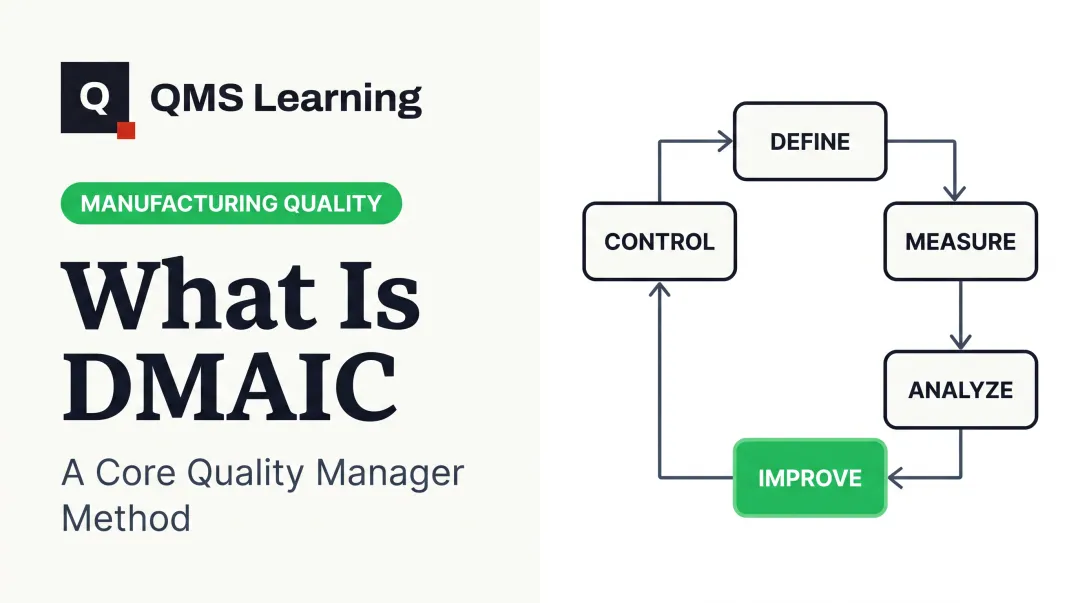
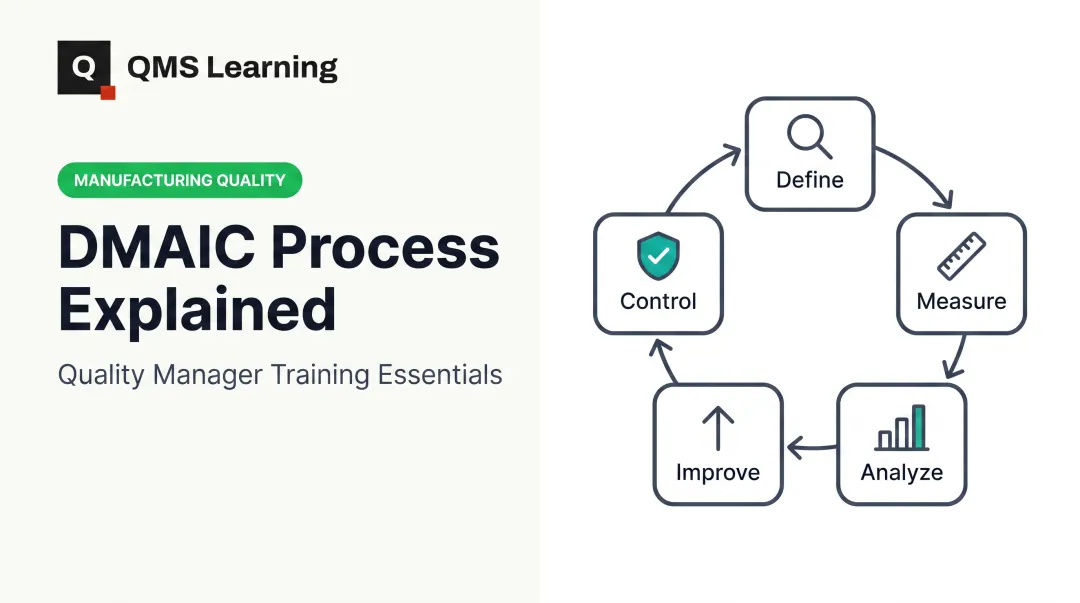
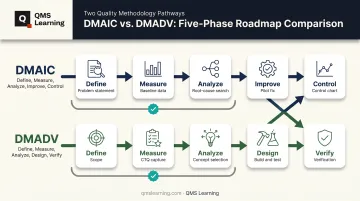
DMAIC is the five-phase improvement cycle: Define, Measure, Analyze, Improve, Control — and it's the backbone of root cause analysis and CAPA work in regulated manufacturing. When an auditor writes a finding, DMAIC is usually the vehicle that closes it.
Here's how the phases map to a real nonconformity:
- Define — State the problem and who it affects (a customer, a shipment, an audit clause)
- Measure — Pull baseline data: defect rate, scrap cost, recurrence frequency
- Analyze — Find the root cause using 5-Why, fishbone diagrams, or FMEA
- Improve — Pilot the fix on a limited run before full rollout
- Control — Lock in the gain with SPC charts, updated work instructions, and control plans
Skip Control, and the fix doesn't stick. That's usually when the same finding reappears at the next audit.
Use Cases of DMAIC
DMAIC dominates anywhere a process already runs but underperforms:
- Closing a CAPA after an internal or third-party audit finding
- Reducing a recurring nonconformity on the same part or supplier
- Improving first-pass yield on an existing production line
- Cutting incident rates for EHS teams tracking near-misses
Results show up when the process and the data are already there. A peer-reviewed case study on an Indian rubber weather-strip manufacturer found that applying DMAIC to a rejection problem delivered:
- Average daily rejection down from 5.5% to 3.08%
- Rejected pieces cut from 153 to 68 per day
- Process sigma up from 3.9 to 4.45 within three months
A separate aeronautics supplier case documented rework time falling from 75 to 15 hours per batch after a DMAIC project targeted final-paint defects.
That's not a universal guarantee — every process is different — but it shows the pattern: DMAIC works when the process exists and the data exists to interrogate it.
What is DMADV?
DMADV is the Design for Six Sigma (DFSS) version of the roadmap: Define, Measure, Analyze, Design, Verify. You reach for it when no process exists yet, or when the current one is structurally incapable of hitting requirements no matter how many incremental fixes you throw at it.
The five phases, as outlined in iSixSigma’s DMADV framework:
- Define — Set design goals and project scope
- Measure — Capture CTQs (Critical-to-Quality specs) and risk factors from customer requirements
- Analyze — Evaluate concepts and select the strongest design direction
- Design — Build and test the detailed solution
- Verify — Confirm the design meets input requirements, often through pilot runs or production trials
Done right, DMADV produces right-first-time launches and bakes regulatory compliance in from day one. That beats discovering a design flaw in review six months after tooling is cut.
Use Cases of DMADV
DMADV shows up wherever there's no existing baseline to improve:
- Launching a new product line or service offering
- Standing up a new facility, production cell, or QMS from zero
- Designing a new inspection or test process that must meet strict specs immediately
- Medical device design controls under ISO 13485, where design history files and risk files need to be right the first time
Two variations add rigor when tolerances are tight or variables interact:
- DMADVO — Adds an Optimize phase after Design to tune robustness before final verification
- IDOV — Identify, Design, Optimize, Validate (same logic, different phase names)
DMAIC vs DMADV: Which Should You Choose?
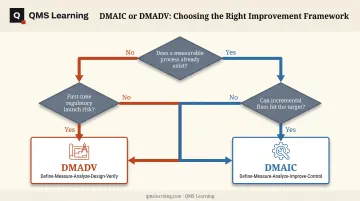
Three questions cut through most of the confusion:
- Does a measurable process already exist? If yes, start with DMAIC.
- Can incremental fixes realistically hit the target? If the architecture itself is the problem, DMADV is the honest answer.
- What's the regulatory or launch risk? A design that must pass ISO 13485 design controls on the first submission leans DMADV; a repeat nonconformity on an existing line leans DMAIC.
In practice: choose DMAIC if you're closing an audit finding or fixing a live production issue. Choose DMADV if you're launching something new that has to be compliant from day one.
Here's the part most compliance teams actually struggle with: it's rarely the five phases that trip people up. It's picking the right tool inside DMAIC under time pressure: is this a 5-Why problem, an FMEA problem, or does it need a full CAPA with effectiveness verification?
That diagnostic step is where QMS Learning's AI Workbench and Method Router come in. The Method Router evaluates a plain-English problem description and routes teams to the right method among ten supported approaches: 5-Why, FMEA, CAPA, Gap Analysis, Root Cause Investigation, and others.
A recurring defect from the same supplier across three jobs, for example, gets routed to 5-Why plus Supplier CAPA. That path fits a systemic issue on an existing process, not a new-process case where FMEA would apply.
Real-World Example
Picture a Tier 2 aerospace supplier that keeps seeing the same nonconformity resurface every 12-18 months.
Each time, the senior quality engineer gets pulled off other work to run the investigation manually, because junior staff don't yet have the judgment to pick between 5-Why, fishbone, and a full CAPA.
That bottleneck is a common trigger for formalizing a DMAIC-based CAPA process instead of relying on ad hoc fixes. S3 AeroDefense, a QMS Learning customer, reported that root-cause and corrective-action training gave their operations "a structured, disciplined process", replacing the pattern of one senior person carrying every investigation.
The mechanics that support this shift:
- The AI Workbench diagnoses the problem type and drafts the applicable artifact
- The Manager Dashboard tracks who's completed root-cause training and where gaps remain
- Every generated document and time-stamped activity compiles into a single Audit-Evidence Package PDF for the next registrar visit

Standardizing method selection means the team doesn't freeze the next time a finding lands. It doesn't all rest on one person's memory of how the last CAPA got closed.
Conclusion
DMAIC and DMADV solve different problems. DMAIC fits existing, measurable processes with a defined performance gap. DMADV fits clean-sheet design work full of unknowns. Neither is "better." The right choice depends on whether a process already exists to fix.
For regulated manufacturers, getting this decision right the first time means faster audit closure, fewer repeat findings, and design launches that meet CTQs on the first attempt.
Building that diagnostic judgment across the whole team, not just the one senior quality engineer everyone calls when things go wrong, keeps a quality operation resilient when the next finding lands. To see how that works in practice, QMS Learning offers a 30-minute working demo covering the AI Workbench, Manager Dashboard, and audit-evidence export.
Frequently Asked Questions
Is Six Sigma still relevant in 2026?
Yes. Six Sigma remains widely used across manufacturing, aerospace, and healthcare for structured problem-solving. It continues to evolve alongside AI-assisted root cause tools that speed up the Analyze phase.
Does Six Sigma use DMAIC?
DMAIC is Six Sigma's core roadmap for improving existing processes. DMADV, sometimes called DFSS, is the branch used for designing entirely new ones.
What is the difference between PDCA and DMAIC?
PDCA (Plan-Do-Check-Act) is a simpler, faster improvement loop suited to small changes. DMAIC is more rigorous and data-driven, built for complex or high-risk problems needing formal root cause analysis.
When should DMAIC not be used?
Skip DMAIC when no process currently exists, or when the existing process is structurally incapable of meeting requirements even after incremental fixes. That's when DMADV takes over.
Can DMAIC and DMADV be used together in the same project?
Yes. Many organizations use DMADV to design a new process, then switch to DMAIC once it's live and generating data so they can keep improving it.
What is DMADVO and how does it differ from DMADV?
DMADVO adds an "Optimize" phase after Design, focused on tuning and robustness before final verification. It serves a similar purpose to the IDOV variant for design-heavy projects.