Introduction
A single workplace injury costs an employer an average of $48,000, according to the National Safety Council's 2024 work injury cost data. A workplace death runs $1.54 million.
Add in OSHA penalties that can reach $165,514 per willful or repeated violation, and the financial exposure becomes hard to ignore.
Many organizations still treat EHS as a checkbox: complete the training, file the paperwork, move on. That approach works fine until an unexpected hazard, a surprise audit finding, or a real incident exposes the gap.
This guide breaks down what EHS risk management means, the risk categories you need to manage, a step-by-step framework you can apply immediately, and how to build lasting capability instead of one-time training completions.
Key Takeaways
- Treat compliance as the legal floor—risk management is what prevents incidents
- Cover all four EHS risk types: compliance, safety, environmental, and emerging/climate
- Run a five-step cycle—identify, assess, control, document, monitor—to keep risk current
- Anchor programs in leadership buy-in, verified competency, and cross-functional ownership
- Connect training, documentation, and compliance tracking in one system instead of siloing them
What Is EHS Risk Management?
EHS risk management is the systematic process of identifying, assessing, and controlling environmental, health, and safety hazards before they cause harm. It's proactive by design, going beyond what any single regulation requires.
Here's the distinction that trips up most organizations: compliance means meeting the legal minimum.
Risk management means addressing hazards regulations don't fully anticipate: the near-miss nobody logged, the process change nobody re-assessed, the contractor on a task your training program never covered.
Verdantix's 2026 global corporate survey of 302 senior EHS decision-makers across 25 countries found workforce risk controls, training, and safety-risk mitigation among the top investment priorities for the year ahead. That ranking signals leaders are shifting budget toward prevention, not just documentation.
EHS risk isn't owned by one person with "safety" in their title. It touches:
- Operations: process design and equipment decisions
- HR: onboarding, incident reporting, and workers' comp
- Facilities: building conditions, ventilation, egress
- Leadership: budget, staffing, and accountability structures
When EHS lives in a silo, blind spots multiply.
Types of EHS Risks Every Organization Must Manage
EHS risk isn't a single bucket. It spans distinct categories. Each one needs its own controls, owners, and regulatory exposure.
Compliance Risk
Compliance risk is the exposure created when your operations fail to meet a legal or regulatory requirement. A classic example: an OSHA citation for missing fall protection on an elevated work platform.
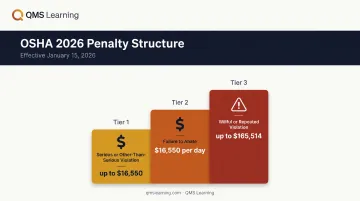
The financial stakes have increased. Effective January 15, 2026, OSHA's maximum penalties run:
- Up to $16,550 per serious or other-than-serious violation
- $16,550 per day for failure to abate
- Up to $165,514 per willful or repeated violation
These are ceilings, not averages — but they show how quickly a single overlooked hazard escalates.
Safety Risk
Safety risk covers the hazards most people picture first: trip hazards, unguarded machinery, and repetitive-motion strain from poor ergonomics. These risks connect directly to injury and illness rates, and they're usually the easiest to spot during a routine walkthrough.
That same visibility is why non-routine work gets missed. A one-off maintenance job or unusual contractor request rarely appears on the standard checklist.
Environmental Risk
Environmental risk involves chemical spills, air and water emissions, and improper waste disposal. These activities fall under EPA authority.
The scale of enforcement is real. In FY2025, the EPA completed 2,127 civil enforcement cases, collecting over $650 million in civil penalties and securing more than $6.4 billion in commitments to bring facilities back into compliance.
Emerging and Climate-Related Risk
Newer risk categories are reshaping EHS planning: climate disruption, resource scarcity, and supply chain exposure.
A 2022 Deloitte survey of over 2,000 global executives found that 97% said their companies had already been negatively affected by climate change, with roughly half reporting direct disruption to operations or supply networks. These risks don't fit a legacy safety checklist, so they get missed.
The EHS Risk Management Process: A Step-by-Step Framework
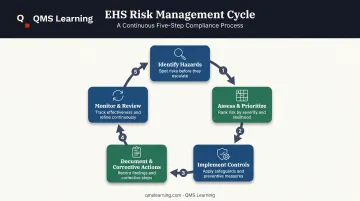
Treat this as a cycle you run continuously, not a checklist you complete once a year.
Step 1: Identify Hazards and Potential Risks
Hazard identification draws from multiple sources: site inspections, employee feedback, incident history, and job hazard analysis. OSHA's own Recommended Practices call for continual identification, not a one-time sweep.
The overlooked category: non-routine tasks. A rarely-performed maintenance job or a novel contractor scope creates hazards nobody's job hazard analysis ever covered.
Step 2: Assess and Prioritize Risks
Once hazards are identified, score them. A risk matrix weighs likelihood against severity, helping teams separate the urgent from the merely notable. A centralized risk register keeps that prioritization visible across the organization. It stays out of one person's spreadsheet.
Step 3: Implement Controls Using the Hierarchy of Controls
NIOSH's hierarchy of controls ranks interventions from most to least effective:
- Elimination — remove the hazard entirely
- Substitution — replace it with something safer
- Engineering controls — redesign the process or equipment to limit exposure
- Administrative controls — adjust schedules, procedures, or training
- PPE — equip workers to reduce exposure only after higher controls are in place
Example: for a solvent-based cleaning process, substitution might mean switching to a water-based alternative, then adding local exhaust ventilation (engineering), limiting exposure time via rotation (administrative), and requiring respirators only as a backstop.
Step 4: Document Evidence and Assign Corrective Actions
Vague corrective actions like "be more careful" fail audits every time — because they're not verifiable. Effective CAPA tracking assigns a specific owner, a target date, and a method to confirm the fix worked. Tie each action back to training records that prove people knew what to do.
Step 5: Monitor, Review, and Continuously Improve
Reassess on a set cadence so new hazards don't slip through. Reassessment triggers include:
- New equipment or process changes
- Regulatory updates
- Near-misses or incidents
- Significant organizational or workflow shifts
Building a Sustainable EHS Risk Management Program
A program built for the long haul needs more than good intentions during audit week.
Five elements keep EHS risk management working after the auditors leave:
- Leadership commitment and safety culture. Top-down accountability determines whether EHS gets real budget and attention or becomes paperwork that stalls the moment leadership looks away.
- Verified competency, not just completion. Finishing a course is not the same as applying root-cause and corrective-action judgment when an auditor is standing over your shoulder.
- Centralized documentation and audit-evidence management. Auditors and regulators need a controlled document history they can trust: one current revision, a preserved review trail, and no ambiguity about what's active.
- Cross-functional coordination. EHS workflows touch operations, HR, and facilities simultaneously. Siloed ownership creates the blind spots that turn into citations.
- Technology-enabled monitoring. Track leading and lagging indicators so risk shows up before it becomes a recordable.
On competency, judgment under pressure is the real test. QMS Learning's Environmental & Safety Compliance pathway pairs role-specific ISO 14001, ISO 45001, and OSHA training with an AI Workbench that helps teams diagnose problems and generate audit-ready documentation on the spot.
For ongoing monitoring, the Bureau of Labor Statistics formula for Total Recordable Incident Rate (TRIR) is:
(Number of cases × 200,000) / Total employee hours worked
DART (Days Away, Restricted, or Transferred) uses the same formula, scoped to more severe cases. Both give you a comparable rate across sites and time periods, which is far more useful than raw incident counts.
Common Challenges in EHS Risk Management
Even well-intentioned programs hit the same recurring friction points.
- Regulatory complexity across jurisdictions. Multi-site operations face different state, federal, and local requirements at the same time, making it hard to keep every site current.
- Resource constraints. EHS teams are often stretched thin across facilities and hazards, with little capacity left beyond day-to-day response.
- Data silos. Spreadsheets, incident logs, and training records live in separate systems, so risk exposure looks fragmented and outdated at any given moment.
Choosing the Right EHS Risk Management Tools
Not every EHS software platform solves the same problem, so evaluate against a few core criteria.
What to look for:
- Hazard and risk assessment tracking
- Compliance calendars for recurring obligations
- Incident management workflows
- Real-time reporting and dashboards
Integration matters more than feature count. Disconnected point solutions create redundant data entry and leave audit gaps between systems. The goal is one connected view: training, evidence, and compliance tracking talking to each other, not living in separate tabs.
This is where training-first platforms fit alongside broader EHS software stacks rather than replacing them.
QMS Learning's approach pairs role-specific EHS training scoped to ISO 14001, ISO 45001, and OSHA with an AI-guided method selector and exportable audit-evidence packages. Those packages combine training records, completed scenarios, and AI-generated artifacts (such as hazard analyses or environmental aspect registers) into one PDF.
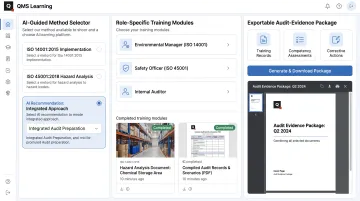
The platform complements existing incident-tracking and recordkeeping systems instead of duplicating them.
Frequently Asked Questions
Is EHS part of OSHA?
No. OSHA is a federal regulatory body under the Department of Labor governing workplace safety. EHS is the broader organizational discipline that includes OSHA compliance plus environmental obligations regulated by the EPA and health-related requirements beyond OSHA's scope.
What are the 7 types of risk management?
Common categories include compliance, safety, environmental, financial, operational, strategic, and reputational risk. EHS risk management specifically covers the safety, health, and environmental subset of that broader list.
What is the best EHS software?
It depends on your organization's size, industry, and primary need — incident tracking, compliance management, or training. Evaluate options based on how well they integrate with your existing training and documentation workflows.
What's the difference between EHS risk management and EHS compliance?
Compliance means meeting the legal minimum set by regulators. Risk management proactively addresses hazards that regulations may not fully cover, including near-misses and process-specific risks.
How often should EHS risk assessments be conducted?
Assessments should run on a regular schedule, typically at least annually, plus immediately after any operational change, new equipment installation, or regulatory update.
Who is responsible for EHS risk management in an organization?
EHS managers typically own the program, but responsibility is shared across leadership, supervisors, and frontline employees who identify and report hazards in real time.