Introduction
An EHS compliance checklist is a structured tool that verifies whether a facility's safety, health, and environmental practices meet regulatory and internal standards. It sounds simple. It rarely is.
After two decades and more than 1,000 audit findings, one pattern keeps showing up: facilities that get hit with OSHA citations, EPA notices, or repeat audit findings are almost always working from a checklist that wasn't built for their specific site, process, or chemical inventory.
Generic templates miss the details that matter. A checklist pulled from a general industry PDF won't catch your facility's specific NAICS-based recordkeeping thresholds or your actual wastewater permit conditions.
This guide covers:
- What a site-specific EHS checklist actually needs
- The three checklist types mature EHS programs run
- How to interpret results so findings turn into fixes
- Mistakes that quietly erode audit-readiness over time
TL;DR
- Blend OSHA, EPA, and ISO 14001/45001 requirements scoped to your site, not a downloaded template
- Three checklist types cover the full picture: safety/OSHA, environmental/EPA, and management-system audit-readiness
- Sort findings into compliant, minor deviation, or non-compliant—each with its own corrective path
- The most common failure is a generic or outdated checklist used without independent review
- Build audit-readiness through team capability, not PDFs sitting in a shared drive
What You Need for an Effective EHS Compliance Checklist
Before anyone checks a single box, two things have to be settled: which reference materials you're pulling from, and whether your site-specific scope is actually current. Skip either step and the checklist becomes a paperwork exercise instead of a real compliance tool.
Resources and Reference Materials Required
Pull these together before you start:
- A site-specific regulatory applicability register — which OSHA, EPA, and state rules apply to your specific NAICS code and operations
- A current SDS/HazCom library matching your actual chemical inventory, not last year's
- Permit and consent files covering air, water, and hazardous waste
- A document control system for version history and approvals
- A digital checklist tool for recording completion, photos, and timestamps in one place
Preconditions and Setup
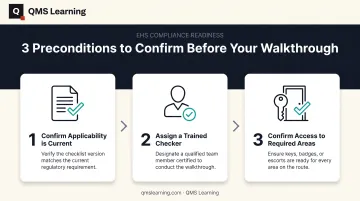
A few things need to be true before the walkthrough starts:
- Confirm applicability is current. NAICS changes, new processes, and updated chemical inventories all shift which standards apply.
- Assign a trained checker. OSHA recommends evaluating a safety and health program at least annually, and right after process changes, serious injuries, or a jump in complaints. Untrained or inconsistent evaluators miss shortcomings that go uncorrected until they resurface as bigger problems.
- Confirm access to every required area, including chemical storage, wastewater treatment, generator sets, and confined spaces, and arrange any lockout or isolation needed for the walkthrough.
Here's the part most teams skip: understanding why an item is on the checklist. People often complete a line correctly on paper without grasping the regulatory intent behind it.
That gap—checklist completion without diagnostic judgment—is what QMS Learning's Environmental & Safety Compliance pathway is built to close. It pairs checklist practice with the reasoning behind each requirement.
Types of EHS Compliance Checklists
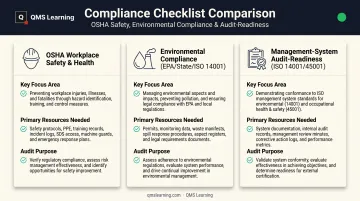
No single checklist covers every legal and management-system obligation a facility carries. Most mature EHS programs run three checklist types in parallel, each scoped to a different audit purpose.
Type 1: OSHA Workplace Safety & Health Checklist
This checklist covers HazCom/GHS labeling, PPE, machine guarding, emergency action plans, and OSHA recordkeeping under Forms 300 and 300A.
Resources needed: HazCom-compliant SDS library, injury/illness log, PPE inspection records, training attendance records.
Step-by-step:
- Confirm applicable OSHA standards for your NAICS code and recordkeeping thresholds. Some establishments carry a partial recordkeeping exemption depending on size and industry classification.
- Walk the floor checking PPE, machine guarding, signage, and emergency equipment against checklist items.
- Cross-check OSHA 300A posting timelines (February 1 through April 30), GHS label compliance, and training completeness.
Pros & cons: Fast, routine-friendly, and easy to run weekly or monthly. The tradeoff is that it demands strong familiarity with regulatory language. Ambiguous items like "adequate guarding" get interpreted very differently by an untrained checker versus a trained one.
Type 2: Environmental Compliance Checklist (EPA/State/ISO 14001)
This checklist covers air emissions, wastewater/stormwater discharge, hazardous waste manifests, and permit conditions.
Resources needed: current air/water permits, hazardous waste manifest tracker, monitoring/testing schedule, e-Manifest registration.
Step-by-step:
- Verify permit validity and confirm actual operations match the permitted scope.
- Review monitoring adherence and cross-check lab report parameters against permit conditions.
- Confirm hazardous waste manifests, e-Manifest records, and disposal documentation are complete and reconciled. Large and small quantity generators have been required to register for e-Manifest through RCRAInfo since January 2025.
Pros & cons: This checklist catches the gaps that trigger the largest fines. In FY2025 alone, EPA ran more than 14,000 compliance-monitoring activities nationwide, including inspections and record reviews. The downside: these regulations shift often, so the checklist needs continuous updates, not a one-time build.
Type 3: Management-System Audit-Readiness Checklist (ISO 14001/45001)
This is a deeper conformance check against your internal EMS/OHSMS procedures, used to prepare for third-party certification audits rather than just meeting legal minimums.
Resources needed: management system manual, internal audit schedule, CAPA log, prior audit findings and closure evidence.
Step-by-step:
- Map checklist items to specific ISO 14001/45001 clauses and internal procedures.
- Interview process owners and review objective evidence for each clause.
- Compile findings into a single evidence package reviewable by auditors and registrars.
Pros & cons: The most audit-defensible of the three types, but it requires trained internal auditors and more time per cycle.
QMS Learning's AI Workbench can compile training records, completion evidence, and generated artifacts into a single indexed PDF for ISO 14001, ISO 45001, and OSHA 29 CFR 1910 programs. That groundwork helps, but it does not replace the interview and evidence-review steps above.
How to Interpret Your EHS Checklist Results
Misreading a result is nearly as risky as skipping the check altogether. A wrongly marked "compliant" item can leave a real hazard unaddressed until the next inspection, or worse, until an incident forces the issue.
Classify every finding into one of three buckets:
- Compliant: The item fully meets the requirement with no deviation. File dated evidence and move to the next cycle.
- Minor Issue: A small deviation within acceptable tolerance, such as a missing log initial or a slightly overdue calibration. Log a lower-priority corrective action with a defined closure date.
- Non-Compliant: An actual violation or hazard. Escalate immediately, open a CAPA, and notify regulators within required timeframes where applicable.
The trap most teams fall into is treating "minor issue" as a permanent resting place instead of a temporary one. A missing calibration date left unaddressed for three cycles is no longer minor. It is a pattern auditors will flag.
Common Mistakes and Best Practices for EHS Checklists
Common Mistakes
Generic downloaded checklists that ignore site-specific rules and recent process changes
Copy-pasting prior-period answers without re-checking current data or conditions
One person owns the whole checklist with no independent review, so slow negative trends stay hidden
Generic downloaded checklists that ignore site-specific rules and recent process changes
Copy-pasting prior-period answers without re-checking current data or conditions
One person owns the whole checklist with no independent review, so slow negative trends stay hidden
That second habit has real enforcement teeth. In one EPA case, a plating company president falsified environmental monitoring and wastewater results, pleaded guilty to four felony Clean Water Act counts, and received jail time, probation, and a $40,000 fine.
Best Practices
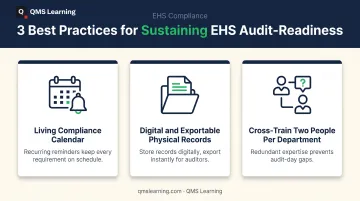
- Run a living compliance calendar with reminders for consent renewals, testing deadlines, and record postings. Memory isn't a system.
- Keep digital and exportable physical records of every completed checklist. Outages have a habit of hitting during real inspections.
- Cross-train at least two people per department so more than one person can walk an auditor through the checklist and its evidence.
Distributed checklist competence keeps you from depending on a single senior lead. QMS Learning's role-specific EHS pathway and Manager Dashboard make that visibility practical—who is fluent in which standards, and where the gaps still sit.
Conclusion
An EHS compliance checklist is only as strong as three things: the applicability analysis behind it, the training of the person completing it, and the discipline of interpreting results correctly.
Combining OSHA, EPA, and ISO 14001/45001 scoping with genuine team capability, not just a document, is what keeps a facility audit-ready year-round instead of scrambling before every inspection.
Every result should trigger a clear next action. Filing dated evidence. Opening a CAPA. Notifying a regulator. Without that follow-through, the checklist is only a filing exercise.
Frequently Asked Questions
What is an EHS audit checklist?
It's a structured tool auditors use to evaluate compliance with EHS regulations, internal policies, and management-system standards during a formal audit. It typically maps directly to specific regulatory clauses or ISO requirements.
What is a 21 CFR Part 11 compliance checklist?
This is an FDA framework governing electronic records and signatures, primarily relevant to regulated life-sciences data integrity. It's distinct from the OSHA/EPA-focused checklists covered in this guide.
How often should an EHS compliance checklist be updated?
Update it whenever regulations change, processes shift, or your chemical inventory changes — and review it periodically even without a trigger event. OSHA recommends evaluating safety programs at least annually.
What is the difference between an EHS inspection checklist and an EHS audit checklist?
An inspection is routine and narrower in scope, usually checking physical conditions like PPE or signage. An audit is deeper and less frequent, evaluating whether entire processes and procedures function as designed.
Who is responsible for maintaining EHS compliance checklists?
EHS managers typically own the overall program and applicability analysis. Checklist completion accountability should extend to trained site personnel who understand both the item and its regulatory intent.
What happens if a facility fails an EHS compliance check?
Outcomes vary by severity: corrective action requirements, escalating fines, or operational restrictions. OSHA penalties for willful or repeated violations can reach $165,514 per violation under current maximums.