Introduction
A team can run a solid risk analysis and still walk out of an audit with a finding. It happens constantly.
The hazards were identified, the FMEAs were thorough, the controls were verified — but the Risk Management File itself was scattered across three shared drives, an old spreadsheet, and someone's inbox.
ISO 14971 Clause 4.5 requires manufacturers to "establish and maintain" a Risk Management File, but it never says exactly what that file has to look like. That silence is where most of the confusion starts.
Here is what an RMF actually is, what must sit inside it, how to structure and maintain one, the mistakes that trigger audit findings most often, and where to find usable templates.
Key Takeaways
- Treat the RMF as the full evidence set that risk management happened—not a single standalone document
- Cover planning through post-production in one searchable location auditors can pull without a scavenger hunt
- Pointer-style files that scatter records elsewhere drive the most common audit findings
- No template is mandated, but auditors expect a clear risk-table structure they can follow end to end
What Is an ISO 14971 Risk Management File?
ISO 14971:2019, section 3.25, defines the Risk Management File as a "set of records and other documents that are produced by risk management." That phrasing matters. The RMF isn't a deliverable you write once and file away. It's a collection of evidence built up over the life of a device, according to the ISO 14971:2019 standard itself.
Under Clause 4.5, that evidence has to trace, for every identified hazard, from analysis through risk control implementation, verification, and residual risk evaluation. Miss a link in that chain, and the file fails.
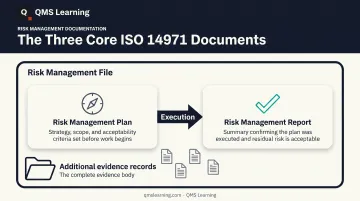
Plan, Report, and File Are Three Different Things
Practitioners mix these up constantly:
| Document | What it is |
|---|---|
| Risk Management Plan | The strategy : scope, acceptability criteria, roles, and methods, written before work begins |
| Risk Management Report | The summary conclusion confirming the plan was executed and residual risk is acceptable |
| Risk Management File | The complete body of evidence, which contains both the Plan and the Report along with everything else |
Confusing the Report for the File is one of the fastest ways to underbuild your documentation.
Why Fragmented Files Fail Under MDR Annex II
ISO 14971 is harmonized under both EU MDR and IVDR, so notified bodies treat it as state-of-the-art risk management. FDA recognizes the standard as a consensus standard, and reviewers expect documentation that follows it.
MDR Annex II goes further: technical documentation, including the RMF, must be presented in a "clear, organized, readily searchable and unambiguous manner" with a central entry point, per Regulation (EU) 2017/745.
That's a hard bar to clear with a paper binder or a folder of loosely linked files. The RMF also isn't a pre-market artifact you close out at launch. It has to span the full lifecycle, from design concept through production and post-market surveillance.
What Must Be Inside a Complete Risk Management File
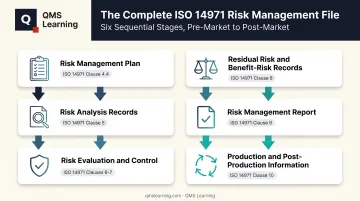
A complete RMF is not a single form. It is a set of interlocking records, each tied to a specific clause of ISO 14971. Auditors expect to see every piece below, linked and current.
Risk Management Plan
Document scope and intended use, risk acceptability criteria, roles and responsibilities, and the methods planned for risk assessment.
Risk Analysis Records
Capture identified hazards, hazardous situations, and harms, with severity and probability estimates. Annex C of ISO 14971 offers a useful reference model: hazard leads to a foreseeable sequence of events, which leads to a hazardous situation, which leads to harm.
Risk Evaluation and Risk Control
This section should show:
- Estimated risk compared against the acceptability criteria set in the Plan
- Which control option was applied, in order of preference: inherent safety by design, protective measures, then information for safety
- Verification that each control actually works as intended
Residual Risk and Benefit-Risk Records
Show evidence that leftover risk was evaluated against the acceptance criteria. Where residual risk exceeds those criteria, include a documented benefit-risk analysis that justifies it against the device's benefit.
Risk Management Report
Provide the pre-release summary confirming overall residual risk is acceptable and that the Plan was carried out as written.
Production and Post-Production Information
Describe how complaints, CAPAs, nonconformances, and post-market surveillance data get captured and fed back into the file.
This is the piece teams most often treat as optional. It is not. Clause 10 requires an active system for collecting and reviewing this information for the life of the device.
How to Structure, Organize, and Maintain an Audit-Ready RMF
Getting the content right solves half the problem. The other half is structure.
Consolidated File vs. Pointer Document
ISO 14971 technically permits an RMF built from cross-references to records living elsewhere in your quality system. In practice, that approach creates real risk:
- Version conflicts between the referenced document and what the RMF cites
- Broken links when documents get revised, renamed, or moved
- Auditors asking for something the pointer references, and nobody being able to locate it quickly
A consolidated file, controlled in one location, avoids all three. It's not mandatory. It's just far more defensible.
Product vs. Product Family
Manufacturers with closely related device variants often organize risk management by product family rather than one file per SKU. This works when devices share intended use, design architecture, and hazard profile.
It breaks down when variants have meaningfully different failure modes. At that point, separate files (with shared reference sections) tend to hold up better under review.
Digital vs. Paper
MDR Annex II's searchability requirement is difficult to satisfy with paper. Electronic systems that maintain revision history and a single point of access make this far easier to demonstrate.
This is where a controlled document management system earns its keep. The capabilities that matter for an audit-ready RMF include:
- Append-only audit trail that preserves every draft, review, and release action
- Clause-mapped linkages from each record to the standard clause, CAPAs, and training it supports
- Single point of access so coverage gaps show up instead of staying buried
QMS Learning's Document Management System is built around this structure and cuts much of the administrative burden fragmented RMFs create.
Living Document, Not a One-Time Deliverable
The RMF doesn't close when the device launches. A defined process should feed post-market signals back into the file, including:
- Complaints and adverse event data
- CAPA outcomes and related investigations
- Post-market surveillance trends
Use that input to update hazard lists, probability estimates, and residual risk conclusions as real-world data arrives.
The Most Common Risk Management File Mistakes That Trigger Audit Findings
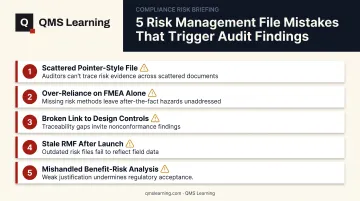
Some mistakes show up in nearly every finding report. Here are the five worth knowing before an auditor finds them for you.
Treating the RMF as a scattered reference file. A collection of pointers to records elsewhere creates traceability gaps that auditors catch almost immediately. Consolidation solves this.
Relying on FMEA alone. FMEA captures single-fault failure conditions well, but it misses hazards that exist even when the device works exactly as designed: normal-use hazards, human factors, and foreseeable misuse. FDA risk management guidance treats FMEA as one technique among several, not a complete process on its own.
Breaking the link to Design Controls. Risk controls need to trace to specific Design Outputs, Verifications, and Validations in the Design History File. Without that connection, auditors see two systems that don't talk to each other.
Letting the RMF go stale after launch. This is a documented, recurring finding. In a 2021 FDA warning letter to Smiths Medical, a risk was classified as "negligible" despite being linked to at least three deaths, and relevant quality data sources went unreviewed. A stale RMF misses real safety signals, not just paperwork.
Mishandling benefit-risk analysis. Skipping a documented benefit-risk analysis when residual risk exceeds acceptability criteria is a finding waiting to happen. So is leaning on cost or financial reasoning as justification. Acceptability has to rest on clinical benefit, not budget.
Risk Management File Templates and Tools
Is There a Standard Risk Assessment Template?
ISO 14971 doesn't mandate a specific template or form. But most manufacturers converge on the same working structure, commonly called a risk table:
- Hazard ID and cause
- Hazardous situation
- Harm
- Severity and probability estimates
- Initial risk rating
- Control measure applied
- Verification of control effectiveness
- Residual risk conclusion
Auditors expect to see something resembling this table, even if the exact columns vary by organization.
Spreadsheets vs. Purpose-Built Software
Spreadsheets are accessible and cheap, which is why so many teams start there. The trade-off shows up later: weak version control, no automatic traceability between hazard and verification record, and a real risk of someone editing the "wrong" copy during an audit crunch.
Dedicated risk management or eQMS software built around ISO 14971's structure solves that traceability problem directly, at the cost of a steeper setup.
Neither option replaces the judgment required to classify hazards, set severity and probability, and defend residual-risk conclusions under review. The file is only as strong as the reasoning behind each row.
QMS Learning's Medical Device & Life Sciences pathway covers ISO 13485, FDA 21 CFR Part 820, and ISO 14971 with that evidence structure in mind. Pilot cohorts open in Q3 2026 for design-control and CAPA teams.
Frequently Asked Questions
Is there a standard risk assessment template?
ISO 14971 doesn't require a specific template. Most manufacturers use a common risk-table format with columns for hazard, cause, severity, probability, and control measures.
What is the difference between a Risk Management File and a Risk Management Report?
The Report is a summary document confirming overall residual risk is acceptable. The File is the complete evidence set, and it includes the Report along with every other risk record generated.
What is the difference between a Risk Management File and a Risk Management Plan?
The Plan defines strategy and acceptance criteria before any risk work starts. The File is the evidence produced once that plan gets carried out.
Does ISO 14971 require the Risk Management File to be one physical document?
No — the standard only requires a "set of records." MDR Annex II does expect an organized, searchable structure with a single entry point, which is why fragmented pointer-style files tend to draw findings.
How long must a Risk Management File be maintained?
Retention depends on your regulatory market. Under MDR, technical documentation must stay available for at least 10 years after the last device reaches market (15 years for implantables). Check your specific jurisdiction's rules before setting a retention policy.
What happens to the Risk Management File after a device is on the market?
It stays active. Complaints, CAPAs, and post-market surveillance data get reviewed continuously and fed back into the file, updating hazard assumptions and risk conclusions as needed.