Introduction
A supplier defect resurfaces. A customer complaint lands on your desk for the third time this year. Somewhere, a nonconformity keeps escaping detection, and the fix from last time clearly didn't hold.
That's the exact scenario the 8D (Eight Disciplines) methodology was built to solve. It's a structured, team-based process for containing a problem immediately, finding the true root cause, and locking in a permanent corrective action.
This guide is for quality engineers, quality managers, and continuous improvement leads in manufacturing, automotive, and aerospace/defense.
In those environments, corrective action documentation under AS9100D and IATF 16949 isn't optional—it's an audit requirement.
8D is one of the most referenced frameworks in supplier quality, yet teams often finish the report without isolating the real cause. This guide walks through each discipline, shows where 8D fits against other methods, and flags the failure points that let problems return.
Key Takeaways
- 8D is an 8-step framework (sometimes 9, with D0) for containing, finding root causes, and permanently fixing recurring quality problems
- Ford developed 8D in the 1980s, and it's now standard across automotive, aerospace, and manufacturing supply chains
- D4 needs a separate root-cause tool such as 5 Whys or Fishbone; 8D structures the investigation but does not supply the method
- Containment usually happens in 24–48 hours; full closure often takes 30–60 days depending on customer requirements
- Success hinges on team authority, evidence quality, and verification, not just filling out the template
What Is the 8D Process?
8D is a structured, eight-discipline corrective action process that guides a cross-functional team from "we have a problem" to a verified, permanent fix. Some teams add a D0 planning step, expanding the method to nine disciplines.
The American Society for Quality describes 8D as an approach for identifying, correcting, and eliminating recurring product or process problems. It establishes permanent corrective action and determines root causes.
The intended output isn't just paperwork. A properly run 8D produces:
- A verified root cause, not a guessed one
- A permanent corrective action, tested before rollout
- Documented evidence that the failure mode can't recur
- A formal 8D report tying all of it together for the customer or auditor
How 8D Differs From DMAIC and PDCA
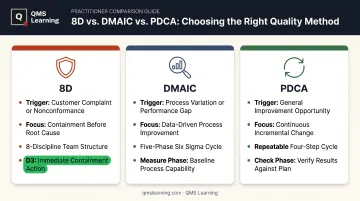
Quality teams often lump 8D, DMAIC, and PDCA together as interchangeable "problem-solving frameworks." They're not.
- DMAIC (Define, Measure, Analyze, Improve, Control): a Six Sigma method for improving an underperforming process. Analytical and improvement-focused, not complaint-driven.
- PDCA (Plan-Do-Check-Act): a general four-step cycle for carrying out change of almost any kind.
- 8D: triggered by a known nonconformity (complaint, escape, or recurring defect). It alone names an interim containment discipline (D3) that DMAIC and PDCA do not require.
8D reacts to something that already broke, protects the customer immediately, then digs for the cause. That containment-first structure is what sets it apart.
Why the 8D Process Is Used in Manufacturing and Regulated Quality Environments
8D shows up most often after one of four triggers:
- A customer complaint or field return
- A supplier quality escape
- An internal nonconformity caught before shipment
- An audit finding demanding documented root cause and corrective action (CAPA)
Regulated manufacturing runs on traceability. Auditors don't just want to know a problem got fixed. They want to see who investigated it, what evidence supported the conclusion, and how the fix was verified before the case closed.
IATF 16949 requires a documented, scaled problem-solving process covering containment, root-cause analysis, systemic correction, and effectiveness verification. It also requires organizations to use whatever specific method their customer prescribes, unless that customer approves otherwise, per the IATF 16949 Sanctioned Interpretations.
Customer-specific requirements fill in the rest. Ford's supplier requirements, for example, call for a 24-hour initial response and a 15-calendar-day submission milestone for the full 8D or Six Sigma report, according to Ford's IATF Customer-Specific Requirements. Other OEMs set their own containment and closure windows.
What Happens Without It
Skip the structure and you get familiar results:
- Ad hoc fixes that address the symptom, not the cause
- The same nonconformity resurfacing months later
- No audit trail explaining why a particular fix was chosen
- Repeat findings on the next surveillance audit
The 8D Process: The Eight Disciplines Step by Step
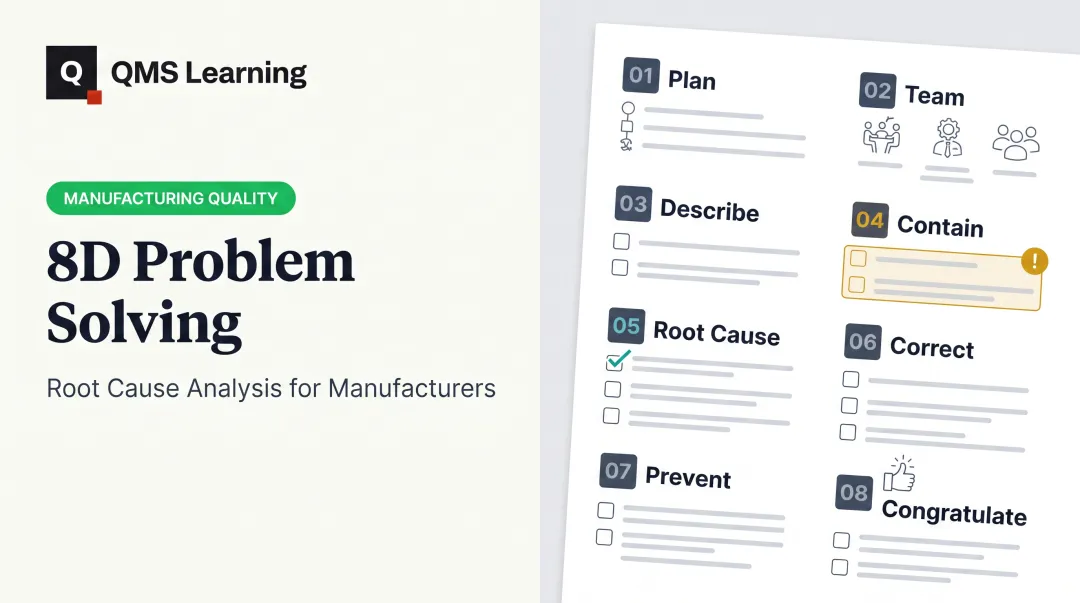
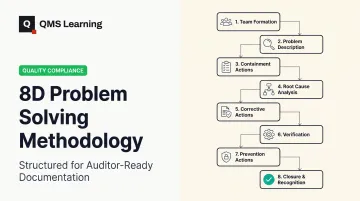
8D moves a team through eight stages: team formation, problem definition, containment, root cause, correction, implementation, prevention, and closure.
Some organizations add a D0 planning/emergency-response step before D1 to decide whether a full 8D is even warranted. Ford's "Global 8D" also layers escape-point analysis across D4 through D6, asking not just what caused the failure but why it wasn't caught earlier in the process.
Here's how each discipline actually works.
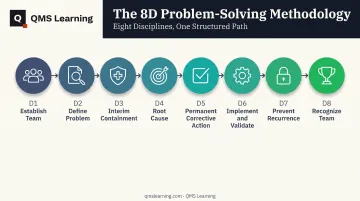
D1: Establish the Team
Assemble a cross-functional team with real product and process knowledge, plus the authority to make changes. Appoint a team leader to drive the investigation. Skip this step's rigor, and you'll end up with a "team" that's really just the quality department working alone, without the engineering or production input needed to reach a real cause.
D2: Define the Problem
The team turns a vague complaint into a specific, measurable problem statement using 5W2H: who, what, where, when, why, how, and how many. "Parts are failing" isn't a problem statement. "Lot 4471 showed 12 units with undersized bore diameter, detected at final inspection on March 3" is.
D3: Implement Interim Containment Actions
Temporary measures go in immediately to protect the customer while the investigation continues: sorting, added inspection, quarantining suspect stock. This is not the fix. It's a stopgap, and it needs ongoing monitoring until a permanent correction replaces it at D6.
D4: Determine and Verify Root Cause
The team identifies and verifies the true root cause, along with the escape point (the earliest place in the process where the problem could have been caught but wasn't). Common tools include:
- 5 Whys for straightforward, single-path causes
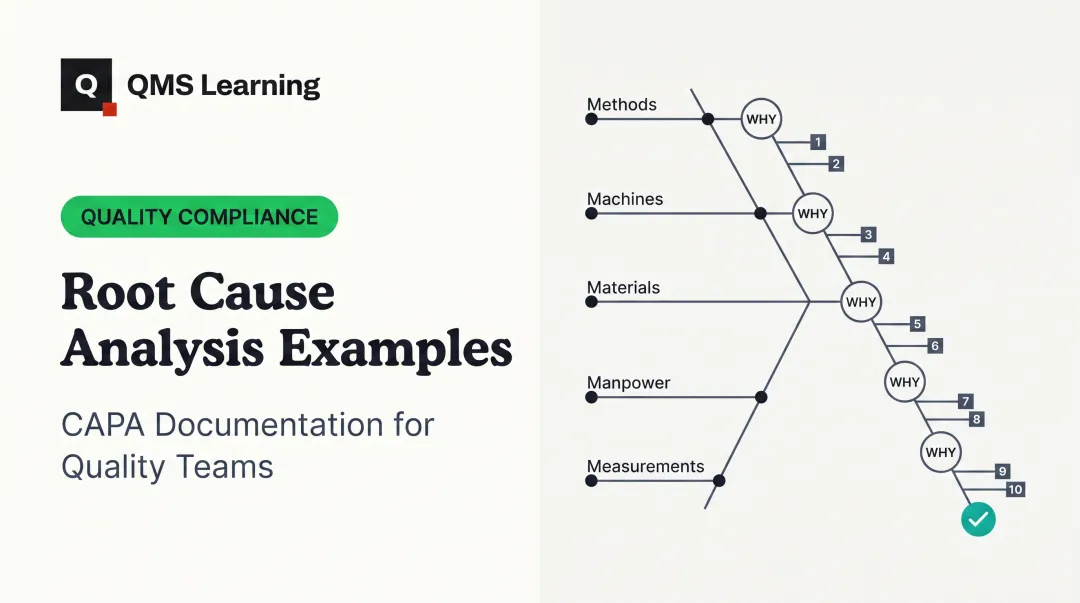
- Fishbone/Ishikawa diagrams for multi-factor failures
- Fault Tree Analysis for complex, layered failure modes
- Is/Is Not comparative analysis to narrow the field of suspects
This is where most 8Ds fall apart. The discipline itself only says "determine and verify root cause." It doesn't tell you how, and picking the right method for a given failure mode is its own skill.
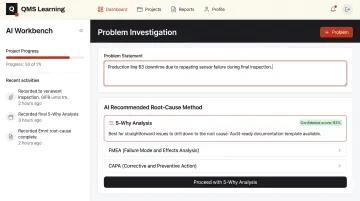
A team investigating dimensional drift with a Fishbone built for a single-cause scenario will produce a plausible answer that doesn't hold up. QMS Learning's AI Workbench addresses that gap by diagnosing the problem type and routing the team to the right method, instead of leaving a junior engineer to guess.
D5: Develop and Verify Permanent Corrective Actions
The team selects a permanent fix and quantitatively confirms, through testing or a pilot run, that it eliminates the verified root cause before it ever touches full production. Skipping this verification is how "permanent" fixes fail six months later.
D6: Implement and Validate Corrective Actions
The permanent fix rolls out fully, replacing the interim containment from D3. Validation continues under real production conditions to confirm the fix performs the way it did in testing. Verification (D5) proves it should work; validation (D6) proves it actually does.
D7: Prevent Recurrence
Update systems so the same root cause can't produce this failure, or a similar one, anywhere else. That means revising FMEAs, control plans, work instructions, and training materials. This is the step that separates a real fix from a one-off patch.
D8: Recognize the Team
Formal closure and recognition of the team's effort reinforces a culture that treats problem-solving as a shared discipline, not a punishment. It's a small step, but skipping it tends to erode participation in the next investigation.
Key Factors That Affect 8D Effectiveness
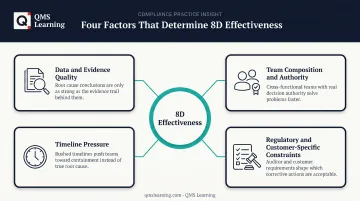
An 8D is only as strong as its execution. Four factors usually decide whether you get a real fix or a signed report:
- Data and evidence quality — Weak problem statements and thin data (complaints, inspections, process records) sink D4; vague inputs yield vague, unverified causes.
- Team composition and authority — Teams lacking cross-functional representation or real decision-making power stall out at containment and never reach a verified permanent fix.
- Timeline pressure — Aggressive customer deadlines, often a 24-hour initial response and an interim report within days, can push teams to skip verification just to hit the date.
- Regulatory and customer-specific constraints — AS9100D, IATF 16949, and OEM supplier manuals set report format, escalation timing, and evidence rules—and those rules still vary by customer, not only by industry.
Common Misconceptions About 8D (and When It's Not Enough)
The biggest misconception: 8D is not a root-cause analysis method. It's an investigation and reporting framework. Discipline 4 instructs teams to "determine and verify root cause" — full stop. It doesn't specify how.
A separate analytical method has to be applied inside that discipline. Choosing the wrong one produces a technically complete 8D built on a guessed cause.
Other patterns show up repeatedly:
- Treating containment as the fix — D3 protects the customer temporarily. It's not a corrective action, and it was never meant to be one.
- Brainstorming instead of verifying — A plausible cause isn't a verified cause. If it wasn't tested against evidence, it's a hypothesis wearing a root-cause label.
- Confusing process with outcome — Report completion and customer sign-off aren't the same as solving the problem. Recurring nonconformities after 8D closure almost always trace to a root cause that was never truly isolated.
- Misreading D8 as proof — Team recognition at D8 doesn't confirm anything got fixed. D6 validation data is what actually demonstrates effectiveness.
That method-selection gap is what QMS Learning's AI Workbench targets. It diagnoses the compliance problem in front of the team, recommends the right method—5-Why, FMEA, CAPA, or Gap Analysis—and helps generate the audit-ready artifact.
Junior engineers stop guessing which tool applies, and the document holds up when an auditor asks for the evidence behind it. In the Commercial Aviation pathway, training covers AS13000 8D investigations alongside 5-Why, FMEA, and CAPA effectiveness verification.
When 8D Isn't the Right Tool
Not every problem needs the full weight of eight disciplines:
- Low-complexity, single-cause problems often resolve faster with a direct 5-Whys exercise or a simple PDCA cycle.
- Internal opportunities for improvement that aren't customer-facing nonconformances rarely need a full 8D; a lighter corrective action or kaizen loop usually fits better.
- Highly complex, multi-variable process problems—chronic variation across a production line, for instance—are often better served by a full DMAIC/Six Sigma project.
Conclusion
8D remains a structured framework for containing and permanently resolving quality problems. Its eight (or nine) disciplines carry a team from initial symptom to prevented recurrence.
In AS9100D, IATF 16949, and other audited environments, a poorly executed 8D doesn't produce resolution. It produces paperwork—and eventually, repeat findings on the next audit.
The fix isn't complicated: pair 8D's structure with a genuine root-cause method at D4, and treat containment as a bridge, not a destination. That combination, more than any template, is what produces corrective action that actually lasts.
Frequently Asked Questions
What does 8D stand for?
8D stands for Eight Disciplines, a structured problem-solving process developed by Ford Motor Company in the 1980s. It guides teams through eight numbered steps, D1 through D8, from team formation to final recognition.
What are the 8D rules?
Work as a cross-functional team, quantify the problem with data, contain it before fixing, and prove root cause with evidence—not assumptions. Validate the corrective action after rollout before you close the case.
What is the difference between 8D and CAPA?
CAPA (Corrective and Preventive Action) is a broader requirement built into most quality management systems. 8D is one structured method organizations use to actually execute and document a CAPA investigation, step by step.
How long does the 8D process typically take?
Initial containment usually happens within 24–48 hours of the report. Root cause analysis and a corrective action plan often follow within days to a few weeks. Full closure with verified corrective action commonly lands between 30 and 60 days.
Which industries require 8D reporting?
Automotive, aerospace and defense, and other regulated manufacturing supply chains most often require or reference 8D. It usually appears in OEM customer-specific requirements and in standards that mandate structured problem-solving, even when 8D is not named directly.
What tools are used for root cause analysis in D4?
Common D4 tools include 5 Whys, Fishbone/Ishikawa diagrams, Fault Tree Analysis, and Is/Is Not comparative analysis. 8D does not mandate a single tool; the choice depends on the failure mode under investigation.