Introduction
A plant manager gets an email at 4 p.m. on a Friday: "Are you ISO 9001 certified?" A new customer wants to know before signing the contract. Panic sets in, because nobody on the floor is quite sure what that actually means, let alone what it takes to get there.
This scenario plays out constantly. ISO 9001 is the most widely used quality management standard on earth, yet most explanations of it are buried in dense, jargon-heavy language that tells you nothing useful.
This guide cuts through that. You'll learn what ISO 9001 actually requires, who needs it, what it costs, and how long certification realistically takes.
Key Takeaways
- ISO 9001 is the international standard for Quality Management Systems (QMS), currently in its 2015 revision
- ISO 9001 is built on seven quality principles and ten clauses; clauses 4–10 are the auditable requirements
- Certification is voluntary under the standard itself, but customers and contracts often make it mandatory in practice
- Costs and timelines vary widely: expect a few months to over a year depending on company size
What Is ISO 9001?
ISO 9001 is the international standard that specifies requirements for a Quality Management System (QMS). Published by the International Organization for Standardization (ISO), it's designed for organizations of any size or industry that want to consistently meet customer and regulatory requirements.
The current edition is ISO 9001:2015, which replaced ISO 9001:2008. In February 2024, ISO published Amendment 1:2024, adding climate action considerations to the standard. A full sixth edition is currently in development, with expected release in September 2026. Until then, certification bodies audit against the 2015 requirements plus the 2024 amendment.
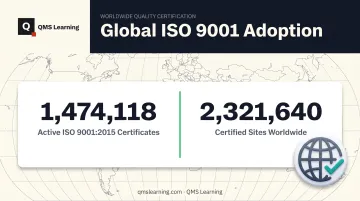
The scale of adoption is hard to overstate. According to the latest ISO Survey data, there are 1,474,118 ISO 9001:2015 certificates in circulation, covering 2,321,640 certified sites worldwide. That's certificates and sites, not a headcount of individual companies, but it still makes ISO 9001 the default quality language of global business.
ISO 9000 vs. ISO 9001: Clearing Up the Confusion
People use these names interchangeably, and it causes real confusion during supplier conversations.
- ISO 9000 is the broader family of standards — it covers fundamentals, concepts, and vocabulary. You cannot get certified against it.
- ISO 9001 is the only standard in the family an organization can actually be certified against. It contains the auditable requirements.
- ISO 9004 is a companion document offering guidance on sustained organizational success. It's explicitly not designed for certification, so if a consultant offers to "certify" you to ISO 9004, that's a red flag.
The 7 Quality Management Principles of ISO 9001
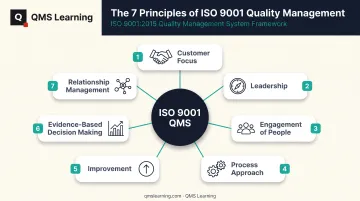
Before you get into clause numbers, it helps to understand the philosophy underneath them. ISO 9000 defines seven Quality Management Principles (QMPs), and every clause in ISO 9001 is built on top of them.
Here's a plain-language summary of each:
- Customer focus — meet customer requirements and strive to exceed expectations
- Leadership — leaders establish unity of purpose and the conditions for people to succeed
- Engagement of people — competent, empowered, engaged employees are essential to delivering value
- Process approach — managing activities as interrelated processes produces more consistent, predictable results
- Improvement — successful organizations maintain an ongoing focus on getting better
- Evidence-based decision making — decisions grounded in analyzed data produce better outcomes
- Relationship management — sustained success depends on managing relationships with suppliers and other interested parties
Process approach is the one that trips people up in the abstract. On a shop floor, it looks like this: instead of treating "incoming inspection" as an isolated task, you map how it connects to purchasing, production scheduling, and nonconforming material handling. When one link breaks, you can trace exactly where and why.
A 2021 study of 50 automotive-component manufacturers found that applying these principles explained 35% of the variation in operational performance across the companies studied (Nurcahyo et al., 2021.
That's an association, not a guarantee. Still, it matches what most quality managers already see: teams that treat the seven principles as a checklist get less from ISO 9001 than teams that actually run by them.
What Are the ISO 9001 Requirements? (The Core Clauses)
ISO 9001:2015 is structured around ten clauses. Clauses 1 through 3 are introductory: scope, references, and definitions. They set context but aren't audited directly. Clauses 4 through 10 are where certification bodies actually assess conformance.
| Clause | Focus Area | PDCA Stage |
|---|---|---|
| 4 | Context of the Organization | Plan |
| 5 | Leadership | Governs all stages |
| 6 | Planning | Plan |
| 7 | Support | Do |
| 8 | Operation | Do |
| 9 | Performance Evaluation | Check |
| 10 | Improvement | Act |
Clauses 4 and 5: Context and Leadership
Clause 4 requires you to define your QMS scope and identify interested parties: customers, regulators, suppliers, anyone with a stake in your quality outcomes. Clause 5 demands visible top management commitment, not just a signed quality policy sitting in a binder.
Clauses 6 and 7: Planning and Support
Clause 6 introduces risk-based thinking and measurable quality objectives. Clause 7 covers the resources behind execution: competence, training, infrastructure, and monitoring and measuring equipment.
Clause 8: Operation
This is the largest clause. It covers product and service planning, design controls, supplier evaluation, and how you handle nonconforming output when things go wrong on the line.
Clauses 9 and 10: Performance and Improvement
Clause 9 requires internal audits and a formal management review. Clause 10 covers corrective action: closing the loop when a nonconformity happens so it doesn't repeat.
Across these clauses, you also need documented evidence the system is running. Mandatory documented information on file typically includes:
- QMS scope and quality policy
- Quality objectives and evidence they're being tracked
- Competence records and internal audit results
- Nonconformity and corrective action records
- Management review outputs
ISO 9001 doesn't require a rigid "quality manual" format. It requires evidence that the system works, in whatever format supports that.
Who Needs ISO 9001 and What Are the Benefits?
ISO 9001 applies to any organization, in any industry. That said, it's most common among manufacturers, suppliers bidding for contracts, and companies whose customers simply won't do business without it.
In regulated supply chains—aerospace, medical devices, automotive—many primes treat certification as a gate before you can bid or stay on the approved-vendor list.
The benefits organizations typically report include:
- Improved customer satisfaction through more consistent output
- Operational efficiency gains from standardized processes
- Stronger supplier management and fewer surprise defects
- Easier alignment with industry-specific regulatory demands
ISO 9001 also functions as the universal baseline for a family of derivative standards built for specific industries:
- AS9100 — aerospace, space, and defense
- ISO 13485 — medical devices
- IATF 16949 — automotive
If your organization already runs ISO 9001, moving into one of these sector-specific standards is a far shorter jump than starting from scratch. QMS Learning builds its aerospace and general manufacturing pathways on that same ISO 9001 foundation.
Getting ISO 9001 Certified: Steps, Timeline, and Costs
Certification follows a consistent path, regardless of industry.
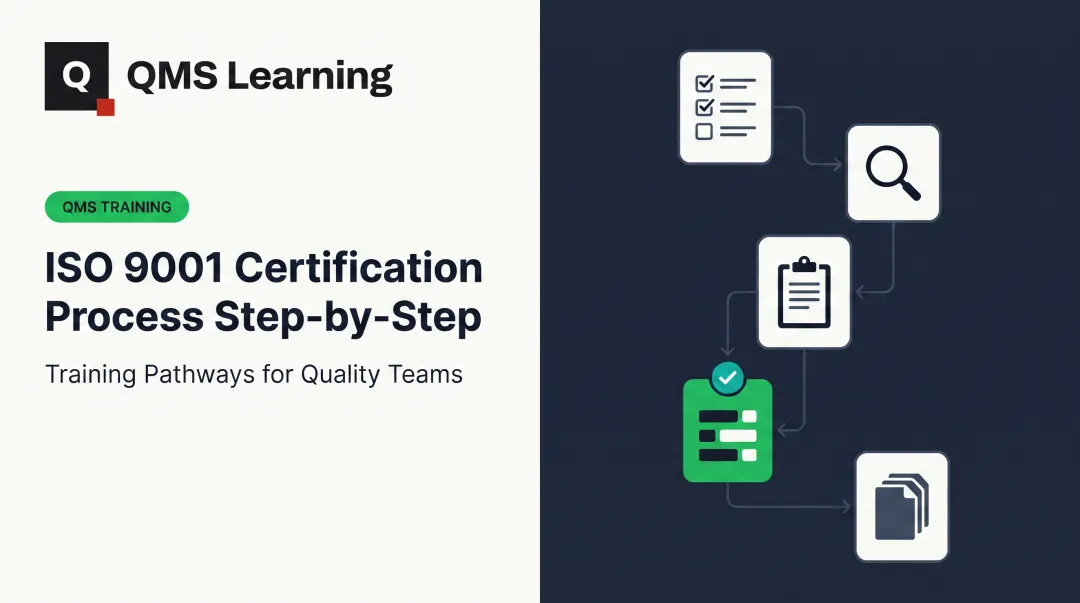
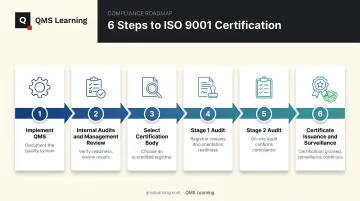
- Implement the QMS — document processes, close gaps against clause requirements
- Run internal audits and management review — generates the readiness evidence auditors expect
- Select an accredited certification body — ISO itself doesn't issue certificates
- Stage 1 audit — a documentation and readiness review
- Stage 2 audit — the main audit, testing whether the implemented system actually works in practice
- Certificate issuance — followed by ongoing surveillance
Timeline and Cost Realities
There's no fixed timeline. It depends on your QMS maturity, number of sites, process complexity, and staff time available. In practice, most companies land somewhere between a few months and over a year.
Budget across these categories:
- Consultant support (optional, scales with gap size and internal expertise)
- Certification body audit fees (based on audit-day effort, not a flat rate)
- Annual surveillance audits (required to maintain the certificate)
- Internal resource time (often the most underestimated cost)
Keep these facts in mind:
- ISO 9001 itself does not mandate certification — that pressure almost always comes from customer contracts
- Certificates are valid for three years
- Surveillance audits happen at least annually, with the first one due within 12 months of your Stage 2 audit
Beyond the Certificate: Building Real Audit-Ready Capability
Passing the certification audit proves paper conformance. It doesn't prove your team can handle a live nonconformity, an unannounced supplier change, or an auditor finding something you didn't expect. That gap, between passing training and performing under pressure, is where most quality teams get exposed.
QMS Learning’s General Manufacturing Quality pathway pairs role-specific online training with an AI Workbench that diagnoses the issue in front of you and routes the right method:
- Recurring supplier defect across jobs → 5-Why plus Supplier CAPA (systemic pattern, not a design-risk FMEA)
- Major finding for accepting parts from an unqualified supplier → 5-Why, then CAPA with verified effectiveness
- Standard-gap assessment → Gap Analysis; potential-failure evaluation → FMEA
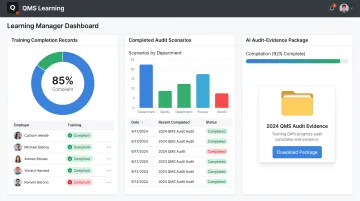
A Manager Dashboard then compiles training records, completed scenarios, and AI-generated documentation into a single audit-evidence package : the proof registrars want to see, built in minutes instead of the night before an audit.
Founder Will Trikha spent 20+ years on quality and audit floors, writing over 1,000 findings as an auditor and closing twice that many as a quality manager. That background inside machining, fabrication, and packaging operations shaped the pathway.
Classroom training often runs $1,200 to $1,500 per seat plus travel. This model is built to get teams audit-ready within 30 days at 70–90% lower cost, without pulling the floor offline.
Frequently Asked Questions
What is ISO 9001 and what is its purpose?
ISO 9001 is the international standard for Quality Management Systems. It helps organizations consistently meet customer and regulatory requirements while improving overall satisfaction and process control.
What are the 7 principles of ISO 9001?
The seven principles are Customer Focus, Leadership, Engagement of People, Process Approach, Improvement, Evidence-Based Decision Making, and Relationship Management. Every ISO 9001 clause is built on these seven concepts.
How much does it cost to get ISO 9001 certified?
Costs vary by company size and complexity, covering consultant support, certification audit fees, and annual surveillance audits. See the cost breakdown section above for the main budget categories.
Is ISO 9001 certification mandatory?
No. The standard itself doesn't require certification. In practice, customers, contracts, or industry regulators often make it a condition of doing business.
How long does it take to get ISO 9001 certified?
Most organizations take anywhere from a few months to over a year. The timeline depends on company size, process complexity, and how mature your existing systems already are.
What is the difference between ISO 9000 and ISO 9001?
ISO 9000 covers the fundamentals and vocabulary of the standard family; you can't be certified against it. ISO 9001 contains the actual certifiable requirements organizations are audited on.