Many organizations know they need an environmental management system but get stuck on the details: What does ISO 14001 actually require? How is it different from a quality standard like ISO 9001? Is it even legally mandatory?
This guide answers all three. We'll cover what ISO 14001 is, break down its core elements, compare it to ISO 9001, clarify its legal status, and walk through how organizations build compliance capability that outlasts the certificate on the wall.
Key Takeaways
- ISO 14001 is the international EMS standard, built on the Plan-Do-Check-Act cycle of continual improvement
- Certification is voluntary, but customer contracts and public tenders increasingly make it a business necessity
- It shares the Annex SL structure with ISO 9001 and ISO 45001, simplifying integrated management systems
- Certificates run on a three-year cycle with annual surveillance audits and full recertification after year three
- ISO 14001:2015 remains the current published edition; the 2026 revision is forthcoming
What Is ISO 14001?
ISO 14001 is the internationally recognized standard that specifies requirements for an environmental management system (EMS). It's published by the International Organization for Standardization as part of the broader ISO 14000 family of environmental standards.
ISO 14001 is not a checklist of environmental performance targets. It does not tell you how much waste to cut or which emissions limits to hit. It is a framework for how you manage environmental responsibility. Your organization sets its own objectives based on your actual footprint.
The standard has evolved through several editions:
| Edition | Published | Status |
|---|---|---|
| ISO 14001:1996 | August 1996 | Withdrawn |
| ISO 14001:2004 | November 2004 | Withdrawn |
| ISO 14001:2015 | September 2015 | Withdrawn |
| ISO 14001:2026 | April 2026 | Current edition |
If your certificate still references the 2015 edition, organizations have a three-year transition window. Certificates issued to the 2015 edition must move to the new version before they expire.
ISO 14001 applies regardless of size or sector. A three-person environmental consultancy and a multinational auto parts manufacturer follow the same framework, scaled to fit their operations.
The PDCA Foundation
The whole standard runs on a repeating loop:
- Plan: Commit to an environmental policy and set objectives
- Do: Implement the processes and controls needed to meet them
- Check: Evaluate performance against those objectives
- Act: Revise and improve based on what you find
That loop never really stops. Each cycle should leave the EMS a little sharper than the last one.
Why Organizations Adopt ISO 14001
Adoption drivers tend to cluster around four pressures:
- Customer and supply chain mandates: Buyers increasingly require it as a condition of doing business
- Regulatory pressure: A structured EMS makes it easier to track and meet legal obligations
- ESG reporting demands: Investors and stakeholders want documented environmental performance
- Competitive differentiation: Certification signals maturity to buyers evaluating multiple vendors
The scale of adoption backs this up. ISO reports more than 670,000 active ISO 14001 certifications worldwide, based on 2024 survey data. It is now routine practice across manufacturing, construction, and services.
The Core Elements of ISO 14001 (The 5 Elements Explained)
ISO 14001 follows the Annex SL high-level structure shared across ISO management standards. Clauses 4 through 10 contain the auditable requirements, commonly grouped into five core elements mapped to PDCA.
Context and Leadership: Understand internal and external factors that affect your organization. Top management sets policy and owns EMS accountability — this isn't delegated to an EHS coordinator and forgotten.
Planning: Map environmental aspects (how your operations interact with the environment) and decide which are significant. Track legal and compliance obligations, then set measurable objectives against them.
Support and Operation: Provide resources, training, and awareness. Apply a life cycle perspective from design through disposal, and put operational controls on significant aspects.
Performance Evaluation: Monitor progress, run internal audits, and hold formal management reviews to confirm the system actually works — not just that it exists on paper.
Improvement: Close nonconformities with corrective action and refine the EMS so environmental performance gets measurably better year over year.
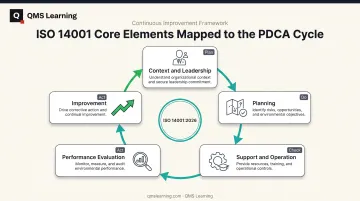
These five elements aren't independent boxes to tick. They feed into each other. A weak aspects register in Planning shows up as gaps in Performance Evaluation months later.
ISO 14001 vs. ISO 9001: What's the Difference?
Both standards share the same Annex SL structure, with identical clause numbering and common terminology. That shared design makes running both systems together far simpler than treating them as separate programs.
| Clause | Shared Annex SL Title |
|---|---|
| 4 | Context of the organization |
| 5 | Leadership |
| 6 | Planning |
| 7 | Support |
| 8 | Operation |
| 9 | Performance evaluation |
| 10 | Improvement |
The core distinction is subject matter, not structure:
- Primary aim: ISO 9001 targets product/service quality and customer satisfaction; ISO 14001 targets environmental performance and impact control
- Unit of analysis: Quality nonconformities and customer requirements vs. environmental aspects, impacts, and compliance obligations
- Success measure: Requirements met and customer satisfaction vs. environmental objectives achieved and obligations fulfilled
Shared structure doesn't make the requirements interchangeable. A quality nonconformity and an environmental aspect are evaluated through completely different lenses, even if the clause numbers match.
Manufacturers already certified to ISO 9001 often find ISO 14001 a natural next step. Documentation systems, internal audit programs, and management review processes can largely be shared across both, cutting duplicate administrative work.
Benefits of ISO 14001 Certification
The benefits break down into four categories.
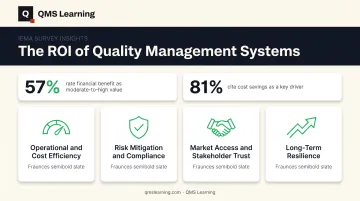
Operational and cost efficiency. Systematic monitoring of energy, water, and raw material use surfaces waste that often goes unnoticed.
A 2024 IEMA report surveying ISO 14001 users across 91 countries found 57% rated financial benefit as moderate-to-very-high value, and 81% cited cost savings as an important reason for adopting the standard.
Risk mitigation and compliance. Maintaining a live legal and regulatory register reduces exposure to fines, shutdowns, and remediation costs. You're tracking obligations proactively instead of discovering them during an inspection.
Market access and stakeholder trust. Major buyers increasingly require certification from suppliers as a condition of the relationship.
Ford's 2025 Supplier Code of Conduct requires an EMS certified to ISO 14001 through an accredited third-party registrar. That is one concrete example of certification as a market-access requirement rather than a marketing badge.
Long-term resilience. The life-cycle perspective built into the standard helps organizations adapt as resource costs rise and regulations tighten around emissions and waste.
Those same compliance and buyer pressures raise a practical question: is certification optional at all?
Is ISO 14001 a Legal Requirement?
No government mandates ISO 14001 certification. It's voluntary under ISO's own framework.
Voluntary does not mean optional in practice. Certification is a framework for identifying and managing your obligations, not a substitute for legal compliance. Contracts tip the scale: customers, supply chains, and public tenders often make certification a practical necessity even without a legal mandate.
How to Get Certified — and Build a Team That Can Sustain It
The certification path follows a consistent sequence:
- Gap analysis against the current standard's requirements
- EMS implementation: build the policy, aspects register, and operational controls
- Internal audit to test the system before an external body sees it
- Two-stage external certification audit: documentation review, then on-site verification
- Ongoing annual surveillance audits, with full recertification every three years
Here's where most organizations run into trouble. They pass the initial certification audit, then struggle at the next surveillance cycle.
Why? The certificate often came from a consultant-built system or a crash training push. The internal team never built the skill to run root cause investigations, manage corrective actions, or keep evidence current day to day. Knowledge walks out the door with whoever built it.
QMS Learning's Environmental & Safety Compliance pathway is designed for that gap. It pairs two courses with an AI Workbench trained on ISO 14001:2026, ISO 45001, and OSHA 29 CFR 1910: EHS Fundamentals (12 modules, 50 lessons) and ISO 14001:2026 Transition (8 modules, 14 lessons on clause changes, gap analysis, and the Clause 6.3 change-management procedure).
What that looks like day-to-day:
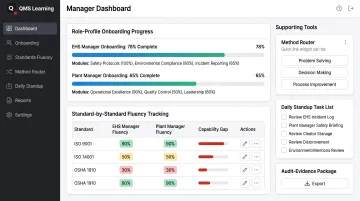
- The Method Router selects the right approach (5-Why, CAPA, FMEA, or Gap Analysis) instead of forcing every issue through one template
- A Daily Standup surfaces the top urgent compliance tasks each morning, already drafted
- The Workbench generates environmental aspects registers, gap analyses, and other audit-ready artifacts
- A single Audit-Evidence Package export compiles training records, completed scenarios, and time-stamped activity for surveillance audits
The Manager Dashboard tracks role-profile onboarding and standard-by-standard fluency, so EHS and plant managers can see capability gaps before an auditor does. The goal is lasting capability: keep EMS knowledge and evidence generation in-house so you are not starting over every time a trained employee or consultant leaves.
Frequently Asked Questions
What is the ISO 14001 standard?
ISO 14001 is the international standard for environmental management systems, published by ISO as part of the ISO 14000 family. It's built on the Plan-Do-Check-Act cycle of continual improvement.
What are the 5 elements of ISO 14001?
The core elements are Context and Leadership, Planning, Support and Operation, Performance Evaluation, and Improvement. Together they map to the standard's Plan-Do-Check-Act structure.
What is the difference between ISO 9001 and ISO 14001?
Both share the same Annex SL clause structure, but ISO 9001 focuses on quality management and customer satisfaction, while ISO 14001 focuses on environmental aspects and impacts. Many organizations run both as one integrated system.
Is ISO 14001 a legal requirement?
No. Certification is voluntary, and no government mandates it. However, customers, supply chains, and public tenders frequently require it contractually, making it a practical necessity for market access.
How long is ISO 14001 certification valid?
Certificates run on a three-year cycle, with annual surveillance audits in between to confirm the EMS is still functioning. Full recertification happens at the end of each three-year cycle.
Which industries use ISO 14001?
Manufacturing, construction, energy, logistics, and services all use it widely, along with public sector organizations. Any organization managing environmental impact, regardless of size or sector, can apply the standard.