Most EHS managers aren't short on rules to follow. They're short on time. A single plant might answer to OSHA, the EPA, ISO 14001, and ISO 45001 at once, sometimes across multiple sites with different local requirements layered on top. Generic checklists and once-a-year classroom training don't build the judgment a team needs when an inspector walks in unannounced.
This guide covers what EHS compliance actually means, the regulations and standards worth tracking, the real cost of getting it wrong, and a practical framework for building a program that holds up under pressure.
Key Takeaways
- EHS compliance rests on three pillars — environmental, health, and safety — each with its own regulators and rules
- Non-compliance costs more than fines—lawsuits, shutdowns, and reputational damage often dwarf the penalty
- A written program isn't enough; auditors now expect proof of verified competence, not just completed training logs
- Stacking ISO 14001 and ISO 45001 on top of OSHA and EPA basics signals a mature program to regulators, customers, and insurers
What Is EHS Compliance?
EHS compliance is the combination of environmental, health, and safety rules, protocols, and management systems a business must follow to operate legally and safely. It goes beyond avoiding violations. It includes:
- Proactive risk management: identifying hazards before they cause harm
- Documented procedures: written processes for permits, training, and inspections
- Demonstrable proof: training logs, inspection records, and audit findings that show procedures are followed, not just filed away
In the US, two agencies dominate the landscape. OSHA governs workplace safety and health. The EPA governs environmental protection, from air emissions to hazardous waste. Organizations with international operations should also watch equivalent bodies, such as the UK's Health and Safety Executive, which enforces work-related health and safety law across Great Britain.
Compliance vs. Management System
EHS compliance is the legal floor: the minimum you must meet to avoid violations. An EHS management system, such as ISO 14001 or ISO 45001, is a structured, continuous-improvement approach that keeps you compliant over time and pushes performance past the minimum.
Day-to-day ownership usually sits with a designated EHS or plant manager. Legal responsibility doesn't stop there, though. It extends from executives down to frontline supervisors, so the program cannot depend on one person alone.
Key EHS Regulations and Standards You Need to Know
Four frameworks show up on almost every facility's compliance register. Here's what each one actually requires.
OSHA Compliance
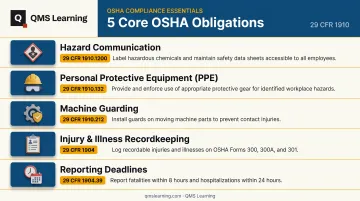
Most facilities need to track five core OSHA obligations:
- Hazard Communication (29 CFR 1910.1200) — chemical hazards must be classified and communicated through labels, safety data sheets, and employee training
- PPE (29 CFR 1910.132) — employers must assess hazards, provide properly fitting PPE, and confirm workers can demonstrate correct use
- Machine guarding (29 CFR 1910.212) — guards must protect against point-of-operation hazards, nip points, and flying debris without creating new hazards
- Injury and illness recordkeeping — Forms 300, 300A, and 301 for most employers with more than 10 employees
- Reporting deadlines — a work-related death must be reported within 8 hours; a hospitalization, amputation, or eye loss within 24 hours
Environmental Protection Agency (EPA) Requirements
Three federal statutes drive most environmental permitting and reporting obligations:
- Clean Air Act (Title V permits) — major sources generally need an operating permit once emissions hit 100 tons per year of a pollutant, or lower thresholds for hazardous air pollutants
- Clean Water Act (NPDES permits) — any point-source discharge to US waters requires a permit with discharge limits and monitoring duties, valid for up to five years
- RCRA (hazardous waste) — generator duties vary by category and include waste identification, accumulation controls, manifests, and emergency preparedness
ISO 14001: Environmental Management
ISO 14001 is the internationally recognized framework for environmental management systems. It gives organizations a structured way to identify environmental impacts, set objectives, and drive continual improvement.
The ISO 14001:2026 revision tightens structure and puts sharper focus on:
- Climate change and biodiversity
- Resource efficiency
- Leadership accountability
- Value-chain impacts
Certification bodies are still finalizing transition deadlines from the prior version, so confirm timing directly with your registrar.
ISO 45001: Occupational Health & Safety Management
ISO 45001 is the global standard for occupational health and safety management systems. Adoption is voluntary—not a legal requirement—and it complements OSHA compliance for US operations rather than replacing it. The standard gives you a management framework built around continual OH&S improvement.
If your operations span multiple countries, layer additional frameworks on top of these four:
- REACH — chemical registration duties in the EU
- GHS — harmonized hazard classification used globally
Both interact with existing OSHA and EPA obligations, so map them early rather than finding the gap in an audit.
Why EHS Non-Compliance Puts the Business at Risk
The fines get the headlines, but they're rarely the biggest cost. Direct consequences include financial penalties, lawsuits, executive criminal liability, and forced shutdowns.
Indirect costs often run higher:
- Reputational damage that follows a facility for years after an incident
- Lost contracts in supply chains that require certified suppliers
- Rising insurance premiums as underwriters price in your risk history
Sometimes the gap isn't in the written policy at all. It's in daily practice. The BP Texas City refinery explosion in March 2005 shows what that looks like.
During restart of a hydrocarbon unit, a distillation tower flooded and overpressurized, killing 15 workers and injuring 180. The Chemical Safety Board's investigation found organizational and safety deficiencies at every level, including outdated startup procedures and deficient maintenance testing. The policies existed on paper. They weren't followed on the ground.
The National Safety Council estimates preventable workplace injuries cost the US $181.4 billion in 2024 alone, roughly $1,120 per worker. That's before a single OSHA fine is issued.
Building an Effective EHS Compliance Program: A Step-by-Step Framework
A policy binder on a shelf won't protect your people or your facility. You need a working system. Here's the framework:
- Map every applicable regulation — build a master compliance register by jurisdiction, industry, and site, covering OSHA, EPA, and any ISO standards you hold or pursue.
- Run a baseline gap assessment — compare current practice against each requirement to find where you're exposed before an auditor does.
- Document procedures with clear ownership — assign a named owner for every permit, training requirement, inspection, and recordkeeping task.
- Train employees and verify competence — attendance records no longer satisfy auditors. Use role-specific, scenario-based training and verify employees can apply what they learned.
- Schedule recurring audits and inspections — use findings to drive corrective and preventive actions (CAPA), not just a checkbox for "completed."
- Monitor regulatory change continuously — update your register, training, and procedures as OSHA, EPA, or ISO standards evolve, including the ISO 14001:2026 revision.
Step 4 is where most programs break down: teams can show attendance sheets but not competence. That gap deserves a closer look.
Common Reasons EHS Compliance Programs Fail — and How to Fix Them
The most common failure mode is a team that finishes required training, then freezes or improvises when a real audit finding, inspection, or incident hits. Training completion and verified capability are not the same thing. That gap tends to show up at the worst possible moment.
Two other patterns sink programs just as often:
- Paper or spreadsheet tracking makes it painfully slow to produce audit-ready evidence when OSHA or a certification body requests it on short notice
- Compliance knowledge lives in one EHS manager's head, so the program stalls when that person is out sick, changes roles, or leaves
QMS Learning's Environmental & Safety Compliance pathway was built to close these gaps. The EHS Fundamentals course runs 50 lessons across 12 modules, paired with a 14-lesson, 8-module ISO 14001:2026 Transition course.
Behind the courses sits an AI Workbench trained on ISO 14001:2026, ISO 45001, OSHA 29 CFR 1910, and 20 years of real EHS audits and inspections. On demand, it can:
- Draft a hazard analysis
- Build an environmental aspects register
- Generate a Clause 6.3 change-management procedure
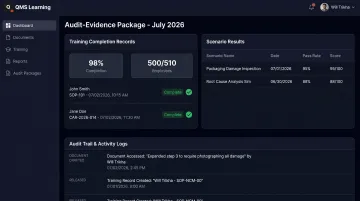
The practical difference shows up at audit time. Instead of digging through spreadsheets for days, a manager can pull a single Audit-Evidence Package from the dashboard in minutes, complete with training records, completed scenarios, and time-stamped activity.
Capability also spreads across plant managers, safety coordinators, and environmental compliance staff. That cuts the single-point-of-failure risk that sinks so many EHS programs when one person is unavailable.
Frequently Asked Questions
What is EHS regulatory compliance?
EHS regulatory compliance means following the environmental, health, and safety laws and standards that govern how your organization operates. That includes OSHA and EPA requirements, plus voluntary standards such as ISO 14001 and ISO 45001.
What are the main EHS regulations businesses need to follow?
OSHA and EPA rules form the legal baseline in the US, while ISO 14001 and ISO 45001 add voluntary management-system structure. Relevance varies by industry, facility size, and location.
Who is responsible for EHS compliance within an organization?
An EHS or plant manager typically owns the program day-to-day. Legal responsibility, though, extends across the organization, from executive leadership down to frontline supervisors.
What are the consequences of EHS non-compliance?
Direct consequences include fines, lawsuits, and forced shutdowns. Indirect costs (reputational damage, lost contracts, and higher insurance premiums) often exceed the direct penalties.
How often should EHS compliance audits be conducted?
Frequency should be set by hazard level, operational changes, and prior findings, with higher-risk operations audited more often. OSHA recommends regular, documented inspections rather than a single fixed interval for all facilities.
What is the difference between ISO 14001 and ISO 45001?
ISO 14001 governs environmental management systems, covering impacts like emissions and waste. ISO 45001 governs occupational health and safety management, focused on reducing workplace risk and injury.