This guide covers what a quality manual actually is, what belongs inside it, how to write one without duplicating your entire QMS, and whether auditors and customers still expect to see one in 2026. It's written for quality directors, plant quality managers, and continuous improvement leads running ISO 9001 across single or multi-site manufacturing operations.
Key Takeaways
- ISO 9001 doesn't mandate a quality manual, but most auditors and customers still expect one
- A manual should describe your scope, quality policy, and process interactions — not restate clause text
- There's no fixed length requirement; manuals vary widely based on organizational complexity
- Treat it as a controlled document with formal approval and version history
What Is an ISO 9001 Quality Manual?
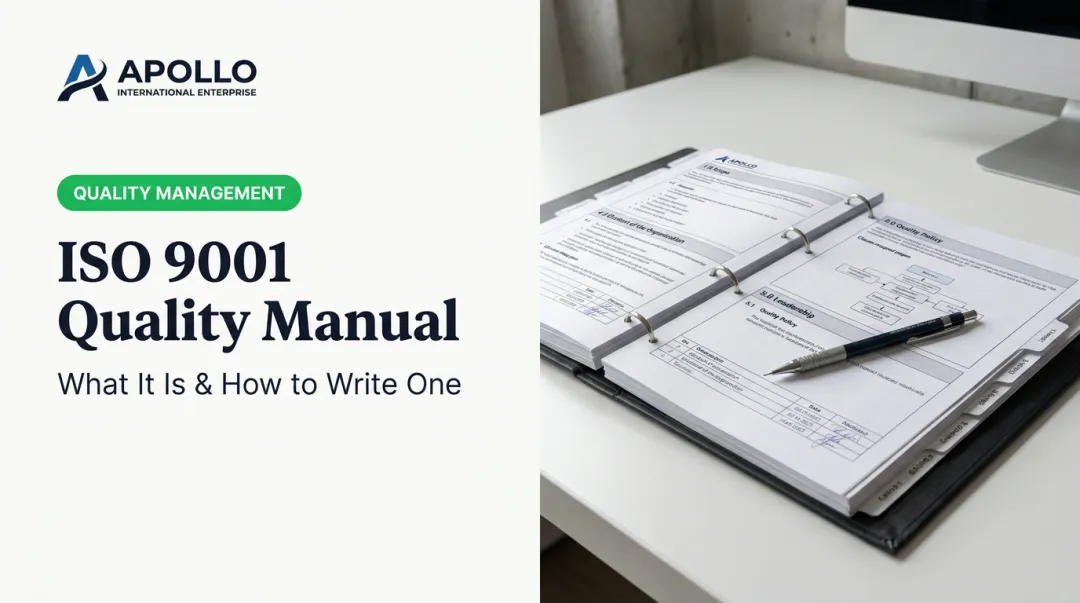
A quality manual is the top-level, controlled document that describes how your quality management system is structured. It covers your organization's scope, quality policy, how processes interact, and who's responsible for what. It's a description of the system, not the system itself.
SGS frames it well: the manual documents and communicates the QMS (its scope, processes, procedures, and resources) so it functions as a consistent reference point across the organization. Think of it as the map, not the terrain.
That distinction matters because three very different audiences read this document:
- Employees who need a practical "how-to" reference for how the organization runs its quality system
- Auditors (internal, customer, or certification body) who use it to get oriented before digging into the details of an audit
- Prospective customers who flip through it to gauge how seriously an organization takes quality before signing a contract
Quality Manual vs. Quality Policy vs. QMS vs. Quality Plan
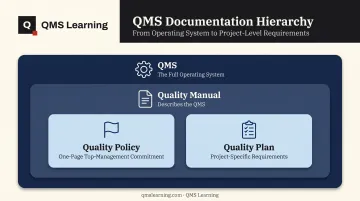
These four terms get mixed up constantly, and mixing them up leads to bloated, confusing documentation. Here's how they differ:
| Document | What it actually is |
|---|---|
| Quality Policy | Short top-management statement of commitment to quality and continual improvement; often one page and the basis for objectives |
| Quality Manual | High-level document describing QMS structure: scope, policy, process interactions, and responsibilities |
| QMS | The full operating system — every policy, procedure, work instruction, form, and record. The manual describes it; it is not the system |
| Quality Plan | Project- or product-specific requirements for one deliverable, service, or contract — not organization-wide |
A quality plan, for example, might spell out inspection requirements for a single customer's part number. Your quality manual stays above that level of detail.
Is a Quality Manual Mandatory Under ISO 9001?
The confusion started with ISO 9001:2008. Clause 4.2.2, "Quality manual," required one explicitly. ISO 9001:2015 removed that clause. Instead of naming a document, the standard now asks organizations to maintain whatever "documented information" is necessary for the QMS to function effectively.
In plain terms: nobody is required to write a document titled "Quality Manual" anymore. But that hasn't changed much in practice.
The assumption that "we don't need one" is still risky:
- Certification bodies still treat it as the most efficient single document for scope, quality policy, process interactions, and roles under Clause 5.3
- Auditors use it to orient themselves before a site visit; without one, they piece together your QMS from scattered procedures
- Customers evaluating suppliers often ask for it first as a signal of how seriously you take quality
Where the 2026 Revision Stands
ISO 9001 is undergoing a major update. As of this writing, the next edition is listed as under publication, with a formal final draft registered in early 2026 and release targeted later that year.
Early guidance does not indicate the revision will reinstate a mandatory quality manual. Standards text can still shift between draft and final publication, so check the published edition before locking your documentation strategy.
What Should Be Included in an ISO 9001 Quality Manual?
There's no ISO-mandated table of contents, but most manuals that pass audits cover roughly ten common elements that map to Clauses 4 through 10 of the standard.
| ISO 9001 Clause | Typical Manual Section |
|---|---|
| Introduction & Scope | Purpose, applicability, exclusions |
| 4 — Context | Organization, interested parties, process interactions |
| 5 — Leadership | Quality policy, roles, responsibilities, authorities |
| 6 — Planning | Risks, opportunities, quality objectives |
| 7 — Support | Resources, competence, communication, documented information |
| 8 — Operation | Operational planning and controls |
| 9 — Performance Evaluation | Monitoring, internal audit, management review |
| 10 — Improvement | Nonconformity, corrective action, continual improvement |
Getting the Scope Statement Right
Your scope statement (Clause 4.3) must define QMS boundaries clearly, including any parts of the standard you treat as non-applicable.
Under ISO 9001:2015, non-applicability is not limited to Clause 8 the way exclusions were under the 2008 standard. A requirement can be non-applicable anywhere in the standard if it does not affect your ability to meet customer or regulatory requirements. You still need objective evidence to support that decision.
What Auditors Actually Look For
Auditors spend real time on leadership. They do not only want a quality policy printed in the manual. Per Clause 5.3, they want evidence it has been communicated and understood at every level. Roles, responsibilities, and authorities must be specific enough that a shop-floor employee can describe their piece of it.
For support and operation sections, resist the urge to copy-paste your procedures into the manual. Reference them instead:
- Reference procedures by ID (for example, "Calibration is controlled per Procedure QP-7.6")
- Keep the manual as a map to controlled documents, not a second repository
- Avoid rewriting the manual every time a procedure changes
Should Headings Mirror ISO's Clause Numbers?
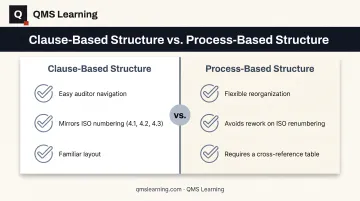
Structuring your manual around ISO 9001 clause numbers (4.1, 4.2, 4.3...) makes navigation easy for auditors and employees. Everyone knows where to look.
The tradeoff is maintenance. If ISO revises clause numbering, you rewrite the table of contents. A process-based structure avoids that rework, but you need a cross-reference table so auditors can still map content to the standard.
Neither approach is wrong. Choose based on how often your team reorganizes documents versus how much auditor familiarity matters.
Length varies by operation. Manufacturers with calibration, production control, and traceability usually need more depth than service organizations. There is no target page count. Match depth to process complexity, not an arbitrary benchmark.
How to Write an ISO 9001 Quality Manual
Writing a quality manual from scratch works best as a fixed sequence of steps. Here's the order that keeps drafts focused and audit-ready:
- List which policies you need — start from your QMS scope and identify every policy area the standard requires you to address
- Draft policies against applicable ISO requirements — write each section to answer what the clause actually asks for, not what sounds good
- List or reference supporting procedures — link out to your operating procedures rather than embedding them
- Determine format and structure — clause-based or process-based, decided upfront
- Circulate for cross-department review — production, quality, and management all need to weigh in before anything's final
- Obtain formal approval and release — treat this like any other controlled document
On writing style: favor active voice and clear, direct commitments ("the quality manager will conduct...") over vague, passive phrasing. Visual aids like process maps or turtle diagrams help readers grasp process interactions faster than paragraphs of text ever will.
Keep the Manual Under Document Control
Because the manual itself qualifies as documented information under Clause 7.5, it needs version numbers, an approval record, and a documented revision history. Maintain those controls for the life of the QMS, not only at initial certification.
Writing From Scratch vs. Starting From a Template
Writing from a blank page means researching every clause, drafting language, and building your own review workflow before you've written a single policy. Starting from a structured pathway or pre-built framework skips that research phase and lets you focus on customizing content to your operation instead of inventing structure.
For teams that want that head start, QMS Learning's General Manufacturing Quality pathway supports building or updating an ISO 9001 manual. The pathway's AI Workbench is trained on ISO 9001:2015, ISO 19011, and two decades of internal-audit experience across machining, fabrication, packaging, and consumer goods.
It flags which policies and procedures apply to your operation so you customize from a relevant framework instead of guessing from a generic checklist.
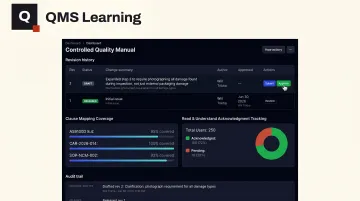
Once drafted, the Document Management System keeps the manual audit-ready over time:
- Maintains one clear live revision while retaining superseded versions, so no one accidentally works from an outdated copy
- Enforces segregation of duties — the person who drafts a revision can't approve it themselves
- Logs read-and-understand acknowledgments per person, per revision, with timestamps
- Maps documents to the standards clauses they satisfy, exposing coverage gaps before an auditor finds them
- Compiles controlled documents, revision history, and acknowledgments into one indexed evidence package for audit day
Benefits of a Quality Manual
Beyond satisfying auditors, a well-built manual pays off in ways that show up in daily operations.
Internally, it:
- Sets clear expectations for management and staff on how the QMS actually works
- Gives new hires a fast onboarding reference instead of a scavenger hunt through scattered procedures
- Provides a bird's-eye view of how processes connect, hard to see from inside one department
Externally, it:
- Builds confidence with prospective customers evaluating you as a supplier
- Often comes up during bid evaluations for contracts requiring ISO 9001 certification
- Gives auditors an efficient starting point, saving everyone time during the site visit
There's also a resilience angle that's easy to overlook. A well-maintained manual keeps institutional knowledge documented and accessible: your QMS doesn't live entirely in one quality manager's head, or worse, with an outside consultant who walks away when the contract ends. Pairing it with controlled document management locks that knowledge in-house permanently.
Frequently Asked Questions
Does ISO 9001 require a quality manual?
No. ISO 9001:2015 removed the explicit quality manual requirement that existed in the 2008 version. Most certification bodies still expect to see one in practice, and the same is true under the draft ISO 9001:2026 revision.
What is a quality assurance manual?
The term is often used interchangeably with "quality manual," though it sometimes emphasizes proactive, prevention-focused QA activities and controls specifically. There's no separate ISO 9001 document category by that name.
What is a quality manual in pharma?
Under ICH Q10 and EU GMP Chapter 1, pharmaceutical companies should establish a quality manual or equivalent covering QMS policy, scope, processes, and management responsibilities. Neither framework requires that exact title.
Can you provide an example of a company quality manual?
A typical section, like Management Review, pairs the ISO requirement statement with company-specific policy and where records are stored. QMS Learning's General Manufacturing Quality pathway includes worked ISO 9001 examples as part of its training materials.
How long should a quality manual be?
There's no fixed length requirement. Certified organizations use manuals from about 10 pages to well over 150, so match length to your operation's size and process complexity—not an arbitrary page target.
Who is responsible for maintaining the quality manual?
Top management is ultimately accountable for the QMS overall. Day-to-day ownership of the manual typically sits with the quality manager or QMS coordinator responsible for keeping it accurate under Clause 5.3.