This article defines what a quality manual is (and what it isn't), clarifies what belongs inside one, and walks through a structured writing sequence that holds up under external audit scrutiny.
Key Takeaways
- A quality manual describes how the QMS is structured — it is not the QMS itself
- ISO 9001:2015 made the manual optional, but auditors still expect one at certification
- Content maps to Clauses 4–10; auditors will trace each section back to the clause it satisfies
- Sequence matters: scope first, then context, then leadership, then process mapping
- The most common failures (vague scope, embedded procedures, missing process interactions) are preventable
What Is an ISO 9001 Quality Manual?
A quality manual is a high-level controlled document that describes the framework of your QMS — its scope, process interactions, roles, and governing principles. It describes the system; it is not the system itself.
The Documentation Hierarchy
Three documents get conflated often, and mixing them up is a reliable path to audit confusion:
| Document | Purpose | Typical Length |
|---|---|---|
| Quality Policy | Top management's statement of intent | ~1 page |
| Quality Manual | Describes how the QMS is structured | 20–50+ pages |
| QMS | The complete operational system — all policies, procedures, work instructions, forms, and records | Varies widely |
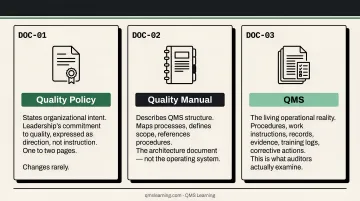
The quality policy states intent. The quality manual describes structure. The QMS is the living operational reality beneath both.
Is a Quality Manual Mandatory?
ISO 9001:2008 explicitly required one under Clause 4.2.2. ISO/TC 176 guidance confirms that ISO 9001:2015 removed that explicit requirement — organizations now have flexibility in how they document their QMS, with required documented information governed by Clauses 4.4.2 and 7.5.
However, major certification bodies including TÜV SÜD and SGS describe Stage 1 audits as reviews of the documented system, scope, process interactions, and audit readiness. A quality manual remains the most efficient way to present all of that in one place. Skipping it doesn't eliminate the requirement to demonstrate those things — it just makes the demonstration harder.
On ISO 9001:2026: That calculus may shift with the next revision. As of mid-2026, ISO lists Edition 6 as under publication with a target date of 2026-09. Public ISO and ISO/TC 176 pages do not confirm whether a quality manual requirement will return. Verify the current status before your next audit cycle and plan accordingly.
What Should Be Included in an ISO 9001 Quality Manual?
The content of the quality manual maps directly to ISO 9001:2015 Clauses 4–10. Auditors will trace each section back to the clause it satisfies — which means the structure of the standard should drive the structure of the document.
Scope, Context, and Interested Parties (Clauses 4.1–4.4)
Clause 4.3 requires a documented scope statement that:
- Identifies which products, services, sites, and functions are inside the QMS boundary
- States any ISO 9001 requirements deemed not applicable, with justification
- Is precise — ISO/IAF guidance explicitly warns against scope wording that is broad, vague, or misleading
Clauses 4.1 and 4.2 require the manual to address the internal and external issues that could affect the QMS, and the relevant needs of interested parties — customers, regulators, suppliers, employees. This output feeds into risk and opportunity planning under Clause 6. Clause 4.4 builds on this by requiring the sequence and interactions of QMS processes to be determined — typically through a process interaction map or equivalent visual.
Leadership, Quality Policy, and Roles (Clause 5)
This section establishes three things:
- Top management's commitment to the QMS
- The quality policy — appropriate to organizational context, providing a framework for quality objectives, and committing to continual improvement
- Roles, responsibilities, and authorities — the manual must show who owns what, not just that ownership exists
Auditors will probe this section for evidence that leadership is genuinely engaged, not ceremonially compliant.
Planning, Support, and Operation (Clauses 6–8)
- Clause 6 covers risk-based thinking and quality objectives — how the organization identifies and addresses risks and opportunities
- Clause 7 covers resources, competence, awareness, communication, and documented information controls
- Clause 8 covers operational planning through to product/service release and control of nonconforming outputs
The manual references — not reproduces — the Level 2 procedures for each of these areas. Step-by-step instructions don't belong in the quality manual — that content goes in a Level 2 procedure document.
Performance Evaluation and Improvement (Clauses 9–10)
The manual must describe how the organization:
- Monitors and measures QMS performance (Clause 9)
- Conducts internal audits and management reviews
- Tracks customer satisfaction
- Drives continual improvement through nonconformity handling and corrective action (Clause 10)
A note on appendices: Process interaction maps, an organizational chart, and a clause-to-section cross-reference matrix are not optional extras. An auditor arriving without a cross-reference matrix will build one on the spot — and that's time spent scrutinizing your document, not navigating it.
How to Write an ISO 9001 Quality Manual: Step-by-Step
Most quality manuals fail not because they're poorly written, but because they were drafted in the wrong order — policy before scope, or process descriptions before roles are defined. Getting the sequence right is what keeps every subsequent section from requiring rework.
Step 1: Define the Scope First
Start with Clause 4.3. Identify which products, services, sites, and functions fall inside the QMS boundary. Document any justified exclusions.
The scope statement becomes the anchor for everything written afterward. Vague scope creates downstream misalignment in every section that follows.
Weak scope: "All activities of the organization." Tight scope: "Design and manufacture of precision-machined aluminum components for aerospace applications at our facility in Tucson, AZ. Clause 8.3 (design and development) is excluded — customer-provided drawings govern all design requirements."
Step 2: Document Context and Interested Parties
Conduct a structured analysis of the internal and external issues that could affect the QMS. TÜV SÜD identifies several acceptable approaches — STEP analysis, stakeholder mapping, benchmarking, and SWOT among them. ISO 9001 doesn't mandate a specific tool; it requires the output.
List your interested parties (customers, regulators, suppliers, employees) and their relevant needs. This output feeds directly into Clause 6 risk and opportunity planning.
Step 3: Draft the Leadership and Quality Policy Section
Work with top management to write the quality policy. It must:
- State the organization's intent on quality
- Provide a framework for setting quality objectives
- Commit to continual improvement
Then define and document organizational roles, responsibilities, and authorities. Confirm this section receives formal top management approval before proceeding — an unapproved quality policy is a nonconformity waiting to happen.
Step 4: Map Processes and Their Interactions
Identify all QMS processes across three categories:
- Management processes — planning, review, audit
- Core processes — the value-adding activities that produce products or services
- Support processes — HR, training, infrastructure, document control
Assign a process owner to each. Then create a process interaction map — a flow chart, turtle diagram, or similar visual — that shows the sequence and interdependencies. TÜV SÜD notes that turtle diagrams and flow charts are acceptable discretionary formats for presenting processes.
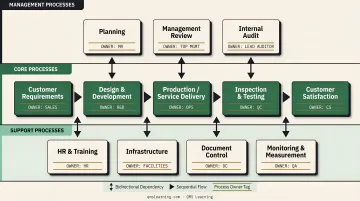
Lead auditors typically open here during Stage 1 — they use this map to verify that process owners are assigned and that linkages between processes are explicit, not assumed.
Step 5: Reference Procedures and Set Up Document Control
Write each clause section of the manual to describe what is done — and reference the Level 2 procedures rather than reproducing them. Then establish your document control framework:
- Version numbering convention
- Approval workflow (with segregation of duties — the author cannot approve their own document)
- Revision history requirements
- Distribution and access controls
Teams using QMS Learning's Document Management System can maintain the quality manual with an append-only audit trail, clause-mapped linkages, and controlled revision history built in from day one. That means audit-acceptable evidence is already compiled when surveillance visits arrive — not reconstructed the week before.
Step 6: Review, Approve, and Control the Manual
Circulate the draft to department heads for accuracy review. Address any gaps with department heads directly. Obtain formal top management approval. Release as a controlled document.
The document header and revision log should record: version number, effective date, and approver's name.
Schedule an annual review cadence at least, plus a triggered review for any significant QMS change, scope revision, or update to ISO 9001 itself.
Common Mistakes When Writing a Quality Manual
Experienced auditors recognize structural failures immediately — not because they're looking for them, but because the same patterns appear consistently across organizations.
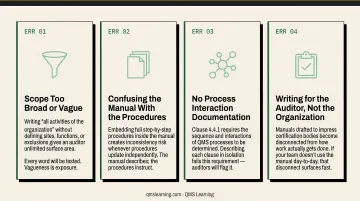
The four mistakes that surface most often:
Scope too broad or vague. Writing "all activities of the organization" without defining specific sites, functions, or exclusions gives an auditor unlimited surface area to probe. Every word in the scope statement will be tested. Vagueness is exposure.
Confusing the manual with the procedures. Embedding full step-by-step operating procedures inside the quality manual creates an unmanageable document and increases the risk of internal inconsistency whenever procedures are updated independently. The manual describes; the procedures instruct.
No process interaction documentation. Clause 4.4.1 requires the sequence and interactions of QMS processes to be determined. A manual that describes each clause in isolation — without showing how processes connect — fails this requirement, and auditors will flag it.
Writing for the auditor, not the organization. Quality manuals drafted to impress certification bodies rather than guide internal operations become disconnected from how work actually gets done. Auditors probe for this gap during clause-by-clause walkthroughs. If your team doesn't use the manual day-to-day, that disconnect surfaces fast.
Frequently Asked Questions
What is a quality manual in a QMS?
A quality manual is a high-level controlled document that describes the structure, scope, processes, and responsibilities of the QMS. It sits above procedures, work instructions, and records in the documentation hierarchy — the top-level reference document that shows how the entire system is organized.
What are the 4 main components of QMS?
While frameworks vary, the four commonly cited components are quality policy and objectives, documented processes and procedures, resources and competence, and performance monitoring and improvement. Together they form the Plan-Do-Check-Act cycle that underpins ISO 9001.
What are the 7 principles of QMS?
The seven ISO 9000 quality management principles are: customer focus, leadership, engagement of people, process approach, improvement, evidence-based decision making, and relationship management.
Is a quality manual required for ISO 9001 certification?
ISO 9001:2015 does not mandate a quality manual, but most certification bodies still expect one during external audits — it's the most efficient way to present scope, policy, process interactions, and roles in a single document. Skipping it doesn't remove the underlying requirements; it just makes them harder to demonstrate.
How long should an ISO 9001 quality manual be?
There is no required length. Quality manuals range from 10 to 150+ pages depending on organizational size and complexity — length should reflect the actual scope of the QMS, not a desire to appear thorough. A concise, well-structured manual typically serves auditors better than an exhaustive one.
How often should a quality manual be reviewed and updated?
Review it whenever there's a significant change to the QMS, organizational structure, scope, or a revision to ISO 9001 itself. Clause 7.5 requires review and approval when documented information is created or updated — a change-triggered review is the baseline. Annual review is a reasonable organizational choice, but the standard doesn't mandate a fixed interval.