The problem is that most organizations pursue certification to satisfy a customer request or unlock a specific contract, then treat it as complete. The certificate goes on the wall. The management system quietly drifts. And the operational value that ISO was built to deliver never materializes.
This article covers what ISO certification actually means in practice, what measurable business benefits it produces, and why sustaining it matters more than earning it.
Key Takeaways
- ISO certification is third-party verification against an international standard — ISO itself does not issue certificates
- Benefits are operational and measurable: contract access, cost reduction, and risk reduction — not just reputational
- Certificates are valid for three years, but annual surveillance audits require real, ongoing compliance capability
- Organizations that treat ISO as a living operating system — not a one-time project — compound its advantages
- Most audit risk lives in the gap between holding a certificate and actually running a compliant operation
What Is ISO Certification?
ISO certification is an independent, third-party confirmation that a business's management system meets the requirements of a specific International Standard published by the International Organization for Standardization. One critical clarification most organizations miss: ISO itself does not issue certifications. Accredited certification bodies conduct the audits and issue the certificates.
Which Standards Apply to Which Industries
Each standard governs a specific management system, not the company as a whole:
| Standard | Scope | Primary Industries |
|---|---|---|
| ISO 9001 | Quality management systems | Manufacturing, general industry |
| ISO 14001 | Environmental management | Operations with environmental impact |
| ISO 45001 | Occupational health & safety | Industrial, manufacturing |
| ISO 13485 | Medical device QMS | Medical devices, life sciences |
| AS9100D | ISO 9001 + aerospace requirements | Aerospace, defense |
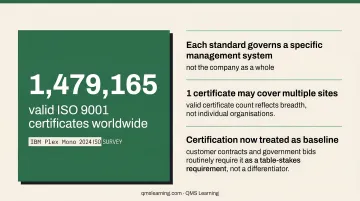
The 2024 ISO Survey reports 1,479,165 valid ISO 9001 certificates worldwide — a scale that reflects how deeply this standard is embedded in global supply chain requirements. That number represents valid certificates, each potentially covering multiple sites. That breadth also explains why so many customer contracts and government bids now treat certification as a baseline requirement rather than a differentiator.
What Certification Actually Signals
The certificate itself signals that documented processes, audit evidence, and improvement cycles exist. The operational discipline those systems build — consistent processes, traceable decisions, closed-loop corrective actions — is what opens supply chain tiers, satisfies customer requirements, and keeps bids competitive. The certificate is the proof. The capability behind it is the point.
Key Business Benefits of ISO Certification
The benefits below focus on outcomes organizations actually track: contract access, cost, risk exposure, and operational consistency. The magnitude of each depends heavily on how rigorously the management system is implemented and maintained. Organizations that run ISO as a living system see compounding returns across every surveillance cycle — those that treat it as a one-time event rarely do.
Benefit 1: Market Access and Contract Eligibility
In many procurement environments, ISO certification isn't a competitive advantage — it's the entry ticket.
Boeing's D6-82479 Rev K requires Appendix A suppliers to hold 9100 certification from an accredited body and maintain representation in IAQG OASIS. RTX's ASQR-01 requires AS9100 certification for defined manufacturing supplier types. Northrop Grumman's FQA-0500 requires the certificate as contract documentation where the clause is flowed through the purchase order. FAR 46.202-4 names ISO 9001 and AS9100 as higher-level quality requirements for federal contracts.
These aren't soft preferences. They're hard requirements with documented consequences — Boeing's policy allows probation, disapproval, and short-notice audits when certification status changes.
In practice, certification creates three concrete commercial advantages:
- Eligible for approved vendor lists without starting from scratch at every customer
- Can bid on government or enterprise contracts that require certification as a mandatory criterion
- Passes supplier qualification audits faster, reducing new customer acquisition costs in regulated markets
For smaller manufacturers or defense subcontractors, ISO certification can be the single factor that determines whether the business can compete in its target market at all — not whether it wins, but whether it's allowed to bid.
KPIs impacted: New market eligibility, approved vendor list inclusions, bid qualification rate, customer acquisition cost in regulated channels
Benefit 2: Operational Efficiency and Cost Reduction
ISO 9001 requires organizations to document processes, measure performance, identify inefficiencies, and systematically correct defects. The gap analysis and internal audit cycle that precede certification force a structured review of how work actually gets done versus how it's supposed to get done.
That gap is almost always where the money is leaking.
The operational mechanism is ISO's Plan-Do-Check-Act (PDCA) cycle, which ISO directly confirms can apply to individual processes and the QMS as a whole. This means efficiency improvements aren't a one-time certification event — they compound across surveillance cycles as the system identifies and corrects new gaps.
What organizations typically surface during the gap analysis and audit cycle:
- Redundant process steps with no documented owner
- Recurring defects that were being reworked but never formally tracked
- Unclear handoffs between departments producing inconsistent outputs
- Scrap and failure costs that were categorized as normal operational waste
The McKinsey estimate for medical device quality costs puts direct quality costs at 6.8%–9.4% of sales in that sector, with roughly two-thirds attributable to cost of poor quality (COPQ). While that's a 2017 medical-device-specific figure, it illustrates why structured quality systems have real P&L implications — not just compliance ones.
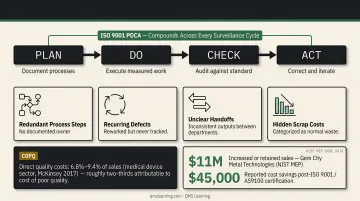
NIST MEP case data shows concrete commercial outcomes: Gem City Metal Technologies reported $11M in increased or retained sales and $45,000 in cost savings following ISO 9001 and AS9100 certification assistance. These are company-reported outcomes, not controlled studies, but they reflect real business decisions driven by certification.
KPIs impacted: Defect rate, scrap and rework costs, first-pass yield, cost of poor quality, on-time delivery
Benefit 3: Risk Reduction and Audit Defensibility
ISO certification requires organizations to identify risks, document controls, and maintain evidence of corrective action. This isn't bureaucratic overhead — it's the infrastructure that prevents small problems from becoming major nonconformities.
When a registrar or customer auditor arrives, organizations that pass cleanly have one thing in common: structured response capability. Documented nonconformity records, CAPA logs, and internal audit trails let the quality team present evidence rather than improvise answers.
DNV's dataset covering more than 25,000 companies and 250,000 audit results shows that more than half of organizations audited received ISO 9001 findings related to Clause 6 (Planning). Clause 6.1 — actions addressing risks and opportunities — represented 35.4% of planning findings and was the second most common nonconformity type overall. This is a recurring gap, not a rare edge case.
The practical risk reduction that a functioning management system produces:
- Nonconformities are caught internally before the registrar finds them
- CAPA logs provide evidence that problems were addressed systematically
- Internal audit trails demonstrate continuous improvement activity, not just compliance claims
- When a finding does occur, the team can present objective evidence immediately — no scrambling
That audit defensibility has a direct counterpart: the consequences of losing it. Under SGS's certification code, suspension or withdrawal applies to unresolved corrective actions, missed required audits, and misuse of certification marks — at that point, the certificate cannot be represented as valid. Boeing's policy is equally direct: certification status changes require immediate written notice and can trigger probation or disapproval.
KPIs impacted: Major vs. minor nonconformity count per audit, CAPA closure rate and cycle time, repeat nonconformity rate, internal audit finding closure time
What Happens When ISO Certification Is Missing or Mismanaged
Operating without certification in regulated markets has direct commercial consequences — not just reputational ones. In many supply chains, failing to achieve or maintain certification results in removal from approved vendor lists and disqualification from bids before price or capability is evaluated. The same applies to organizations that hold a certificate but have let the management system atrophy between audits.
The operational consequences of mismanaged ISO compliance:
- Inconsistent process outputs and rising defect rates as undocumented workarounds accumulate across the team
- Reactive audit response — teams that completed compliance training but never built diagnostic capability freeze when a registrar requests objective evidence for specific clause requirements
- Nonconformities that accumulate across audit cycles, compounding the risk of certificate suspension
- Rising internal costs from rework, scrap, and emergency corrective actions that a functioning system would have caught earlier
The gap between holding an ISO certificate and running an ISO-compliant operation is where most of the risk lives. Organizations that treat certification as a one-time project are perpetually one surveillance audit away from a major finding — or worse, a contract review.
How to Get the Most Value from Your ISO Certification
ISO certification delivers maximum value when the management system functions as an operating tool, not a compliance artifact. The organizations that see compounding returns use their CAPA logs, internal audit findings, and management review outputs to make real process decisions — not just to satisfy a registrar's checklist.
The management system works best when:
- Procedures reflect how work actually happens — outdated documentation is the most common source of minor nonconformities in surveillance audits. If the SOP describes a process no one follows, the gap will surface.
- Internal audits run on a genuine cycle, not compressed into the weeks before a surveillance visit. Findings should feed directly into improvement activities.
- CAPA closure means verified root cause elimination. Closing a corrective action administratively without confirming the root cause is gone means the same nonconformity will reappear next cycle.
- Audit-ready capability is distributed across the team, not concentrated in one quality manager who becomes a single point of failure during an unannounced visit.
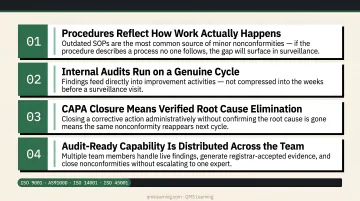
Building this distributed capability — where multiple team members can handle live findings, generate registrar-accepted evidence, and close nonconformities without escalating to one expert — is what separates organizations that pass surveillance audits consistently from those that scramble.
QMS Learning's industry-specific pathways (ISO 9001, AS9100D, ISO 14001, ISO 45001) are built to install exactly this kind of team-wide capability. The platform combines practitioner-built courses with an AI Workbench that diagnoses compliance problems and generates auditor-ready documentation, plus a Manager Dashboard that exports the Audit-Evidence Package registrars accept as objective evidence of training effectiveness. The measure isn't course completion. It's execution when real findings arrive.
Conclusion
The management system discipline ISO certification demands — consistent processes, documented decisions, and an evidence infrastructure auditors can verify — is where the real value lives. Those elements reduce cost, reduce audit risk, and open markets that are otherwise closed to uncertified suppliers.
The advantages compound when the system is maintained as a living standard — reviewed on a real cycle, supported by a team with verifiable compliance capability, and connected to actual process decisions. When the management system drifts — missed management reviews, unresolved CAPAs, records that can't be produced on demand — registration withdrawal and surveillance findings follow. The certificate is only as defensible as the system behind it.
That's why team capability matters as much as the standard itself. QMS Learning's role-specific training pathways and AI Workbench are built to keep that system functional between audits, not just during them — so your team walks into every surveillance cycle with answers and evidence already in hand.
Frequently Asked Questions
What does ISO certification mean?
ISO certification is third-party verification that a business's management system meets the requirements of a specific ISO standard. The ISO organization itself doesn't issue certifications — accredited certification bodies conduct the audit and issue the certificate based on conformity findings.
What is ISO certification for?
It serves two purposes. First, it demonstrates to customers, supply chain partners, and regulators that an organization's processes meet internationally accepted standards. Second, it provides an internal discipline framework that drives consistency, risk management, and continuous improvement across operations.
How much does ISO certification cost?
Certification costs vary by organization size, number of sites, standard, and certification body. One estimate from the Michigan Manufacturing Technology Center puts a single-day year-two surveillance audit at roughly $2,400 in direct registrar fees. Implementation costs for building the management system and training the team are separate and typically exceed audit fees for the initial cycle.
How do you get ISO certified?
Start with a gap analysis against the target standard, then build and implement the management system. Complete an internal audit cycle before engaging an accredited certification body for a Stage 1 documentation review and Stage 2 on-site conformity audit. Most scopes take several months from implementation start to certificate issuance.
How long does ISO certification last?
ISO certificates are valid for three years. Annual surveillance audits are required in years one and two to confirm ongoing compliance. At the end of the three-year cycle, a full recertification audit is conducted before the certificate is renewed.
What is the difference between ISO compliance and ISO certification?
ISO compliance means an organization is following the requirements of a standard internally. ISO certification means an accredited third party has independently verified that compliance through a formal audit. A certified organization is by definition compliant, but a compliant organization is not necessarily certified.